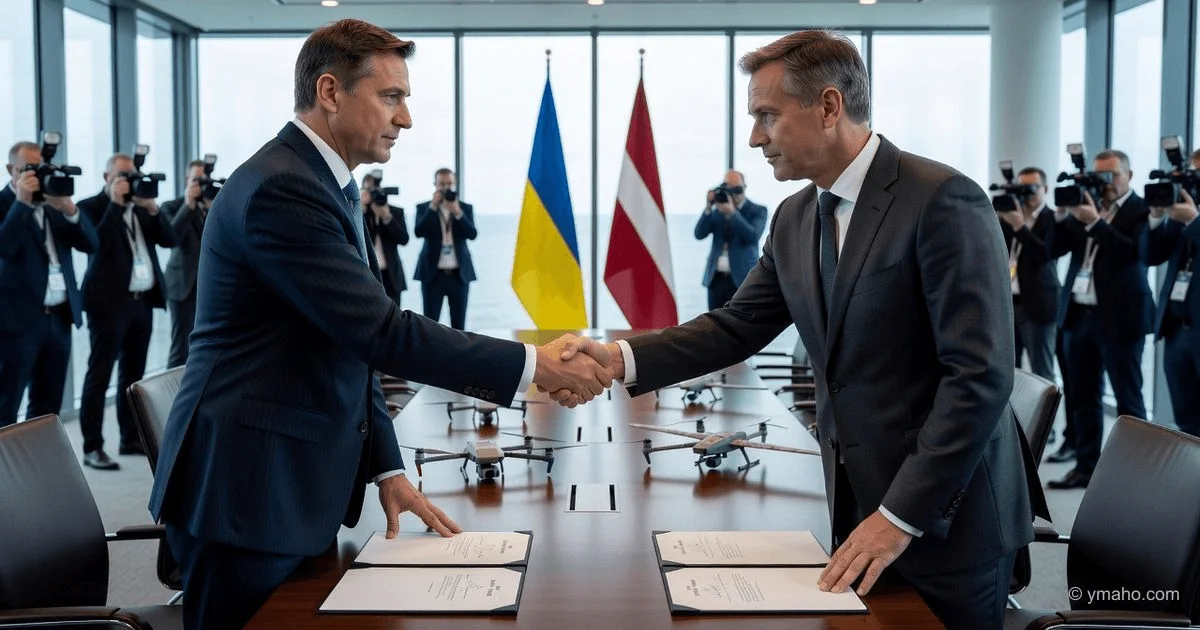
Ukraine and Latvia Sign Agreement on Joint Drone Production
During the summit in Tallinn, President Zelenskyy and Latvian Prime Minister Kulbergis concluded a deal on technology transfer and joint production of drones. Ukrainian anti-drone specialists will immediately arrive in Latvia for training.
Drone Diplomacy as a New Export Commodity: Why the Drone Deal with Latvia Turns Ukraine into Europe's Defense Franchisor
Author: Independent financial analyst, specialist in defense markets and technology transfer
While global media attention is focused on Iran and rising oil prices, an event quietly but fundamentally reshaping the global defense landscape took place in Tallinn on June 9. Ukraine and Latvia signed a Drone Deal — an agreement on joint production of unmanned aerial vehicles and transfer of counter-drone technologies.
Bloomberg and Reuters reported it as just another item on a long list of military aid. But they miss the point. This is not "aid" or "cooperation" in the classic sense. It is war franchising — the first deal in history where a country engaged in an active armed conflict sells not weapons, but the experience of using them as a ready-made commercial product.
My insider insight, which you won't find in official communiqués: Ukraine is no longer asking. It is offering a license for its most valuable intellectual property — FPV attack tactics, electronic warfare countermeasures, and anti-aircraft swarm algorithms. Today I will explain why this model transforms Kyiv from a "Western dependent" into a key NATO technology partner and how you can profit from it in the coming quarters.
[The Core]: What Is Really Happening
Behind the fancy phrase "joint production" lies a new export strategy. What is its essence? Ukraine approaches a partner (Latvia is the sixth country after Qatar, Saudi Arabia, the UAE, and Lithuania) and says: "We have combat algorithms that have destroyed thousands of Russian tanks. You have factories and money. Let's produce our drones at your facilities."
Latvia gets not just "aid" — it gets a battle-proven technological solution with guaranteed effectiveness. And Ukraine gets scarce components, access to the European market, and, most importantly, political insurance: destroying a defense plant in Kharkiv is one thing, but striking a facility in Riga is quite another. That triggers NATO Article 5 automatically.
A key detail that is ignored: the deal provides for the immediate arrival of Ukrainian anti-drone specialists in Latvia. This is not about guest appearances, but a full-scale relocation of expertise. Ukrainian military personnel who have gone through the crucible of drone warfare will train Latvian air defense forces on-site. This turns Latvia into a regional hub for counter-drone competencies.
Timeline and Context (Insider Version)
To understand the scale, you need to look at the map. During 2025-2026, Ukraine concluded such agreements with various countries, and Latvia fits into a clear pattern.
| Date | Country | What Ukraine Got (Besides Money) | My Strategy Assessment |
|---|---|---|---|
| 2024 | Qatar, UAE, Saudi Arabia | Access to Asian components, bypassing Chinese restrictions | Geographic expansion |
| May 2026 | Lithuania | Access to production capacities via the EU | First step into the EU |
| June 9, 2026 | Latvia | Protection from Russian strikes (NATO Art. 5), logistics in the Baltic Sea | Asset insurance |
| Soon | Estonia | (Expected) Coast guard and naval drones | Blockade of the Gulf of Finland |
Crucial context: a week before the signing, on June 8, a drone that flew in from Belarus was shot down over Latvian territory. Riga is under direct pressure from "drone swarms" that are either accidentally (as Kyiv claims) carried by electronic warfare or deliberately launched to test air defense systems. Ukraine didn't have to persuade Latvia — its own vulnerability pushed it.
And another layer not visible in the news: Germany and the US are currently fully distracted by the Middle East. Deliveries of Patriot and IRIS-T to Europe are decreasing. Latvia understands that NATO cover may weaken. Ukrainian air defense systems, built "from scratch" and on a shoestring, but working against Shaheds and Kalibrs, are the only available solution right now.
Who Wins and Who Loses
Winners:
European defense startups (e.g., Latvian Origin Robotics). Latvia does not have its own strong defense industry but has engineering talent and available production space. The deal involves creating joint ventures. Shares of Baltic NATO contractors (public companies like Latvijas Finieris — not traded, but there are analogs in Sweden, SAAB) will get a boost. Investments in European defense ETFs (EUAD) will become profitable for 3-5 years.
Microelectronics suppliers from Southeast Asia (Taiwan, Malaysia). Drones are chips. Europe cannot produce them in the required volume. Ukraine, through intermediaries in the UAE, purchases components in Asia. Now, with the legalization of production in Latvia, flows will go through Euro-Asian hubs. This will boost the stock prices of Taiwanese drone component manufacturers, such as TSMC (indirectly) or smaller ones like Micronics.
Ukrainian private defense companies (not state-owned Ukroboronprom). The Drone Deal model encourages private initiative. Companies like SpetsTekhnoExport or Athlon Avia receive contracts on behalf of the state but with full commercial freedom. This creates a new class of Ukrainian "defense billionaires" who legally profit from exporting know-how, not just from government procurement.
Losers:
Russian defense industry and export monopolies (Rosoboronexport). This is obvious. Russia's share of the global arms market is steadily declining. The deal with Latvia is a signal to Africa and Asia: "Ukrainian drones work against Russian air defense. We prove it every day." For countries that previously bought Pantsir or Tor systems, there is now an alternative — buy a solution from Ukraine that is guaranteed to penetrate Russian defenses.
Iran. Iran is a major drone exporter (Shaheds, Mohajers). The emergence of "franchising" from Ukraine creates direct competition. If Europe starts mass-producing Ukrainian FPV drones, the Iranian model (cheap but ineffective) will lose. Iranian stocks (where they are traded) or crypto projects linked to Tehran will lose investment appeal.
Chinese civilian drone manufacturers (DJI). DJI dominates the civilian sector, but its products are widely used in war. Europe, gaining access to Ukraine's military technologies, will start certifying its own UAV standards, pushing Chinese drones out of government tenders on "security grounds." This is a blow to DJI's future revenues in Europe.
What the Media Isn't Saying
The most scandalous part of this story lies beyond the bounds of what Western media can report.
First: Technology "leakage" to Russia is inevitable, and everyone knows it.
Russia has long obtained samples of Ukrainian drones on the battlefield. But the deal with Latvia raises the stakes. Production lines in Riga will know more about the technologies than a training center in Kharkiv. The question of espionage is only a matter of time. Nevertheless, Western strategists have taken this risk. Why? Because the pace of innovation in drones is now faster than the speed of intelligence. By the time a Russian spy copies a control board, Ukrainian engineers will have released a new version with AI guidance that the old algorithm can no longer jam. The risk is justified by speed.
Second: The fight for talent is the new oil.
Ukraine currently cannot mobilize all talented engineers into the army. But the country needs them for development. The Drone Deal solves this problem: an engineer gets status by working at a joint venture in Latvia (a relatively safe place) while continuing to work for Ukrainian defense through remote code. This is a "brain drain," but legalized and channeled in the right direction. No analyst mentions this, but Kyiv is creating a "Silicon Valley" of drones in the Baltics, not in Kyiv itself.
Third: Insurance math.
Insurance companies Lloyd's and Marsh have already quietly included a "force majeure in case of war" clause in contracts for Baltic plants. But the premium on such contracts is 3-4 times higher than usual due to proximity to Russia. Latvia, by signing the deal, is essentially subsidizing the Ukrainian defense industry with its own money, taking on enormous financial risk. Sooner or later, these risks will be capitalized into the yields of Latvian government bonds, which may decline.
Forecast: Next 30 Days and 90 Days
Next 30 days (by July 12, 2026):
We will see an announcement of the construction of a plant or competence center in Latvia. The focus will be on FPV drones and electronic warfare systems. This will boost component supplies through Poland. Shares of Rheinmetall (which is building a plant in Ukraine) may get an additional boost of +5-7% on news of "European cooperation."
Next 90 days (by September 2026):
The key moment will be the signing of a similar contract with Estonia, which predictably will complete the creation of a "Baltic drone belt." This will make any provocations by Russia in the region unprofitable, as a retaliatory drone strike would be launched instantly. In the long term (2-3 years), Ukraine will become "Licensor No. 1" for countries wanting to quickly militarize without buying expensive fighter jets.
Editorial Forecast
Asset: Shares of Swedish defense concern SAAB AB (SAAB-B.ST).
Direction: Up — target 310-315 SEK within 24-72 hours (from current ~295 SEK). The market is only beginning to realize that the "Baltic model" requires integration of Swedish and Baltic air defense systems, and SAAB is the key integrator of radars and control systems in the region.
Key levels: A break above 300 SEK will be a signal. Stop-loss — below 285 SEK.
Confidence level: Medium (60%). The event is significant, but demand for "defense" is currently overheated; a correction is possible. The main risk is the absence of escalation in the coming days, which would lead investors to take profits in this sector.
Main risk: If NATO suddenly officially announces the start of peace negotiations with Russia, enthusiasm around "war" as a profit driver will sharply decline, and defense stocks will fall along with "peace."
The editorial opinion is not an investment recommendation. You make your own trading decisions.
— Editorial Team