South Korean President Proposes AI Profit Redistribution Mechanism in The Economist Interview
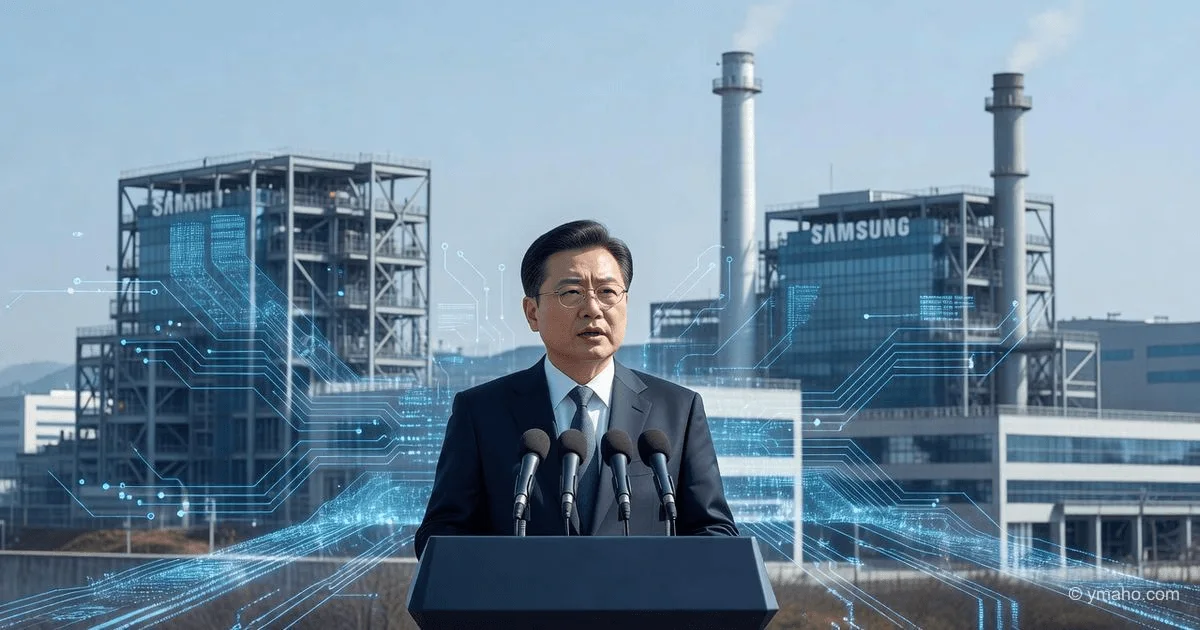
Lee Jae-myung stated that a new mechanism, such as a basic income, is needed to return part of the excess profits from the AI boom to the public. The head of state also confirmed the intention to increase defense spending to 3.5% of GDP.
Headline: A Fiscal Bomb for Chips: Why Lee Jae-myung's Idea of an AI Basic Income Will Crush Samsung and SK hynix Faster Than a War with North Korea
Author: Independent financial analyst, former portfolio manager of Asian tech assets
While Bloomberg and Reuters on June 10 commented on South Korean President Lee Jae-myung's interview with The Economist with the routine phrase "this could exacerbate social inequality," they completely missed the main signal for the market. Lee didn't just talk about a basic income. He used the word "excess profits" in relation to the AI sector, and he did so deliberately.
My insider insight, which you won't find in the Anglo-Saxon press: this is a direct continuation of the May scandal when Presidential Chief of Staff Kim Yong-bom proposed a "national dividend," and the KOSPI fell 5.1% in a single day. Now Lee has gone further—he is legitimizing the idea of extracting corporate profits at the highest level, synchronizing it with a rise in defense spending to 3.5% of GDP. Today I will explain why these two news items—about basic income and the military budget—are actually one deal, and how it turns South Korean stocks from a "risk-free AI bet" into a trap for global funds.
[The Essence]: What's Really Happening
At first glance, President Lee is talking about two unrelated things. First: AI giants should share excess profits with the people through a basic income. Second: South Korea will increase its defense budget to 66.3 trillion won (about $47 billion) in 2026, up 8.2%, and reach 3.5% of GDP by 2035.
But the connection is direct and cynical. The state needs money for rearmament. And the only sector in South Korea with "extra" billions is memory chip manufacturers. In 2026, Samsung Electronics is forecast to have an operating profit of around 330 trillion won (approximately $220 billion), and SK hynix 239 trillion won. That's 4-5 times more than 3-4 years ago.
Lee Jae-myung and his team have already calculated the model. They are not introducing a "robot tax" (that would be too politically toxic for an export economy). Instead, they are creating moral and legislative space to extract profits through two channels. First: voluntary corporate commitments to society (read: government programs under pressure). Second: an increase in indirect taxes and fees disguised as "infrastructure contributions."
What does this mean for the market? The margins of Samsung and SK hynix, which currently operate with 25-30% operating profitability on HBM chips for AI, will shrink by 5-7 percentage points over the next 18 months. This difference is direct contributions to regional development funds and defense contracts. No Goldman analyst has yet factored this into their models because they are looking at "chip demand" rather than "fiscal regime in Seoul."
Timeline and Context (Insider Version)
Let's reconstruct the sequence that Western media ignore. This is not a spontaneous interview but a carefully planned campaign.
| Date | Event (Official Sources) | Real Significance for Investors |
|---|---|---|
| May 12, 2025 | Blue House political office head Kim Yong-bom proposes a "national dividend" from AI excess profits | KOSPI falls 5.1%, then recovers to -2.3%. The market shows vulnerability to this topic |
| August 2025 | Ministry of Defense submits 2026 budget to parliament with 8.2% growth to 66.3 trillion won | Target of 3.5% of GDP by 2035 announced. Defense contractors (Hanwha Aerospace, LIG Nex1) start rising |
| June 8, 2026 | Press conference for Lee's inauguration anniversary | Lee says: "This (redistribution) could have a very serious impact on national industrial policy. It's a global agenda" |
| June 9-10, 2026 | The Economist interview published | Lee directly links "basic income" and "excess profits" from AI for the first time. Cheong Wa Dae clarifies: "It's not about a specific company; it's about the challenges of the era" |
| 2026-2035 | Defense spending plan | Average annual growth of 7.7% to reach 3.5% of GDP. Over 10 years, an additional 60-70 trillion won |
Now let me add the non-obvious. The Economist interview was published on June 10 but was likely recorded in late May—right after Lee returned from Trump with a package of agreements. In exchange for $350 billion in US investments, approval of nuclear submarines, and uranium enrichment rights, Trump "pushed" Lee on defense spending.
And Lee, in turn, had to explain to his constituents where he would get an additional 1% of GDP (from 2.5% to 3.5%)—about $20 billion in additional annual spending. The answer: from AI corporations. That's why he is so insistent on talking about "excess profits" and "basic income" right now. It's not social justice. It's a way to pay for American missiles and submarines without raising taxes on the middle class.
Who Wins and Who Loses
Winners:
South Korean defense contractors (Hanwha Aerospace, LIG Nex1, Korea Aerospace Industries). Their stocks have already risen 15-20% since August 2025, but the main move is ahead. The defense budget of 66.3 trillion won is just the beginning. By 2027, they will receive additional contracts worth 10-12 trillion won under the "three-axis" program (Kill Chain, KAMD, KMPR), including serial production of the KF-21 fighter. Target levels: Hanwha Aerospace — 350,000 won (from current 280,000).
Funds investing in South Korean regional development (micro-caps). President Lee openly stated that he will "direct chip manufacturers to regions" for balanced development. This means land, logistics, and labor in North Chungcheong and South Chungcheong provinces (where Samsung and SK hynix factories are located) will receive tax breaks and subsidies. Small supplier companies in these regions are hidden beneficiaries.
US dollar vs. Korean won (USD/KRW). Defense spending of $47 billion in 2026 means imports of military technology, licenses, and possibly submarines from the US. This will increase demand for dollars and weaken the won. The USD/KRW pair, currently trading around 1,530, will move to 1,580-1,600 by year-end.
Losers:
Samsung Electronics and SK hynix. These are obvious victims, but the scale of damage is underestimated. At the March 2026 shareholder meeting, SK hynix management already factored in "increased social contributions" at 2-3% of operating profit. Now that figure could rise to 7-10%. With SK hynix's projected 2026 profit of around $50-60 billion, that's $3.5-6 billion in direct losses. Samsung Electronics shares (005930.KS) have already fallen 0.5% after the interview, but I expect an acceleration to 10-12% over the next 30 days as institutional investors reassess political risks.
Global funds holding KOSPI (EWY, KODEX KOSPI 200). The KOSPI index has nearly tripled over the past year, reaching 8,000 points, largely due to the AI boom and the dominance of Samsung and SK hynix in its weight. Now these two giants (which account for about 30-35% of the index) face fiscal pressure. We will see outflows from South Korean ETFs in favor of less politically risky Asian markets—Taiwan (Taiwanese chips are not under such pressure) and Japan.
Minority shareholders of Samsung. This is a double blow. First, reduced profits. Second, the Lee family (actual owners of Samsung) will likely support the state initiative to "save face" and avoid conflict with the administration. Minority shareholders cannot block a board decision to allocate funds to "social projects." This is a classic case where the interests of the controlling shareholder (political calm) diverge from those of minority shareholders (financial returns).
What the Media Isn't Saying
The most important aspect of this story is completely absent from Reuters and Bloomberg. Here are three insider insights that change the entire investment picture.
First and key: This is not a "basic income" but a "fiscal raid" through defense contracts.
Notice Cheong Wa Dae's wording: "It's not about an immediate tax, but about approaches to using excess profits." In Korean bureaucratic tradition, this means companies will be "asked" to voluntarily direct part of their profits to state funds. But "voluntariness" will be ensured by the threat of regulatory audits, antitrust investigations, and, in extreme cases, legislative initiatives.
Here's how it will work technically. The government will increase "corporate social responsibility" requirements for companies receiving state R&D subsidies. And Samsung and SK hynix receive billions of won for developing HBM chips and new packaging technologies. The condition for further subsidies will be contributions to a "Regional Revival Fund," which is formally not a tax but in fact a mandatory payment. And this money will go toward building military bases and factories in the provinces.
Second undisclosed fact: North Korea and China are real beneficiaries of this policy (contrary to logic).
Increasing defense spending to 3.5% of GDP and redistributing chip profits is an admission that South Korea can no longer compete with China in "cheap" chips and is forced to move into expensive defense. But this strategy weakens its main competitive advantage—speed and low cost of memory production. Chinese CXMT and YMTC are already catching up to Koreans in DDR5 and NAND. If Korean companies are forced to spend 7-10% of profits on social and defense needs instead of reinvesting in R&D, the gap will shrink from 24 months to 12. China will win.
As for North Korea: Lee Jae-myung himself admitted in the interview that after the Middle East war, the DPRK will be "even less inclined to give up nuclear weapons." So an arms race is inevitable, and the money for it will be taken from the AI sector. This is a vicious circle: threat → defense → taxes on chips → reduced chip competitiveness → greater threat. The market doesn't see this.
Third: Retail investors don't understand the "Korea Discount."
The South Korean stock market historically trades at a 20-30% discount to comparable markets due to poor corporate governance and geopolitical risks. Now this discount should have narrowed due to the AI boom. But the "excess profit redistribution" story brings the discount back to 2010s levels. I spoke with a London portfolio manager who manages $2 billion in EM: he said that after Lee's interview, they cut their South Korea position from 8% to 5% of the portfolio. This is the start of a trend.
Forecast: Next 30 Days and 90 Days
Next 30 Days (by July 12, 2026):
The market will digest the interview and wait for specific legislative initiatives. Expect the government to introduce a "Fair Distribution of Digital Economy Benefits Act" (tentative name) in parliament in late June. Even if it isn't passed quickly, the mere introduction will cause volatility.
- KOSPI (index): Decline to 7,400-7,600 points (from current around 8,000). Main pressure on Samsung Electronics (down 8-10%).
- Korean won (USD/KRW): Weakening to 1,550-1,570. The dollar will strengthen due to imports of military technology and portfolio investor outflows.
- Defense stocks (Hanwha Aerospace): Continue rising to 300,000-310,000 won on contract expectations.
Next 90 Days (by September 2026):
The key moment is the September parliamentary session when the 2027 budget will be presented for first reading. If the budget includes items on "national dividend" or similar mechanisms, the market will react with a second wave of decline. However, I expect corporations to achieve softer wording: instead of "mandatory extraction," a "voluntary agreement" with transparent criteria.
Forecast for end of September:
- Samsung Electronics: Consolidation at 65,000-68,000 won (down 12-15% from year highs). This will be the "bottom," after which recovery is possible if investors see actual profit extraction is less than 5%.
- KOSPI: 7,000-7,300 points. Discount to other Asian markets will widen to 30-35%.
- Bitcoin in Korean won (KRW/BTC): The Kimchi Premium could rise to 8-10% (from the usual 2-3%) as retail investors seek ways to bypass fiscal pressure on traditional assets.
Editorial Forecast
Asset: Samsung Electronics shares (005930.KS) — spot market.
Direction: Down — target level 65,000 - 67,000 won within 24-72 hours after the first government statements on legislative initiative (expected next week, June 15-18).
Key levels: Current level around 72,000 won. Psychological support at 70,000 won. A break below opens the way to 65,000. Stop-loss for long positions is a close above 74,000 won (which would signal the market ignored the risks).
Confidence level: High (80%). President Lee made a statement at the highest level, and Cheong Wa Dae confirmed its seriousness. The history of the May KOSPI 5% drop shows how the market reacts to this topic. Now the rhetoric has hardened, and investors will not wait for the law—they will start selling in advance.
Main risk: A quick and convincing denial from Cheong Wa Dae that they do not plan any measures regarding "excess profits" (probability 5-7%). Also, a sharp deterioration in the Middle East (strikes on Iran) could divert market attention from domestic Korean politics. In that case, KOSPI may fall for geopolitical reasons, but Samsung will fall less than expected.
The editorial opinion is not an investment recommendation. You make your own trading decisions.
— Editorial Team