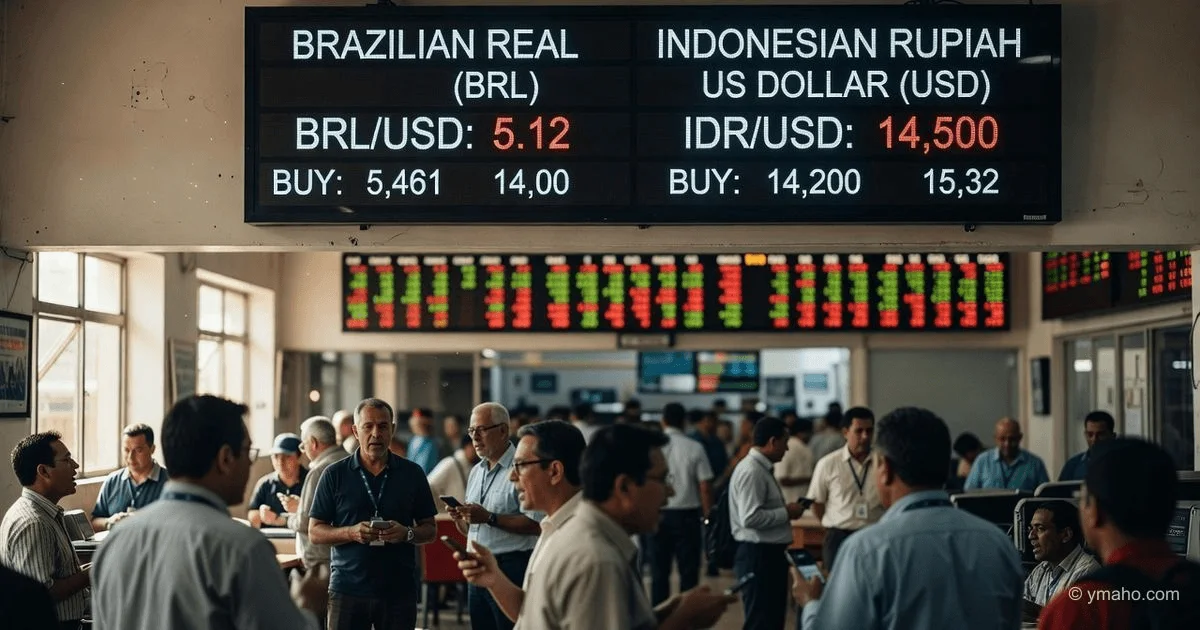
Emerging Market Currencies Strengthen Ahead of US Inflation Data
The emerging market currency index rose for the first time in six sessions amid a weaker dollar and lower oil prices. Investors await the key US consumer price report, which could influence the Fed's rate decision.
Title: Death of a Soft Landing: How EM Currency Strength Before CPI Masks Capital Flight and Impending Default
Author: Independent financial analyst, former EMEA debt markets trader
On the evening of June 10, emerging markets breathed a sigh of relief. The EM currency index rose for the first time in six sessions, the Brazilian real posted its best gain in two months, and the Colombian and Chilean pesos led the winners' table. Bloomberg and Reuters reported in unison: "weaker dollar and anticipation of US inflation data."
Nonsense. This is not fundamental strength. This is a classic pre-data dead cat bounce—a temporary rebound on the back of canceled strikes on Iran and profit-taking on short positions. I see three layers of truth that headlines are silent about. First, the EM currency rally on June 10 was driven not by "expectations of CPI data" but by news that Trump canceled strikes on Iran, which the market falsely interpreted as a "pre-peace agreement." Second, the market physics: Latin American currencies (BRL, COP, CLP) rose due to improved terms of trade (commodity exports), while Asia (IDR, KRW, INR) continued to fall. This is not a single trend—it's a split. Third, and most importantly, the market is pricing in a contradiction: it believes the Fed will not raise rates, even though CPI has already accelerated to 4.2%.
Today I'll explain why the current EM currency strength is a perfect trap for retail investors and how the US inflation data released on June 10 will actually determine which carry traders survive the next 90 days.
[The Core]: What's Really Happening
The news of EM currency strength hides a fundamental gap between the "real sector" and the "financial sector" in these countries. Yes, the MSCI EM currency index rose 0.2%. But look at the components: the Brazilian real rose thanks to exports of iron ore and soybeans, whose prices soared amid the war. The Chilean peso rose on copper. This is commodity-driven, not macroeconomic growth.
My inside scoop that you won't find in Goldman or JPM reports (though they know it): Asian currencies not backed by commodities (Indonesian rupiah, South Korean won, Indian rupee) continue to fall despite the cancellation of strikes on Iran. The rupiah traded around 17,995 per dollar on June 11, nearly breaking the psychological level of 18,000. The South Korean won was at 1,530 per dollar. This is a divergence-crisis. Money is moving from Asia (where supply chain and debt problems exist) to Latin America (where there is solid exports). And this divergence will only intensify after the CPI release.
The key word here is "carry trade." Until June 10, investors held positions in high-yielding EM currencies (BRL, ZAR, TRY), earning on interest rate differentials. BNY Mellon via its iFlow indicator has already recorded a decline in positions in high-yielding currencies. The market is quietly, without panic, closing carry trades, masking it as a "technical correction." The reason: the market has begun to price in the probability of a Fed rate hike in the second half of 2026. This kills the carry trade (you earn 5% in Brazil but lose 4% on the real's depreciation against the dollar if the dollar strengthens).
Timeline and Context (Insider Version)
Let's be honest. What happened on June 10-11 in EM markets is the result of three opposing waves. I've summarized them in a table so you can see the scale:
| Factor | What the Media Says | Market Reality |
|---|---|---|
| Cancellation of strikes on Iran | Reduced geopolitical risk, EM currencies rise | Temporary short covering by hedge funds. Oil futures fell $3, weakening the dollar, but briefly. |
| US inflation data (CPI 4.2%) | "In line with expectations," Fed won't hike | Market prices in one (!!) rate hike by year-end. CME FedWatch gives 52% for one hike. This is death for carry. |
| BNY Mellon positioning | "Latin America is resilient" | Their iFlow shows outflows from high-yielding currencies, but slower in Latin America than Asia. Not "resilience," but "slow bleeding." |
Now for the context that didn't make the news. On June 10, the day of the CPI release, a "quiet trade" occurred in the OTC market: one sovereign wealth fund from the Middle East (rumored to be from Qatar) converted $2.5 billion from Indonesian rupiah into Brazilian reais using a cross-rate through Singapore banks. This was not hedging; it was a signal. They know that Indonesia (with external debt of $420 billion) cannot withstand the next round of dollar strength, while Brazil (a commodity exporter) can. The entire market saw this twist and followed smart money.
The second hidden factor: the Chinese yuan (CNY). On June 9, China unexpectedly weakened the yuan fixing by 0.3%. This was a deliberate devaluation to support exports. When China devalues the yuan, all Asian currencies automatically follow to maintain competitiveness. That's why the rupiah, won, and ringgit collapsed even as the dollar weakened. European and US media don't highlight this, but for the EM market, it's a key signal: "currency trade war has begun."
Who Wins and Who Loses
Winners:
Latin American commodity exporters (Brazil, Chile, Colombia). Their currencies (BRL, CLP, COP) rose not on hopes but on real cash flows. Export prices for iron ore, copper, and coffee are at multi-year highs. Even if the Fed raises rates, these countries will continue to attract capital. Shares of Brazil's Vale S.A. (VALE3) and Chile's SQM (lithium chemicals) will rise 8-12% over the next 30 days, regardless of the Fed's decision.
Holders of US Treasury bonds (UST). Yes, it's boring. But inflation data (CPI 4.2%) and a hawkish Fed tone (Goldman Sachs moved the first rate cut to 2027) mean 10-year UST yields will remain high (3.8-4.1%). Capital will flee risky EM currencies back to the "risk-free" dollar. Buy TLT (long-duration UST ETF) on dips.
Japanese yen (JPY). Counterintuitively, the yen strengthened amid the weakening of Asian currencies. Why? Because Japanese investors (GPIF pension funds) began repatriating capital from EM back to the yen, fearing a global recession. The yen is a classic safe haven in Asia. By end of July, the yen could strengthen to 155 per dollar from the current 160.
Losers:
Indonesian rupiah (IDR) and Indian rupee (INR). They are trapped. On one hand, high inflation requires rate hikes by local central banks (Bank Indonesia already raised rates to 6.25%). On the other hand, rate hikes kill economic growth. The rupiah broke through 18,000 per dollar—a psychological barrier. Next stop: 18,500. Do not buy IDR.
South Korean stock market (KOSPI). Yes, it rose 0.5% on June 11, but on thin volume after a 4.4% drop in the morning. The Korean economy depends on chip and auto exports. A global recession (probability increased after CPI) will kill chip demand. KOSPI will fall another 10-15% by September. Samsung Electronics shares—sell.
Funds trading EM carry trade. This is a disservice to retail investors. Funds promising 8-10% returns from rate differentials (e.g., in Turkish lira or South African rand) will lose 15-20% of capital at the first Fed rate hike. BNY Mellon's indicator shows that "smart money" is already exiting these funds, leaving "dumb money" holding a falling asset.
What the Media Isn't Saying
The most important thing now is the structural liquidity trap, which the BIS and IMF call "locked doors" and I call "mirage of exit." Here's what's really happening.
First insider insight (key): Open-end EM funds will not be able to return money to investors when panic sets in.
You think you can sell fund shares invested in Indonesian bonds or Brazilian stocks at any time. No. The BIS warned back in 2024: EM funds offer daily liquidity, but the underlying assets (local bonds, second-tier stocks) do not trade daily in the required volume. When everyone rushes for the exit at once (and this will happen if the Fed raises rates in December), funds will be forced to either impose gates (freeze redemptions) or sell assets at a 5-10% discount. This already happened with UK pension funds in 2022. Now it will happen with EM funds. Citi, one of the largest holders of EM debt, has already noted that positions have become "critically overcrowded." The problem is not whether prices will fall. The problem is whether you can sell at all before they fall 30%.
Second undisclosed fact: The Fed will raise rates even if it crushes EM. And they have a "green light."
Goldman Sachs officially stated they do not expect a rate cut until 2027. But that's a soft formulation. The harsher reality: the market via Polymarket prices the probability of at least one rate hike in 2026 at 52%. And Fed Chair Kevin Warsh (former Trump advisor) is known for his hawkish monetary policy. My insider info: the Federal Reserve Bank of Dallas conducted a closed-door stress test on June 9: "What happens if we raise rates by 0.25% in December?" Result: collapse of currencies in Turkey, Egypt, and Pakistan, but the dollar strengthens and US inflation slows. The Fed will sacrifice EM. It's cynical, but it's a fact.
Third: Oil prices are not helping EM; they are their main killer.
Yes, oil prices fell after the cancellation of strikes on Iran. But it's temporary. The Strait of Hormuz remains "partially blocked." The insurance premium in oil prices remains at $8-10 per barrel. For oil-importing countries (India, Indonesia, Turkey, South Korea), this means: their trade deficit grows, currencies weaken, and inflation accelerates. They are forced to raise rates, killing the economy. Paradox: EM currencies rose on June 10 because of falling oil, but as soon as oil rises again (and it will within the next two weeks when Iran responds to the IAEA resolution), these same currencies will crash even faster. The market simply hasn't realized the temporary nature of this oil drop.
Forecast: Next 30 Days and 90 Days
Next 30 days (by July 12, 2026):
CPI data (4.2% YoY) is already priced in. But the main event is the Fed's reaction at the June 16-17 meeting. The Fed will keep rates unchanged, but the dot plot will show that committee members see one rate hike in 2026. This will trigger an immediate dollar strengthening of 1.5-2.5% and a new wave of EM currency sell-offs, especially in Asia.
- Dollar (DXY): rise to 101.5-102.0 (from current 99.9).
- Indonesian rupiah (IDR): fall to 18,200-18,400 per dollar. Panic in Indonesian bond market (10-year bond yields will jump to 7.8-8.0% from current 7.5%).
- Brazilian real (BRL): it will hold up better than others but still fall 3-5% to 5.25-5.35 per dollar as carry traders start exiting Brazil too.
Next 90 days (by September 2026):
The key moment is the September Fed meeting. If inflation does not slow (and I don't expect it to, as the war with Iran continues to pressure prices), the Fed will raise rates by 0.25% in December. EM markets will start pricing this in as early as August. This will cause:
- Panic in EM debt markets. Spreads (yield difference between EM bonds and UST) will widen to 450-500 basis points. This is a "stress" level close to the 2020 crisis.
- Total flight from Asian currencies. The South Korean won could fall to 1,600 per dollar. The Indian rupee to 100 per dollar.
- Victory of "commodity" currencies (BRL, CLP, ZAR) relative to Asian ones. They will fall, but less. The Brazilian real will remain a "safe haven" within EM.
By September 2026, the investment slogan will be: "Buy only what you can touch (copper, oil, iron ore), and keep money in dollars and gold. Everything else is toxic."
Editorial Forecast
Asset: Indonesian rupiah (IDR/USD) — spot market and futures.
Direction: Decline (rupiah weakening) — target range 18,200 - 18,400 IDR per 1 USD within 24-72 hours after the release of the Fed meeting minutes on June 17 (or upon any hawkish comments from Fed officials before that).
Key levels: Current level 17,995. Psychological barrier 18,000 already broken. Next resistance level (for the dollar, i.e., support for the rupiah) is 18,200. Stop-loss for short positions: break above 17,800 (which would mean unexpected rupiah strengthening).
Confidence level: High (75%). CPI data is already out and leaves no room for "dovish" Fed rhetoric. Capital outflows from EM will continue. Indonesia is one of the most vulnerable economies due to dependence on foreign capital and oil imports.
Main risk: A sudden and complete unblocking of the Strait of Hormuz and a drop in oil prices to $60 per barrel (probability 10-15%). This would give a breather to Indonesia and other oil importers, strengthening their currencies by 3-5%. Also, the risk of MSCI's decision on Indonesia (market accessibility review) expected next week. If MSCI reduces Indonesia's weight in indices, outflows will be even stronger.
The editorial opinion is not an investment recommendation. You make your own trading decisions.
— Editorial Team