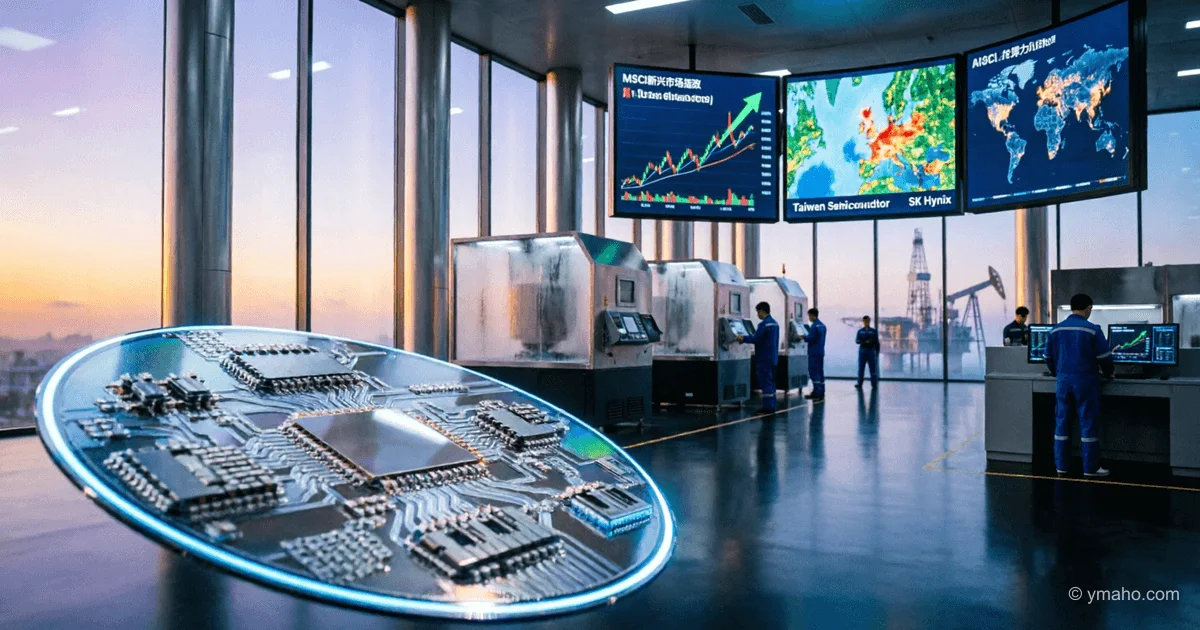
Emerging Markets Hit New Records Amid AI Boom
The MSCI Emerging Markets index rose about 14% in 2026, significantly outpacing the S&P 500. Key drivers were Asian tech companies (Samsung, TSMC) providing AI infrastructure, as well as oil-exporting countries like Brazil.
Emerging markets hit new records amid the artificial intelligence boom.
Introduction
2026 brought an unexpected surprise for global investors. Contrary to gloomy forecasts predicting a collapse of emerging market stocks due to escalating Middle East conflict and soaring energy prices, the MSCI Emerging Markets index not only held up but hit new all-time highs, gaining about 14% year-to-date. This result more than doubled the return of the US S&P 500, which rose only 5.6% over the same period.
The main drivers of this rally were two seemingly opposite factors: booming demand for artificial intelligence (AI) infrastructure and high energy prices enriching oil-exporting countries. Asian tech giants like Samsung and TSMC, which provide the hardware for the global AI race, pulled entire stock markets higher, while Brazil and other net energy exporters turned the geopolitical crisis into a source of super-profits. We will detail how emerging markets managed not only to survive in a turbulent zone but also to become leaders of global growth.
Event Details and Timeline
First Quarter: Rollercoaster in the Middle East
The first two months of 2026 instilled optimism in investors. Asian and other emerging markets rose steadily on the wave of structural demand for semiconductors and easing global monetary policy. However, March brought a sharp shift in sentiment. US and Israeli strikes on Iran and subsequent retaliatory actions by Tehran, including attacks on allies in the Persian Gulf, led to the effective closure of the Strait of Hormuz—a key artery of the global oil market.
Energy prices soared to four-year highs, and global markets were gripped by a risk-off sentiment. But the panic was short-lived. By the end of April, the MSCI EM index had not only recovered its losses but hit new records. The main structural support that kept the market from collapsing was the Asian tech sector.
Tech Surge: Korea and Taiwan
While geopolitics pushed oil prices up, Asian chipmakers posted phenomenal results. South Korea's KOSPI index surged 57%, and Taiwan's TAIEX rose 34%. The flagship industry barometer, Samsung, saw its stock rise 84% year-to-date. Semiconductor giant TSMC also reported double-digit capitalization growth.
This tech boom fully compensated South Korea and Taiwan for the fact that they import about 70% of their crude oil from the Middle East. The rise in energy prices, which should have hit their economies, was offset by positive investor sentiment around their dominant position in the global chip production chain. In effect, AI infrastructure became a shield for these markets against external shocks.
Brazil's Energy Sovereignty
Brazil stood out separately against this backdrop. The Bovespa index gained 16%, and the main reason is energy independence. Having become a net oil exporter in 2017, Brazil not only avoided damage from the Middle East crisis but also gained additional revenue from rising global prices. By 2030, the country's production is expected to reach 4.76 million barrels per day. The iShares MSCI Brazil ETF has grown nearly fourfold in volume over the past year, to $12 billion.
Impact and Significance (for the World, Industry, Society)
Reassessment of Global Supply Chains
There has been an important rethinking of the role of emerging markets. Investors seeking alternatives to overvalued US stocks (S&P 500 trades at a P/E of 28.9 vs. 18.4 for MSCI EM) are increasingly turning their attention to second-tier countries. The AI boom requires enormous amounts of resources: from copper and aluminum (for cables and data center cooling) to rare earth metals. This creates a decade-long super-commodity window for Chile, Peru, Indonesia, and African countries.
Shift in Global Capital Structure
A tectonic shift is underway: global telecom and high-tech corporations building data centers (Microsoft, Amazon, Google) are forced to invest in capacity located in developing countries. Bank of America analysts predict that total capital expenditures (CAPEX) of hyperscalers will grow from $154 billion in 2023 to over $600 billion by 2027. Much of this money will end up in the accounts of component manufacturers from Taiwan, Korea, and Malaysia.
Polarization of the World: US and China
According to a McKinsey report that identified 18 arenas of future competition (from AI and cloud to electric vehicles), the US and China together control about 90% of market capitalization in these fast-growing industries. This means that of the 14% growth in MSCI EM, the lion's share was captured by a few countries that can offer either high tech (Taiwan, Korea) or raw materials (Brazil, Gulf states). Other emerging markets risk being left out of this party.
Reaction of Key Players
Institutional Giants
UBS maintains an overweight on China, neutral ratings on Taiwan and Korea, and underweight on India. The bank's strategists expect significant growth in EM stocks in 2026, forecasting a return of about 9% for the MSCI EM index, driven by the tech sector. UBS believes that the AI trade is still in its early stages, and companies generating real revenue from AI will continue to outperform.
Sovereign Funds and Flows
Matthews Asia notes in its review that investors actively rotated from Chinese giants into Korean and Taiwanese stocks when the Middle East conflict began. The Chinese market fell nearly 9% in the first quarter, while funds focused on Latin American dividend aristocrats, on the contrary, saw strong inflows.
Value-Up Policy in Korea
South Korean authorities, seizing the moment, are actively promoting corporate governance reforms (Value-Up), including mandatory share buybacks, to eliminate the Korean discount—the traditional undervaluation of local companies compared to global peers. This further fueled foreign interest in the market.
Forecast and Conclusions
Short-Term Outlook (6-12 Months)
According to Neuberger Berman experts, emerging markets will receive a tailwind from AI over the next 12-18 months through commodity prices and demand for components. This is favorable for the currencies of exporting countries (Brazilian real, Chilean peso, South African rand). However, high US interest rates and a strong dollar may limit risk appetite.
Long-Term Challenges (5-10 Years)
Here, experts agree that emerging markets may face problems. If AI realizes its growth potential mainly in the services sector rather than in manufacturing (which dominates EM), the gap between developed and developing economies could widen. An IMF study shows that US productivity gains from AI could reach 5.4% of GDP, while in Latin America only 3.2%. Without massive R&D investment and addressing infrastructure bottlenecks, many countries risk remaining mere resource suppliers for others' innovations.
Investor Takeaway
The emerging market is undergoing a structural shift. Cheap money has dried up, replaced by a bet on real assets: chips, copper, oil, and capital-intensive infrastructure. Today, investors face a choice: either buy the expensive but tech-heavy S&P 500 with high risk concentration in the Magnificent Seven, or enter the cheaper and more diversified MSCI EM, which has its own golden nuggets (Samsung, Vale, Petrobras) capable of competing with global leaders.
The main risk remains geopolitical: any new escalation or a full-blown US-China trade war could instantly shut down this growth party. However, current dynamics show that the AI boom and supply chain restructuring are powerful trends capable of outweighing even the most negative news from hot spots around the world.
— Editorial Team









