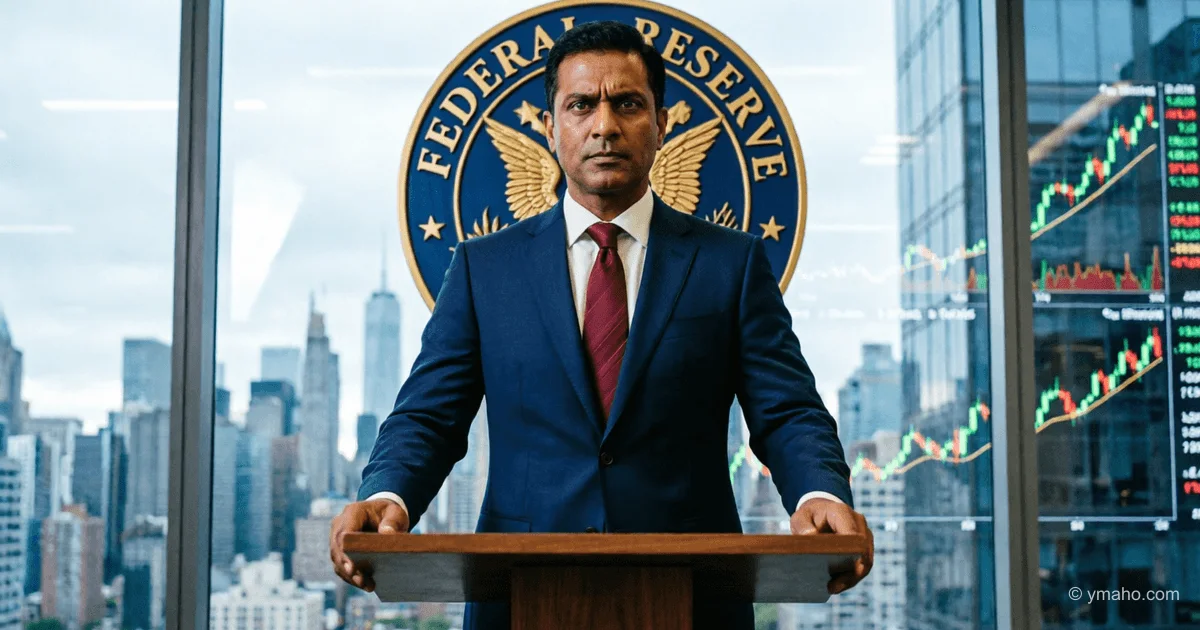
Minneapolis Fed President Kashkari Hints at Possible Rate Hike
Neel Kashkari stated that the inflationary shock from the war may require tightening of monetary policy. He pushed back against signals of an imminent rate cut, arguing that the Fed must be prepared for any scenario.
Fed Rate Hike Back on the Table: Neel Kashkari's Hawkish Maneuver
Introduction
On May 3, 2026, Neel Kashkari, President of the Federal Reserve Bank of Minneapolis, made a statement on CBS's Face the Nation that instantly shifted the tone of the debate on the future of U.S. monetary policy. He not only opposed signals of an imminent rate cut but directly suggested that the Fed's next move could be a hike—and possibly multiple hikes. This speech marked the culmination of the most serious rift within the Federal Open Market Committee (FOMC) since 1992: at the April meeting, four committee members voted against language implying further easing. Kashkari's statement is not merely the opinion of a regional Fed president but a symptom of a fundamental shift in the perception of risk balance: inflation has definitively overtaken the threat of recession.
Event Details and Timeline
Kashkari's appearance came four days after the April FOMC meeting, where the benchmark interest rate was held at 3.50–3.75%. The seemingly routine decision masked a heated internal debate: three voting members—Kashkari, Cleveland Fed President Beth Hammack, and Dallas Fed President Lorie Logan—supported keeping rates unchanged but opposed including language in the statement about a "dovish signal," which markets traditionally interpret as a hint of future cuts.
In the CBS interview, Kashkari laid out his position with remarkable candor. Key points include: First, "the inflationary shock could be much stronger than currently anticipated," making any hints of easing inappropriate. Second, in a worst-case scenario—a prolonged closure of the Strait of Hormuz and further rises in energy prices—"the Fed may have to tighten monetary policy." Third, the price shock from the Iran conflict is already comparable to or exceeds the impact of Russia's invasion of Ukraine.
Kashkari's assessment of the long-term consequences of shipping disruptions deserves special attention. He cited a specific example: the CEO of a global company headquartered in Minnesota estimated that even if the Strait of Hormuz reopened today, it would take about six months for supply chains to return to normal. This estimate sharply contrasts with optimistic statements from the U.S. Treasury Department.
The quantitative parameters of the price shock are also striking. According to the American Automobile Association, the average U.S. gasoline price reached $4.457 per gallon—a high since July 2022, representing a nearly 50% increase from the pre-conflict level of around $2.98. The March Personal Consumption Expenditures (PCE) price index rose 3.5% year-over-year, while core PCE (excluding food and energy) rose 3.2%, both significantly above the Fed's 2% inflation target.
Impact and Significance
Kashkari's statement has multi-layered implications for the U.S. financial system and global markets. First, it solidifies a shift in market expectations toward tightening. According to CME FedWatch data, the probability of at least a 25-basis-point rate hike by year-end jumped to 10% immediately after Powell's press conference, up from 0% the day before. Moreover, Kalshi analysts estimate the probability of a rate hike by July 2027 at 43%.
For global capital markets, a hawkish Fed pivot means a fundamental regime change. The DXY dollar index gains strong support; ING analysts forecast a recovery to 99.00–99.50 amid high energy prices and the Fed's hawkish narrative. ING's key conclusion: "The question is no longer just about delaying Fed easing, but whether the Fed will respond to this inflationary shock with tightening."
The fundamental dilemma facing the FOMC is that the Fed's dual mandate—price stability and maximum employment—are in direct conflict under current conditions. Kashkari acknowledges that rate hikes risk weakening the labor market but insists that protecting the 2% inflation target is a priority. As he stated in a written explanation of his position: "We will likely need to take decisive policy action... A hike in the federal funds rate, possibly a series of hikes, may be warranted even at the risk of further labor market weakening."
This approach effectively means that the FOMC's hawkish wing is willing to sacrifice some labor market gains to preserve credibility on inflation targeting. As Kashkari emphasized, "A sufficiently strong price shock could unhinge inflation expectations, potentially requiring a series of rate hikes for the Fed to maintain credibility in defending its 2% inflation goal."
Reactions from Key Players
Kashkari's speech exposed a serious rift not only within the Fed but also across the U.S. economic establishment. Within the FOMC, three factions have formed. The hawkish wing—Kashkari, Hammack, and Logan—insists that the statement should reflect two-sided risks and the possibility of both rate cuts and hikes. The dovish wing is represented by Fed Governor Stephen Milan, who was the sole vote for an immediate rate cut. The centrist majority, led by Powell, tries to maintain neutral language but faces growing pressure from both sides.
The hawkish position is shared by Chicago Fed President Austan Goolsbee, who described recent inflation data as "bad news." This is particularly notable because Goolsbee is traditionally considered one of the most dovish FOMC members.
A fundamentally different view comes from the U.S. Treasury Department. Treasury Secretary Scott Bessent, on the same CBS program, expressed "high confidence" that oil prices would fall below pre-conflict levels after the conflict ends. Bessent also noted that futures markets already price in lower energy prices later this year, and that the U.S. benefits from turbulence as a crude oil exporter. Thus, the executive branch has taken a markedly optimistic stance, directly contrasting with Kashkari's alarmism.
Markets reacted to Kashkari's statement with a classic risk reassessment. Yields on short-term U.S. Treasury bonds continued to rise, pricing in 6 to 7 basis points of tightening in 2026. Spreads on high-yield corporate bonds widened, reflecting increased risks of an economic slowdown. The S&P 500 declined as investors reconsidered the assumption built into valuations since the start of the year—that rates would only go down.
Forecast and Conclusions
Neel Kashkari's speech marks a turning point in Fed communication. The central bank, which at the start of 2026 considered further easing as the baseline scenario, now must acknowledge the equal probability of opposite outcomes. TD Securities analysts forecast that the FOMC will maintain the status quo at least until September, and even if inflation normalizes, total easing in 2026 will be only 50 basis points. They also acknowledge that "the risk of the Fed holding steady longer is rising."
The actual rate path will depend on developments in the Middle East. An optimistic scenario—a quick resolution of the conflict, reopening of the Strait of Hormuz, and oil prices falling below $100 per barrel—would allow the Fed to refrain from tightening and possibly even implement one rate cut late in the year. A pessimistic scenario, as Kashkari points out—a prolonged war, persistent supply disruptions, and inflation expectations becoming entrenched above target—would make a rate hike nearly inevitable.
The main takeaway is that the Fed is entering a period where monetary policy becomes a derivative of the geopolitical situation. Kashkari made clear that even a favorable scenario—a swift reopening of the strait—would leave inflation around 3% by year-end, still above the 2% target and enough to keep rates unchanged. This means the period of high rates will last significantly longer than anticipated before the Iran crisis. For markets accustomed over recent decades to the "Fed always comes to the rescue with easing" model, this will be a serious stress test.
— Editorial Team









