IRGC Threatens to Wipe US Military Bases Off the Face of the Earth, Promises a New World Order
Iranian military officials have announced a complete blockade of the Strait of Hormuz and promised to soon "deactivate" all American bases in the southern Persian Gulf. Tehran is openly declaring its intention to create a new world order.
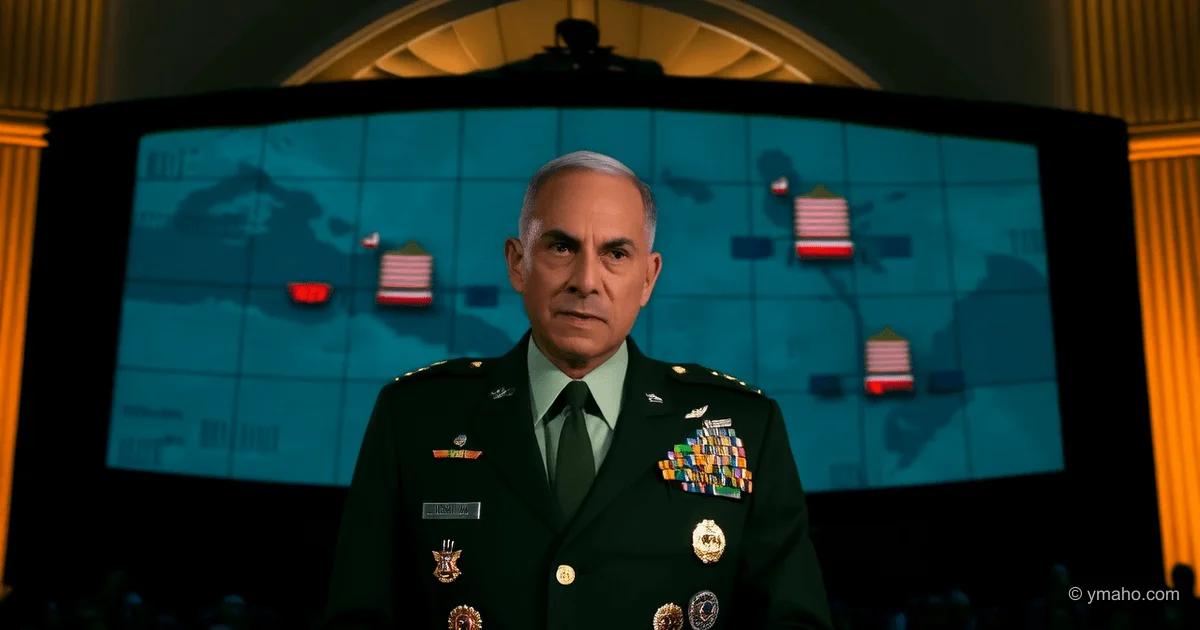
General Hossein Salami stepped up to the podium in Tehran and uttered a phrase that global news agencies spread in four minutes: "We will deactivate all American bases in the southern Persian Gulf and build a new world order." The commander of the Islamic Revolutionary Guard Corps left no room for interpretation — the IRGC announced a complete blockade of the Strait of Hormuz and vowed to wipe out the US military presence in the region.
This is not the rhetoric of a Friday sermon. It is a policy statement from a man who commands 190,000 troops, controls Iran's nuclear program, and manages a shadow economy worth hundreds of billions of dollars. An hour after his speech, Brent crude broke $118. The market understood: Tehran is no longer negotiating — it is dictating terms.
Five Bases, One Threat
Salami named specific targets. Al Udeid Air Base in Qatar — the largest US military facility in the Middle East, with 11,000 personnel and the CENTCOM command center. The naval base in Bahrain — headquarters of the US Fifth Fleet, which has patrolled the Persian Gulf since 1949. Al Dhafra Air Base in the UAE, the same one whose radars missed a drone over the Barakah nuclear plant two weeks ago. Ali Al Salem Air Base in Kuwait. And Camp Arifjan, also in Kuwait.
All five facilities are located within 300–700 kilometers of the Iranian coast. For a medium-range ballistic missile — five to seven minutes of flight. For a cruise missile — fifteen minutes. For a swarm of Shahed drones — forty minutes to an hour.
According to the IISS, Iran's arsenal includes at least 3,000 ballistic missiles of various classes and about 10,000 attack drones. The figure is imprecise — the IRGC does not publish an inventory. But analysts at RUSI in London estimate Iran's capability for a massive salvo at 500–700 missiles simultaneously. The air defense systems available to the US and its allies in the region can intercept at best 60% of such a salvo. The remaining 40% reach their targets.
Where Did the "New World Order" Come From?
The phrasing is no accident. "New world order" is a term that Iran's Supreme Leader Ali Khamenei introduced in 2023 during a speech to IRGC commanders. At the time, it sounded like an ideological abstraction. Now Tehran is filling it with military content.
The concept is simple and radical: the era of American hegemony is over. The world is becoming multipolar. The Western bloc is losing control over resource flows. Iran, controlling the Strait of Hormuz, is becoming not a regional power but a global player capable of single-handedly collapsing the world economy.
Tehran indeed has economic leverage. Through the Strait of Hormuz passes 21 million barrels of oil per day — 20% of global consumption. Another 110 million cubic meters of liquefied natural gas — a third of the global LNG market. To completely block the strait means sending the world economy into recession within two weeks.
China, the largest buyer of Iranian oil, is not intervening. Beijing is building up its strategic reserve, buying Iranian oil through a shadow fleet at an 8–10% discount to Brent. Russia is also silent — Moscow only benefits from rising energy prices. The West is left alone with the problem.
Diplomacy in Ruins
The Geneva talks, launched with such difficulty in March, are effectively dead. US Special Representative for Iran Robert Malley held three rounds of consultations with Iranian Deputy Foreign Minister Ali Bagheri Kani. The result — zero. Iran demanded the lifting of all sanctions before discussing the nuclear program. The US insisted on the immediate removal of 400 kilograms of enriched uranium. No compromise is in sight, even in theory.
Tehran is using classic tactics: escalate tension to the breaking point to force concessions from the opponent. In 2015, this worked — the JCPOA nuclear deal emerged precisely after Iran brought the world to the brink of military confrontation. But the context is different now. In the White House sits Donald Trump, who unilaterally tore up that very deal in 2018 and imposed a policy of "maximum pressure." He has no intention of returning to negotiations from a position of weakness.
Salami's speech is also a signal to Trump: "Your maximum pressure has failed; now we are the ones applying pressure." The Iranian general turned the US president's rhetoric inside out. If Trump says "deal or war," the IRGC replies "war or surrender."
Who Pays for This Speech
Stock markets in the Gulf have fallen for the fourth consecutive session. Saudi Tadawul lost 2.1% of its capitalization in a day. The Qatar Exchange dropped 2.8%. The Dubai Financial Market fell 3.3%. Investors are pulling money out of the region at fire-hose speed.
Oil traders are pricing in a war premium of $12–15 per barrel. Goldman Sachs analysts released a note this morning titled "The Hormuz Scenario: A Baseline Threat, Not a Tail Risk." The bank raised its three-month Brent forecast to $130.
Defense contractors are the main beneficiaries. Lockheed Martin shares jumped 4.7% in a day. Raytheon gained 5.2%. Northrop Grumman rose 4.9%. The US Congress is already discussing an emergency $15 billion air defense funding package for Gulf allies.
Marine insurers are in panic. The cost of war risk for a tanker transiting the Strait of Hormuz has reached 2.1% of the cargo value. For a VLCC supertanker carrying two million barrels of oil, that's $2.5 million per voyage. Some carriers are simply refusing trips to the Persian Gulf.
What Happens Next
Scenario one: demonstrative escalation without full-scale war. The IRGC launches pinpoint strikes on facilities that symbolize the American presence but do not provoke a direct military response. A symbolic missile attack on an empty warehouse at a base in Kuwait. A drone attack on a US Navy supply ship in international waters. The goal is to maintain tension at a level where the West sits down at the negotiating table with a losing hand.
Scenario two: miscalculation and spiral escalation. A strike on a facility with American casualties triggers a chain of retaliation. The US strikes Iranian launchers. Iran attacks Saudi oil facilities. Brent soars above $150. The global economy enters recession by the third quarter.
Scenario three: a secret deal. Oman and Qatar continue shuttle diplomacy. The parties agree on mutual de-escalation in exchange for partial sanctions relief. But the IRGC's public rhetoric makes this scenario increasingly unlikely — backing down after words like "new world order" is difficult even for an authoritarian hierarchy.
One thing is certain: Salami was not bluffing. A man commanding a military machine that has gone from proxy wars to direct confrontation with the US on the threshold of the nuclear club in five years does not waste words. When a general says "wipe off the face of the earth," markets should listen carefully.
— Editorial Team









