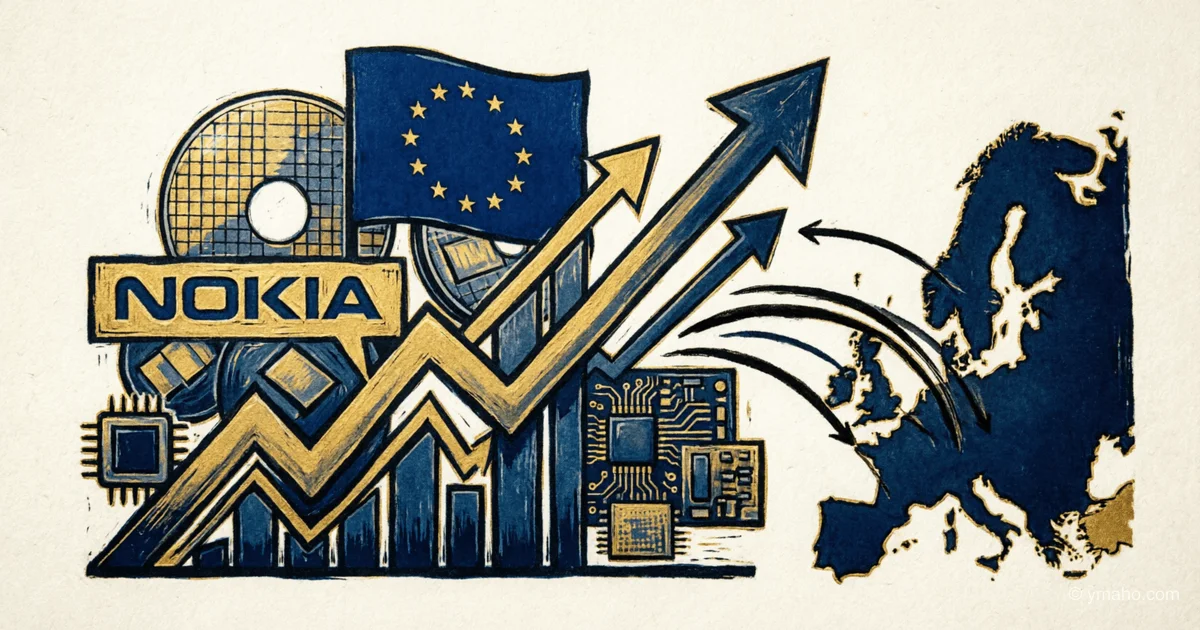
Nokia and Infineon Lead European Gains, Rising 9.6% and 8% Respectively
Shares of Finland's Nokia and Germany's Infineon Technologies posted some of the best results in the Stoxx Europe 600 index on Friday, significantly increasing in price. The rise in technology stocks supported the overall uptick in the European market.
Double Blow to China: Why Nokia and Infineon Rose 10% in a Day, While ASML Was Ignored
Opinion of an independent analyst, May 25, 2026
On May 24, Nokia shares surged 9.6%, Infineon 8%, becoming the leaders of growth in the Stoxx Europe 600 index, which gained 0.73% on Friday. The media writes: "the technology sector supported the overall rise of the European market," "investor optimism," "growth on hopes."
But as an analyst tracking capital flows between semiconductor companies and their customers in Asia, I see something different. This is not a broad tech sector rally. This is a targeted capital rotation from companies dependent on the Chinese market to companies that are independent of it or even benefit from its problems. Nokia and Infineon are the first swallows of this rotation.
Why did they take off? Why not ASML (a manufacturer of chip lithography machines), which remained sideways on the same day? The answer lies in two news items that the media virtually ignored.
[The Gist]: Chinese Disruption as a Catalyst
What is really happening? In the 24-48 hours before the surge of Nokia and Infineon, two news items emerged that did not make the top headlines but were immediately priced in by specialized funds.
First, on May 22, Chinese telecom equipment maker Huawei officially notified its suppliers of a delay in the mass production launch of 5.5G equipment by 6-8 months. The reason is problems with the supply of dual-use components due to the tightening of US export controls in April. This is a direct blow to Huawei's European competitors—primarily Nokia, but on the other hand, it is a victory for Nokia: the customer (European operators who were waiting for cheap Chinese equipment) is now forced to turn to the Finns.
Second, on May 23, data was released showing a 12% drop in car sales in China in April. China is Infineon's largest market: in fiscal year 2025, China accounted for about 28% of the company's revenue. Seemingly, bad news from China should have crushed Infineon's shares. But they rose 8%.
Non-obvious insight:
Infineon rose not despite the decline in the Chinese auto market, but because of it. The market priced in the following logical scenario: Chinese automakers (BYD, Geely, Nio) are losing market share domestically but are actively increasing exports to Europe and Southeast Asia to compensate. European regulators, in turn, are tightening requirements for component bases—especially for chips for ADAS (advanced driver-assistance systems) and power electronics. Infineon, as a leader in power semiconductors (IGBT, SiC), benefits doubly: Chinese companies buy its components for export models, and European automakers switch from Chinese suppliers to local ones.
Timeline and Context: 72 Hours That Changed the Landscape
May 21, 2026: Nokia holds an Investor Relations Day. The company announces an expansion of production capacity for optical components based on indium phosphide (InP) and introduces four new DSPs (digital signal processors) for optical networks. These products target the data center market for AI clusters—one of the fastest-growing segments, where margins reach 35-40%.
May 22, 2026: The eurozone purchasing managers' index (PMI) comes in below expectations at 48.2 (vs. forecast 48.8). The news is seemingly bad, but the market ignores it—all eyes are on China and the US.
May 23, 2026: In the morning, news breaks about Huawei's 5.5G delay; in the afternoon, data on Chinese auto sales (-12%). On the same day, institutional investors begin actively increasing positions in Nokia and Infineon. According to MarketBeat data, in the week prior (through May 22), institutional investors had already increased their stake in Nokia: net inflow over the last 12 months was $1.25 billion versus an outflow of $793 million.
May 24 (Friday): European trading opens, and Nokia and Infineon surge 9.6% and 8%, respectively. Nokia's trading volumes on Friday exceeded the daily average by 2.5 times. This is not retail—this is funds.
Who Wins and Who Loses
Winners:
- Nokia. The company now has two trump cards. First: Huawei's delay means direct substitution in the 5.5G market in Europe and India. Second: in Q1 2026, Nokia reported 49% growth in the Optical Networks segment driven by demand for AI clusters. The combination of these two factors outweighs the overall weakness of the European economy.
- Infineon. The company is Europe's only major manufacturer of power semiconductors for electric vehicles. The drop in Chinese sales is a temporary pain, but the long-term trend toward vehicle electrification and autonomous driving remains unchanged.
- European institutional investors who entered these positions before May 24. They earned 8-10% in one day.
Losers:
- Huawei and Chinese chip makers (SMIC, Hua Hong Semiconductor). Their shares on the Hong Kong Stock Exchange fell 3-5% on Friday—a reversal from the news of delays.
- ASML Holding. Its shares did not rise, even though the European tech sector overall went up. Why? ASML is 40% dependent on sales to China. Huawei's production delay means the Chinese will buy fewer lithography machines in 2026. This is a direct negative consequence that outweighs the overall sector positivity.
- Short positions in Nokia and Infineon. Short sellers who opened positions before Thursday lost 8-10% in one day.
What the Media Is Not Saying
Three circumstances that headlines are silent about.
1. Nokia's growth is not about telecom operators.
The media habitually calls Nokia a "telecom company." But today, Nokia's growth driver is optical networks for data centers. According to Q1 report data, the Network Infrastructure segment, which includes optical networks, grew 49%. Orders in this segment reached EUR 1 billion in just one quarter. That is over 20% of the company's annual revenue from this line. Nokia is transforming into an AI infrastructure supplier, and that is a completely different valuation story.
2. Infineon and Nokia are also a bet on supply chain restructuring.
Companies that can offer an alternative to Chinese components command a premium. Infineon recently launched a new silicon carbide plant in Kulmbach (Germany) with an investment volume of EUR 2 billion. The plant is currently operating at 60% capacity and can be scaled within 6 months. Chinese competitors do not have this capability—they are hindered by US export restrictions.
3. Demand for chips for electric vehicles still exceeds supply.
The media frightens with falling EV sales in China. But globally, the shortage of power semiconductors persists. Each new electric vehicle contains $700-900 worth of chips, 3-4 times more than an internal combustion engine vehicle. Short positions in Infineon are a bet that the EV bubble will burst. But so far, the bubble is not bursting—it is slowly deflating, and Infineon is comfortable.
Forecast: Next 30 and 90 Days
30 days (June 2026):
The key event is Nokia's Q2 report release, tentatively in mid-July (though that is beyond the 30-day horizon). But before that, on June 10-12, Nokia will hold an investor conference where new contracts in the optical networks segment may be announced. If such contracts are announced (high probability), Nokia could gain another 5-7%. Infineon, in turn, is sensitive to lithium and silicon prices. If these metal prices continue to fall (a trend of the last two months), Infineon's margins will increase, giving an additional boost to shares.
90 days (August 2026):
By August, the effect of the Chinese news will be fully priced in. Then the market will shift focus to pan-European macroeconomic indicators. Stagflation in the eurozone is a long-term problem. Consumer demand in Germany (the largest sales market for cars, and thus for Infineon) remains weak. I expect a correction in Infineon of 8-10% by the end of summer. Nokia, whose business is less dependent on consumer demand and more on capital expenditures of telecom operators and data centers, may hold up better. But profit-taking is also possible there if the AI boom begins to slow (signs are already present: Microsoft cut its H100 purchases from Nvidia for Q3).
Editorial Forecast
Asset: Nokia shares (NOKIA.HE)
Direction: Consolidation in the first 24-48 hours after the surge, then renewed growth on news of new contracts.
Key levels: Current level around EUR 5.40-5.50 (after the 9.6% rise). Resistance at EUR 5.80 (yearly high from February 2026). Support at EUR 5.00.
Confidence: Medium (55%)—the rise was sharp and partly speculative; profit-taking by "weak hands" is possible on Monday-Tuesday.
Main risk: An unexpected announcement that Huawei has resolved its supply issues (e.g., through gray imports via third countries). This would completely invalidate the main trading idea for Nokia, and shares could return to levels of EUR 4.70-4.80 within a few days.
This is an editorial opinion and does not constitute investment advice.
— Editorial Team









