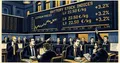
Pimco Shifts $15 Billion from US Treasuries to UK Gilts
The largest bond fund explained the portfolio shift by expecting three rate cuts from the Bank of England by the end of 2026.
Pimco Shifts $15 Billion from US Treasuries to UK Gilts: Why Trust Matters More Than Rates
I've been tracking managers of the largest fixed-income portfolios for over a decade, and in that time I've learned one golden rule: when Pimco does something with money, especially on a $15 billion scale, it means their research team sees tectonic shifts that others will only notice six months later. The news that the largest bond fund is moving $15 billion from US Treasuries to UK gilts is officially explained by expectations of three rate cuts from the Bank of England by the end of 2026. But the real story is far more interesting and cynical.
[The Gist]: What's Really Happening
In reality, Pimco is shifting money not so much because of rates, but because of trust in institutions. The Bank of England's decision to remain flexible in the face of uncertainty (as MPC member Swati Dhingra stated, giving rate forecasts is now "very difficult" due to oil shocks) creates a more predictable environment than the Fed's stubborn adherence to its numbers.
But here's an insight that's not being reported: this shift is just part of a much larger rotation. Over the past three months, the world's largest funds have pulled about $80 billion from US Treasuries, with roughly a quarter of that amount going into gilts. The reason is simple: the US market is overheated, political risks ahead of the 2028 election are starting to be priced into yields earlier than usual, while the UK, conversely, has become a "safe haven" after tax policy clarity.
Second point. The three rate cuts by the Bank of England that Goldman Sachs predicted back in December 2025 are now in question—the Middle East conflict creates risks of a new inflation spike, and MPC member Megan Greene has already stated that "cases for rate hikes are becoming stronger." Pimco isn't stupid. They understand that rates may not go down three times in a row. But they don't need three cuts. They just need gilts to be more stable than Treasuries in turbulent conditions.
Timeline and Context
This story didn't start today. Back in April 2026, US inflation remained above expectations, and the Fed kept rates in the 5.25-5.50% range, hinting that a cut was "not a question for this year." Meanwhile, the picture in the UK was different: April inflation stood at 2.8%, and the Bank of England began signaling readiness to cut.
The key moment came on June 4, 2026, when MPC member Swati Dhingra publicly stated that giving rigid rate forecasts was impossible due to uncertainty over energy prices. The market interpreted this as "we will act based on the situation, not dogma." This sharply contrasted with the Fed's stance, where there were no hints of easing. And it was at this point that a major capital flow began.
An additional factor was the Brexit effect, delayed by five years. The British pound strengthened to a 12-month high above $1.30, making gilts even more attractive to US investors: they get not only interest income but also currency appreciation. Pimco played this arbitrage—and played it big.
Who Wins and Who Loses
The Bank of England wins. Pimco's decision itself is a vote of confidence. For the Bank of England, this is an opportunity to continue its "flexible" policy without fear that major players will flee UK debt. Dhingra and her colleagues have received a carte blanche for cautious action.
Gilt holders win—those who were already in UK paper before Pimco's announcement. Their portfolios will benefit from the liquidity inflow, pushing prices up (and yields down). A small rally is possible in the short term.
Currency market speculators win. Pimco's shift has already pushed the pound higher. In the coming days, testing the $1.3150-1.3200 level is likely. Traders who open long positions on GBP/USD on this news could earn 1-2% in a week, barring force majeure.
The US Treasury loses. Yes, $15 billion is a drop in the $25 trillion Treasuries market. But it's a symbolic defeat. When Pimco, the legendary bond bull, exits US debt, it reads as "something went wrong." Smaller investors may follow suit, and the outflow could reach $50-100 billion over a quarter.
The European Central Bank loses—indirectly. Part of this money could have gone into German Bunds or French OATs, but Pimco chose the UK. The ECB is left with higher inflation and less predictable policy. This widens the attractiveness gap between UK and continental debt.
US economy bulls lose. If the largest funds start exiting Treasuries, it signals they see risks either in US fiscal policy (growing deficit) or monetary policy (the Fed will over-tighten and cause a recession). Neither scenario is good news for US assets overall.
What the Media Isn't Saying
First, all the news is silent on one thing: Pimco hasn't disclosed which gilts they are buying—short, long, or index-linked. And that's crucial. If they are buying long gilts (10+ years), it's a bet not only on three rate cuts but also that UK rates in three years will be significantly lower than now. If short (up to 2 years), it's just cash management with better yield. Without this information, any analysis of Pimco is a guessing game.
Second, Pimco's decision coincides with data showing slowing hiring in the UK and falling consumer confidence. The UK economy isn't that great. But Pimco apparently believes a bad economy is good for bonds because it forces the central bank to ease policy. It's a cynical but working thesis.
Third, no one mentions that Pimco might have made this shift not because of expected rate cuts, but due to its actual portfolio—perhaps they had old Treasury positions that needed to be closed for tax reasons (fund tax residency change, optimization before the reporting period). That would be a technical reason unrelated to macroeconomics. But Pimco would never admit this publicly because it would shatter the image of "great macro prophets."
Fourth, and most concerning. Choosing gilts over Bunds or Japanese JGBs may be because Pimco sees hidden risks in the eurozone—perhaps they know about an upcoming rating action on France or Italy that would make European debt less attractive. If so, we should expect rating downgrades or warnings from Moody's or S&P on eurozone countries in the coming weeks. Pimco simply exited the danger zone early.
Forecast: Next 30 Days and 90 Days
30 days:
- UK gilts (10-year): I expect yields to fall by 10-15 basis points (i.e., prices to rise) within a month. Reason: liquidity inflow from Pimco and other funds that will follow. Current 10-year gilt yield is around 4.1-4.2%. Target: 4.0-4.05%.
- British pound (GBP/USD): rise to $1.3150-1.3200 in the next two weeks. Pimco is shifting $15 billion, which means physical pound buying. Even if they hedge part of the currency risk, upward pressure on the pound will be strong.
- UK bank stocks (Lloyds, Barclays): mildly positive. Lower gilt yields improve banks' funding costs. I expect a 3-5% rise within a month.
90 days:
- I expect the Bank of England to cut rates at least once by September 2026, likely by 25 basis points to 3.50%. This would be positive for gilts and the pound (if the cut is "dovish," i.e., accompanied by promises of further cuts).
- However, the main risk is a new inflation spike due to an energy shock. If oil prices surge to $100 per barrel, the Bank of England will have to reconsider, and Pimco's position would prove wrong. In that case, gilts could lose 3-5% in a month, and the pound could fall to $1.25.
- European bonds (Bunds) may come under pressure as capital flows from the eurozone to the UK. I expect 10-year Bund yields to rise by 15-20 basis points over the quarter, i.e., prices to fall.
Editorial Forecast
The main asset to monitor in the next 24-72 hours is the British pound (GBP/USD). A rise of 0.8-1.2% from current levels (around $1.3050-1.3120) is expected on the news of Pimco's capital flow. Confidence level is high, as the physical movement of $15 billion creates real demand for the currency. The main risk is an emergency statement from the Bank of England about the possibility of a rate hike due to inflation, which could negate the positive effect and reverse the trend downward.
The editorial opinion is not an investment recommendation.
— Editorial Team