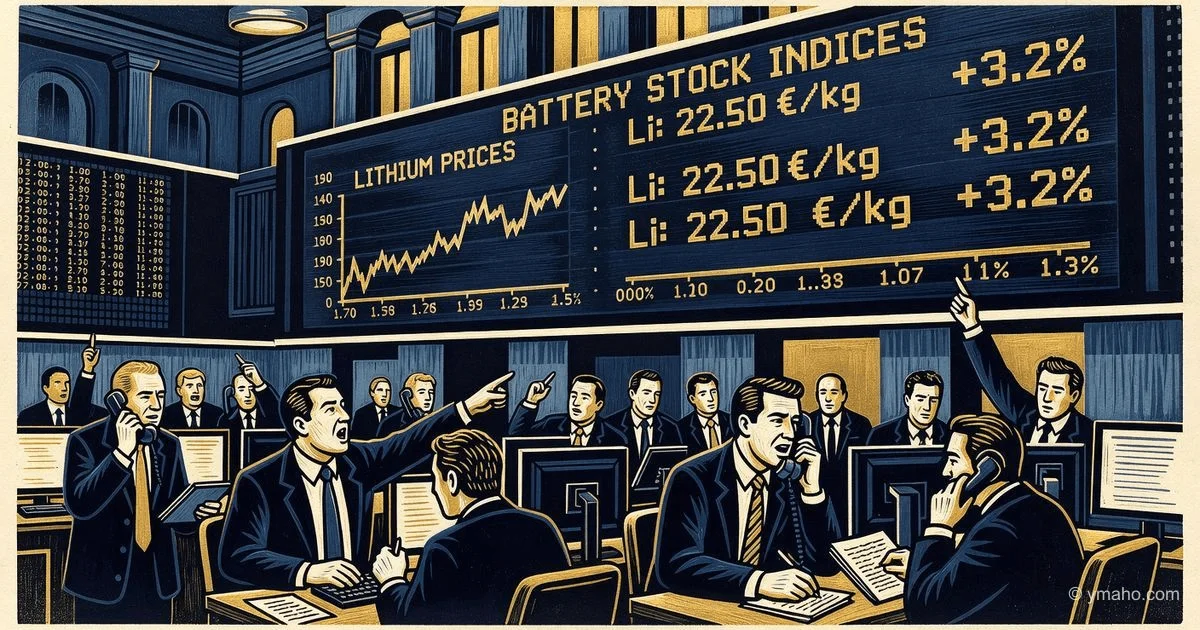
Euronext Launches Futures on European Battery Company Index
The new derivative includes Northvolt, LG Energy Solution, and Tesla Berlin, allowing hedging of risks in the electric vehicle battery market.
Euronext Battery Index Futures: Hedge Against a Bubble or a Tool for Decline?
I have been analyzing energy and technology markets since 2012, having witnessed the rise and fall of dozens of "green" initiatives. The news that Euronext is launching futures on an index of European battery companies, including Northvolt, LG Energy Solution, and Tesla Berlin, looks like another step toward the industry's "maturation." The official goal is risk hedging, and that's true. But there is an insight that most market participants overlook, and I will reveal it right here.
[The Gist]: What's Really Happening
In reality, the emergence of these futures is not so much a tool for hedgers as a signal that major market makers are preparing for high volatility and a possible sector decline. Including Northvolt in the index is a huge red flag. The company is bankrupt. Its assets were recently bought by American startup Lyten, and although the new owner plans to resume production, Northvolt as a legal entity no longer exists. How can you build an index on shares of a company that doesn't exist?
There are two explanations, both alarming. First: Euronext uses an expanded index that includes not only issuers but also Northvolt's debt obligations, trading as junk bonds. Second, more likely: these are forward contracts for the delivery of shares of companies that may go public in the future. Neither is standard practice for exchange indices.
Timeline and Context
The history of Europe's battery sector is dramatic. Just two years ago, Northvolt was considered "Europe's hope" and planned to build factories across the continent, having received billions of euros in investments. But accumulated debt of €5.8 billion and operational problems led to its collapse. The company attempted to produce complex NMC 811 cathode materials, which proved "unmanageable" even for experienced engineers.
Now the dust from Northvolt's bankruptcy is gradually settling, and a new configuration is forming in the market. The European Union, realizing its critical dependence on China (where CATL and BYD hold half the global market), is implementing strict localization quotas. LG Energy Solution, Samsung SDI, and SK On are shifting their plants from EV lines to energy storage systems (ESS), as demand for EVs in the US has slowed.
It is at this moment of uncertainty that Euronext is launching the futures. This is an attempt to create a new liquidity anchor while the old anchors—automakers buying batteries under long-term contracts—are starting to stall.
Who Wins and Who Loses
Winners: energy traders and hedge funds. Finally, there is a civilized way to play the spread between lithium prices (raw material) and battery maker stocks (margin). Previously, this was only possible through complex stock baskets. Now the futures contract simplifies entry into positions, allowing shorting of the sector without borrowing shares.
Winner: LG Energy Solution. The Korean giant, despite operational losses in recent quarters, is actively ramping up ESS production in the US to 50 GWh. Inclusion in the index boosts brand recognition and attracts passive investments. LG clearly benefits from the "China allergy" in the US and Europe.
Winner: Tesla Berlin. Expanding 4680 cell production capacity from 8 to 18 GWh and investing $250 million makes the German gigafactory a key player. The futures index captures the market value of this asset.
Losers: retail investors who don't understand the index structure. If the index indeed includes derivatives on bankrupt Northvolt, volatility could be pathological. News that Lyten will start battery deliveries in 2026 creates an illusion that "everything is fine," although the legal risks from Northvolt's old debts remain.
Losers: LG Chem and Korean cathode material suppliers. Futures will make the market more transparent, eliminating the information asymmetry that allowed selling expensive EV components. Competition will pressure margins.
What the Media Isn't Saying
First and most important. No one is talking about the "dead index." If Euronext included Northvolt, it means the index mainly features US manufacturers (via ADRs) or settlements on future IPOs of Chinese giants. This is not a purely "European" index. It is a global speculative instrument on the theme of nickel and cobalt shortages.
Second. From a macroeconomic perspective, the launch of futures confirms the thesis of a commodity shortage. Lithium prices have risen 50% since the start of the year. Analysts at Global X warn: if mining investments don't accelerate, we face a structural lithium deficit by the end of the decade. Battery index futures are essentially lithium futures, just packaged differently.
Third. The major banks involved in the placement are likely preparing a short squeeze. The mechanics: the index will rise at the start due to hype and hedging, then market makers will open short positions, and when everyone calms down, a gradual decline will begin. If you are not hedging a real stock portfolio but simply speculating, you risk buying at the peak.
Forecast: Next 30 Days and 90 Days
30 days:
- The index itself (tentatively EUBAT) — I expect heightened volatility with a range of 10-12% over the month. First days: growth on news and liquidity inflow (self-fulfilling prophecy). Then a correction when traders realize that Northvolt in the index is a "zombie asset."
- LG Energy Solution stock — bullish trend. The index gives them additional demand. Target: 5-7% rise from current levels.
- Commodity metals — nickel and lithium may get an additional boost as the index indirectly capitalizes demand for them.
90 days:
- I expect open interest in these futures to reach $1-2 billion within the quarter. That's enough for Euronext to launch additional instruments, possibly options on this index.
- European manufacturers of electrolyzer and battery equipment (e.g., Siemens Energy) may conduct SPOs, using the hype around the index as a marketing opportunity.
- Main risk: if it turns out that companies included in the index (e.g., Northvolt) cannot provide transparent reporting, Euronext will be forced to revise the index composition, causing a sharp revaluation.
Editorial Forecast
The main asset in the next 24-72 hours is the Euronext Battery index futures themselves (ticker, presumably ELITH or similar). A sideways trend with a slight increase of +0.5-1.5% is expected in the first days of listing due to mechanical demand from algorithms and ETFs tracking the new index. Confidence level is low, as the liquidity of the new instrument is unpredictable, and the index structure (especially the presence of Northvolt) raises questions among institutional investors. The main risk is a technical failure of the Euronext platform in the first hours of trading, creating chaos and deferred demand.
The editorial opinion is not an investment recommendation.
— Editorial Team