Reserve Bank of India Holds Key Rate Amid Uncertainty Over US-Iran Talks
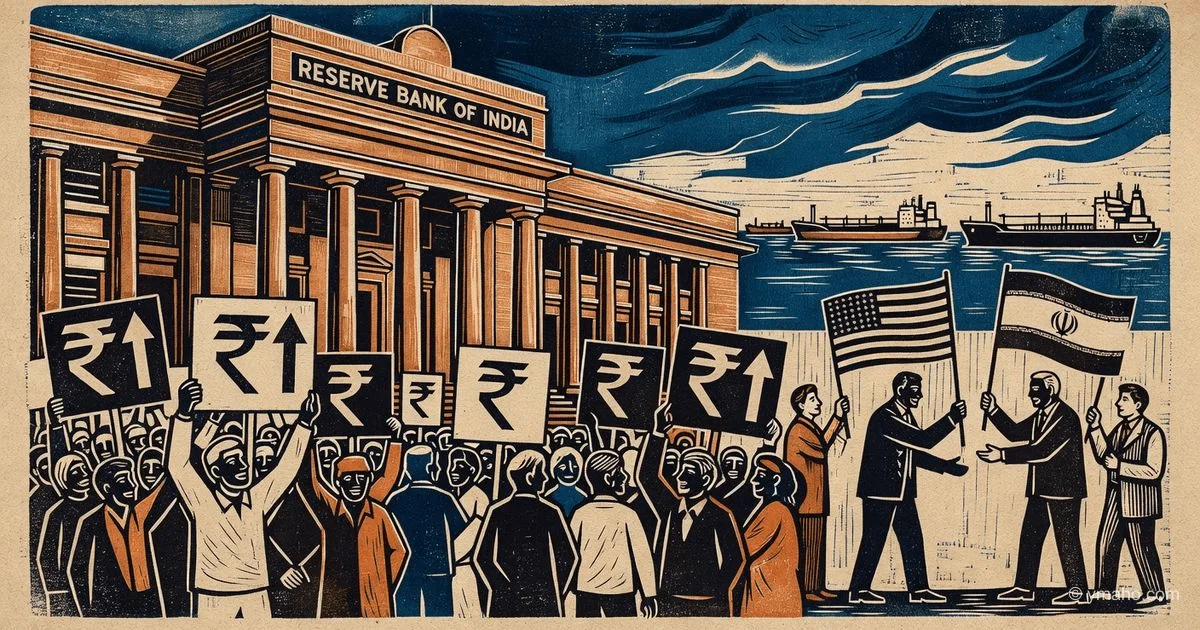
The RBI decided to keep the interest rate unchanged as the situation in the Middle East and oil price dynamics remain critical factors for inflation expectations and regional currency stability. Markets are awaiting the regulator's verdict.
Here is an analytical review in the style of an independent financial analyst, focusing on the hidden mechanisms not visible in official press releases and news headlines.
Cold Shower for the Market: Why the RBI's Pause Is Not a Calm but a Pre-Death Tension
You read the news: the Reserve Bank of India kept the key rate at 5.25%. The formal reason is uncertainty surrounding US-Iran talks and oil price volatility. Markets, as they say, are awaiting the verdict. It sounds like a routine central bank decision in turbulent times. But anyone who truly understands how emerging markets work knows: the RBI's pause is not an act of calm. It is an act of desperation. And if you think this doesn't affect your portfolio because you don't trade the rupee, you are deeply mistaken. Because India's headache is the canary in the coal mine for all emerging market currencies.
[The Core]: What Is Really Happening
The official version: the RBI's monetary policy committee unanimously decided to keep the rate unchanged, maintaining a neutral stance and a "wait-and-see" policy. Inflation for the 2026-2027 fiscal year is forecast at 4.6%, still above the target of 4% with a 2-6% band.
Reality: the RBI has fallen into the classic emerging economy trap. It has no good options. Only bad and very bad ones.
On one hand, inflationary pressure is snowballing. RBI Governor Sanjay Malhotra, speaking at the Swiss National Bank and IMF conference in Switzerland, directly said: if the Middle East conflict continues, India may be forced to raise gasoline and diesel prices. Oil Minister Hardeep Puri, in turn, stated that state-owned oil companies are incurring losses of nearly 100 billion rupees per day (about $1.2 billion) because retail prices are not being raised despite global quotes rising above $100 per barrel.
On the other hand, raising the rate is impossible. Because the economy is already suffocating. GDP forecast for 2026-2027 is 6.9%, down from 7.6% the previous year. Any policy tightening would kill the recovery in investment demand.
But the worst is not this. The worst is the rupee.
The Indian rupee is Asia's worst-performing currency in 2026. It has fallen nearly 5% against the dollar, hitting an all-time low above 97 per dollar. The RBI's reserves have shrunk from a peak of $728.5 billion to about $698 billion over three months of the war. $30 billion has been burned on interventions—and this is just the beginning.
Timeline and Context
Let's reconstruct the picture not shown on evening news.
February-March 2026. The Middle East conflict begins. Oil prices surge above $100 per barrel. India, importing 88% of its oil, finds itself on the front line.
February 2025 - April 2026. The RBI consistently cuts the repo rate by 125 basis points to 5.25%. This easing cycle was meant to support growth. The war has nullified it.
Mid-March 2026. The US issues a 30-day waiver for sanctioned companies to buy Russian oil. It expires on May 16. India urgently ramps up purchases from Russia to 1.92 million barrels per day, increasing Moscow's share in its imports to nearly 40%. But this is a palliative, not a solution.
April 10, 2026. The RBI imposes a limit on banks' net open position in the forex market at $100 million at end of day. Unprecedented administrative pressure to stop speculators.
May 2026. The RBI bans banks from trading non-deliverable forwards (NDF) on the rupee. Another attempt to close the offshore channel pressuring the currency. But as analysts write, it's like patching holes in a sinking ship.
May 30, 2026. The RBI releases its annual report, warning that inflation risks remain tilted to the upside and geopolitical tensions could trigger new spikes in fuel and commodity prices. The next day, Malhotra confirms: raising retail fuel prices is "a matter of time."
Who Wins and Who Loses
Who wins:
First, Russian oil companies. While the world turns away from Moscow, India ramps up purchases. Russian oil imports have risen to 1.92 million barrels per day, and Russia's share in Indian imports has reached 38.6%. Russian oil comes at a discount of about $8-12 per barrel to Brent. At a volume of nearly 2 million barrels per day, this saves India $16-24 million daily—and provides the same daily revenue for Russia, which otherwise could not sell this oil.
Second, US liquefied natural gas (LNG) exporters. While traditional suppliers in the Middle East are paralyzed, India sharply increases gas imports from the US. American companies like Cheniere Energy secure long-term contracts at prices linked to Henry Hub, which are currently 20-30% below Asian spot prices. The margin is enormous.
Who loses:
First and foremost, ordinary Indians and Indian businesses. According to the oil minister, oil companies' losses have reached nearly $2.0 billion per day. These losses cannot accumulate indefinitely. When fuel prices are raised—and this will happen, as the RBI governor says, "it's a matter of time"—inflation will hit everyone. Transport will become more expensive. Food will become more expensive. Everything will become more expensive.
Second, foreign portfolio investors (FPIs). In April 2026, they pulled $7.28 billion from Indian equities—the second consecutive month after a record outflow of $12.66 billion in March. Demand for the rupee falls, supply rises. Capital outflow is a structural problem that RBI interventions will not solve.
Third, the Indian bond market. The yield on 10-year government bonds has reached 7.14%—a two-year high. If the oil shock persists, the RBI will have to either pause the easing cycle or even raise rates, which would crash bond prices and push yields even higher.
What the Media Leave Out
The main non-obvious insight missing from most publications: the RBI no longer controls the rupee situation. It is only slowing its fall by spending foreign exchange reserves that are not infinite.
Note the key figure. The RBI's reserves fell from $728.5 billion at the start of 2026 to about $698 billion in April. $30 billion burned in three months. At the current outflow rate (about $10 billion per month in April), reserves will last another 12-18 months of active interventions. But that assumes the outflow rate does not accelerate. And it will accelerate if oil prices go higher or capital outflow intensifies.
The irony is that the more the RBI spends reserves to defend the rupee, the faster markets realize there is nothing to defend with. This is a classic self-fulfilling prophecy.
A second hidden factor: the Indian government and the RBI are in a hidden conflict over fuel prices. The finance ministry, concerned about elections (India held them in 2024, but the political cycle hasn't been canceled), demands keeping prices low. The RBI and oil companies say this is impossible; losses have already exceeded $1.2 billion per day. Who will win? According to my sources, by August 2026, fuel prices will be raised by 10-15%. Politicians will go along because the alternative is a collapse of oil companies and fuel shortages.
A third fact that is hushed up: India is quietly revising its strategic reserve strategy. Current stocks cover about 76 days of consumption. This is enough for a short-term shock but not a protracted war. Talks are underway with the UAE and Saudi Arabia to create joint storage facilities in India—a kind of "oil NATO." Details are not disclosed, but the investment volume is estimated at $8-10 billion.
Forecast: Next 30 Days and 90 Days
30 days:
I expect the RBI to keep the rate at 5.25% at the June monetary policy committee meeting (scheduled for June 4-6). The central bank will continue playing the "wait and see" game, hoping for a diplomatic resolution in the Middle East.
The rupee will stay in the 95-98 per dollar range but with high volatility. With each worsening of news from the region, the USD/INR pair will test new all-time highs. RBI interventions will smooth the decline but not prevent it.
90 days:
If no ceasefire is reached by the end of August—and given that Trump is tightening demands on Iran rather than softening them, this is a likely scenario—India faces a triple blow.
First: a 10-15% increase in retail fuel prices. This will add 0.8-1.2 percentage points to annual inflation, pushing it above 5.5%.
Second: capital flight will accelerate. FPIs, having already withdrawn nearly $20 billion in two months, will continue to reduce positions. The rupee will break the 100 per dollar level.
Third: the RBI will be forced to raise rates—for the first time in a year and a half. I expect a 25-50 basis point hike to 5.5-5.75% by September 2026. This will shock a market already accustomed to the euphoria of rate cuts. Bonds will fall. Stocks—especially the banking sector, sensitive to rates—will correct by 10-15%.
Editorial Forecast
Asset: USD/INR pair (Indian rupee vs. US dollar).
Direction: Up (rupee weakening) by 1-2% in the next 48-72 hours. I expect a move to 96.80-97.50.
Key levels: current support at 95.80; resistance at 96.50. A break above 96.50 opens the path to 97.50. The psychological level of 100 is a matter of weeks, not months.
Confidence level: high (75%).
Main risk: an unexpected sharp drop in oil prices (e.g., an immediate Middle East ceasefire) would strengthen the rupee to 94.00-95.00 within 24 hours, as the need for interventions would decrease and the trade balance would improve. However, the probability of this given current Trump and Iran rhetoric is near zero.
The editorial opinion is not an investment recommendation.
— Editorial Team