SpaceX Surpasses Amazon in Market Cap, Triggering Tech Stock Sell-Off
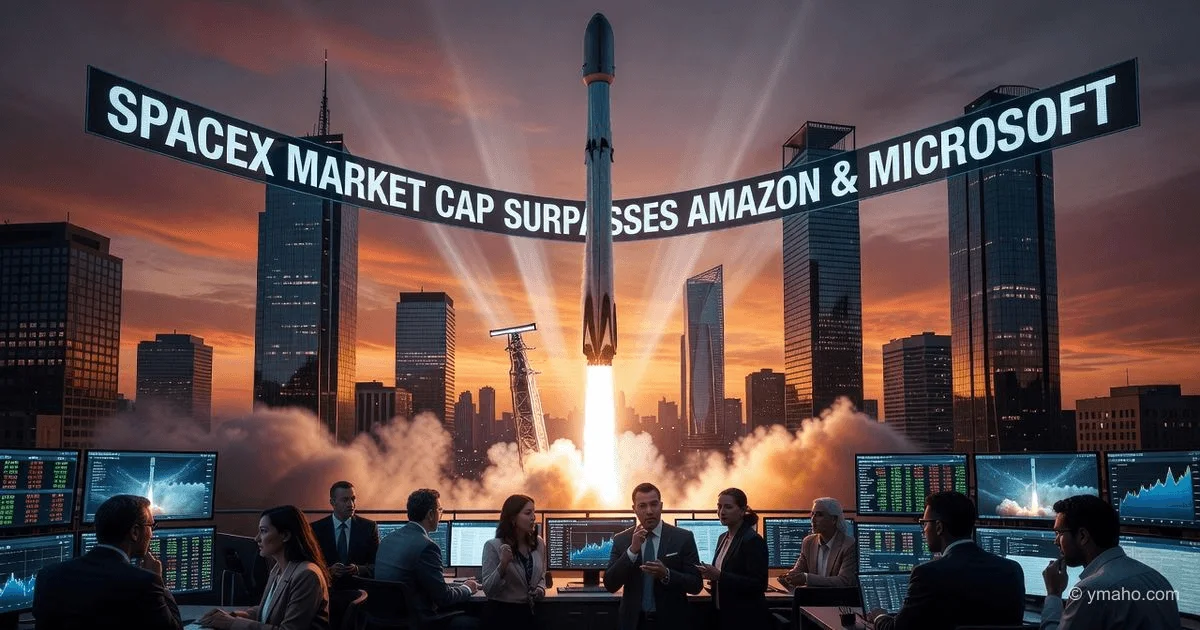
SpaceX shares rose 4.77% to $201.68, pushing its market cap past Amazon and Microsoft. This triggered a capital shift out of Nvidia and other semiconductor stocks, dragging the Nasdaq down 1.15%.
Analytical Breakdown: SpaceX — Trillion-Dollar Dissonance. Why the Market Is Rewriting the Laws of Gravity
Author's Analytical Review
The Core: What's Really Happening
SpaceX debuted on the Nasdaq on June 12, 2026, with a valuation of $1.77 trillion and a share price of $135. After three trading days, its market cap reached $2.65 trillion, and the stock closed at $201.68. The company surpassed Amazon ($2.64 trillion) and even briefly overtook Microsoft during intraday peaks ($225.64).
But this is just the tip of the iceberg. SpaceX shares had been trading over-the-counter for several years, with private investors paying up to $160–180 per share on secondary markets. The public offering at $135 looked like a discount, sparking a wave of aggressive buying.
The mechanics of this rally are largely self-reinforcing. On Tuesday, options contracts on SpaceX began trading on the CBOE and Nasdaq. When traders mass-buy calls (bets on price increases), market makers must hedge risks by purchasing actual shares. This "gamma squeeze" effect creates demand for the stock, pushing the price higher — and the higher the price, the more market makers are forced to buy to maintain portfolio neutrality. Over 1.6 million options contracts were traded in a single day.
Meanwhile, the semiconductor sector experienced a mirror image. The Nasdaq 100 lost about 2% due to capital flowing out of chips and into the space-AI narrative. The Philadelphia Semiconductor Index plunged 5.7%.
Timeline and Context
The key question: Why does the market value SpaceX higher than Amazon when SpaceX posts a $4.3 billion quarterly loss versus Amazon's $30.3 billion profit?
| Date | Event | Market Cap / Quote |
|---|---|---|
| 12.06.2026 | SpaceX IPO on Nasdaq: price $135, valuation $1.77 trillion, raised $75 billion (record in history) | $1.77 trillion |
| 13.06.2026 | Second trading day: +19.6% in one day, adding $412 billion in a single session | ~$2.1 trillion |
| 16.06.2026 (intraday) | Day peak: shares hit $225.64, briefly overtaking Microsoft | $2.94 trillion |
| 16.06.2026 (close) | Price $201.68 (+4.77% for the day), surpassing Amazon at market close | $2.65 trillion |
| 16.06.2026 | Simultaneously: Nasdaq -1.15%, S&P 500 -0.57%, Dow +0.64% (all-time high) | — |
| 16.06.2026 | Philadelphia Semiconductor Index -5.7%, Intel -8%, AMD -7%, Micron -6% | — |
Scale of funds raised at IPO: $75 billion through the primary offering plus an additional $10.7 billion via the greenshoe option — totaling $85.7 billion. For comparison, Saudi Aramco raised $29.4 billion in 2019.
Who Wins and Who Loses
Winners:
Elon Musk and early investors. Musk's net worth after the IPO surpassed $1 trillion — making him the first "trillionaire" in history. At the time of the IPO, the company's free float was only 4.2% of shares, meaning the vast majority of capital remains with insiders, and paper profits are enormous.
Venture capital funds that entered in pre-IPO rounds. Funds that bought SpaceX shares at $40–80 in later rounds have seen 3–5x returns over a few years. They can now exit positions through lock-up periods.
Tech ETFs with a high weighting in SpaceX. Indices and ETFs that include SpaceX after the IPO are forced to buy more shares, creating additional demand. SpaceX almost instantly became one of the five largest companies in the world by market cap.
Losers:
Buyers at the intraday peak. Those who entered at $225 during the session are already sitting on a ~10% loss. High volatility with a small number of shares in circulation makes such moves extremely painful for retail investors.
Semiconductor companies and their shareholders. Intel -8%, AMD -7%, Micron -6%, Broadcom -4.4% — this is a systemic capital shift, not a coincidence. Hedge funds holding long positions in chips massively took profits and rotated into the "new narrative." The question: if SpaceX, with losses, is valued at $2.65 trillion, while Intel (with net profit of $10+ billion per year) loses 8% in a day — what is this if not a structural revaluation of sectors?
Buyers of "safe-haven" assets (bonds, gold). The flow into SpaceX shares means liquidity is being drained from conservative instruments into speculative ones — a sign of a late-cycle phase.
What the Media Isn't Saying
Insight One: "Multiples Don't Matter" — But Only Until the First Earnings Report.
SpaceX trades at a P/S (market cap to revenue) ratio of about 142x, with revenue of $18.7 billion in 2025 and losses of $4.9 billion. Amazon's P/S is ~3.7x. Morningstar estimates SpaceX's fair value at $63 per share — nearly 70% below current levels.
What are investors pricing in? According to Morningstar analyst Nicolas Owens, the market assumes SpaceX will capture about 21% of the entire space-based data center market, a scenario he considers only 7% probable. This means the current price is a bet not on the business, but on a "moonshot."
But the problem isn't just that the valuation is high. The problem is that the company has only 4.2% of shares in free float. This creates an illusion of scarcity. When lock-up periods begin to expire (typically 90–180 days after the IPO), insiders will be allowed to sell their stakes. Even a small sell-off — 5–10% of total shares — could crash the price by 30–40%, given the extremely low liquidity in the market.
Insight Two: Options as a Rally Accelerator — and a Crash Trigger.
The start of options trading on SpaceX on Tuesday was a key factor in the intraday move to $225 and the subsequent pullback. The gamma hedging mechanics fueled the rise, but they will work in reverse during a decline: market makers will be forced to sell shares, exacerbating the crash.
The SpaceX options market is now a separate asset class. The trading volume of 1.6 million contracts on the first day indicates that institutional players are already using SPCX as a tool for volatility bets, not long-term value.
Insight Three: The $60 Billion Cursor Acquisition — A Deal That Changes Valuation Logic.
SpaceX announced the purchase of AI product developer Anysphere (the company behind Cursor) for $60 billion. This means SpaceX is becoming not just a "space" company but a "space-AI" company. The market values it as a hybrid: Tesla (autonomy) + Nvidia (chips) + Amazon AWS (cloud data centers), but in space.
This is both a justification for the high valuation and its vulnerability. The deal has not yet closed, and if it fails antitrust reviews or integration issues arise, the market will quickly reassess expectations.
Forecast: Next 30 Days and 90 Days
30 Days (mid-July 2026):
The coming weeks will be driven by options market dynamics. If call volume remains high, it could push shares to new highs — possibly testing $240–250. However, pressure from insiders looking to lock in profits ahead of lock-up expirations will increase.
Key levels to watch:
- Support: $185–190 (psychological level from which the rally started)
- Resistance: $225–230 (Tuesday's highs)
- Indicator: Options trading volume — if it starts to decline, the gamma hedging effect will weaken, and a correction could be swift.
Meanwhile, the semiconductor sector will try to recover. If the Nasdaq continues to fall, it could create a "domino effect" for the entire tech basket, including SpaceX.
90 Days (September–October 2026):
By this time, lock-up periods for some insiders will begin to expire. If, simultaneously, SpaceX fails to deliver convincing operational results (revenue growth, loss reduction, progress on the Cursor deal), a 20–30% correction is highly likely.
The hawkish Fed signal that coincided with the SpaceX IPO adds to the backdrop: high rates mean expensive capital, and SpaceX is a company with negative free cash flow of over $300 billion over the last four quarters. This makes it vulnerable to rising borrowing costs, even if it doesn't take on new debt directly — through the discounting effect on future earnings.
The most likely scenario: volatility in the $160–240 range, with a gradual downward drift toward the end of the 90-day horizon, unless a new positive shock occurs (e.g., signing a major space data center contract).
Editorial Forecast
Asset: SpaceX shares (SPCX). Direction: Downward correction within the next 24–72 hours after the intraday peak of $225 and close at $201.68. Expect a move to $185–190 if options buying volume declines. Confidence Level: Medium. Main Risk: Continued aggressive call buying could trigger another gamma squeeze upward, returning shares to $210–215. This opinion is analytical and does not constitute investment advice.
— Editorial Team