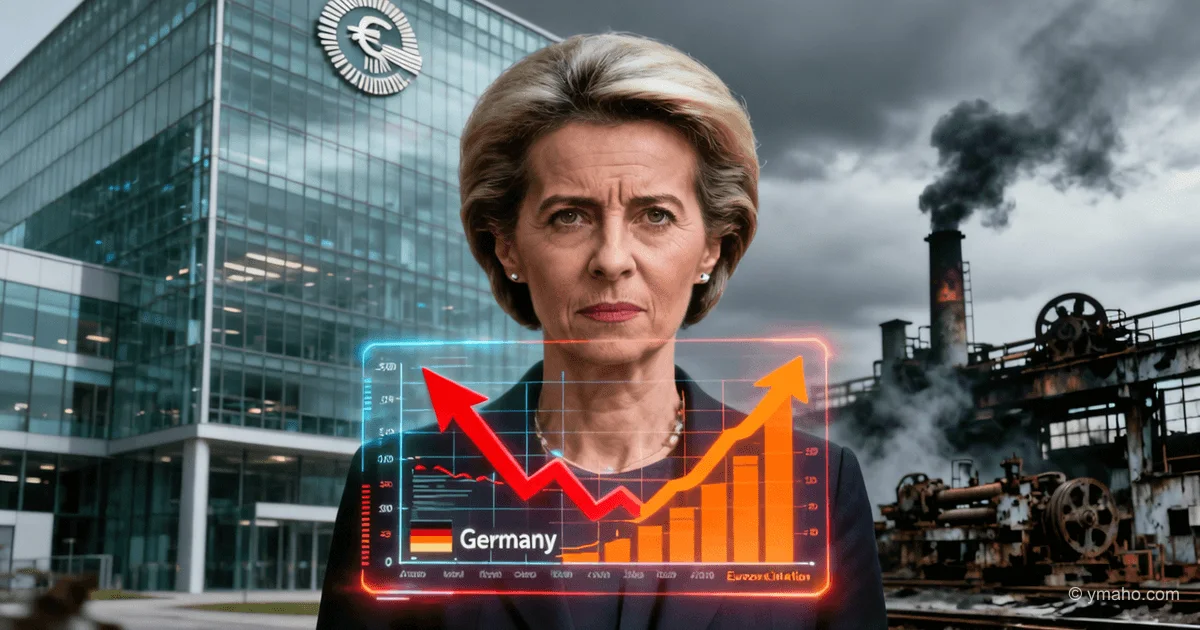
ECB's Lagarde Warns of Stagflation Risks in the Eurozone
Christine Lagarde called for a cautious approach to monetary policy amid a spike in inflation to 3% and a decline in industrial production in Germany, describing the situation as "enormous uncertainty."
Lagarde vs. Reality: Why the ECB Denies the Stagflation It Is Already Preparing For
The Core: What Is Really Happening
This is a classic case of verbal intervention: Christine Lagarde publicly rejects the term "stagflation" precisely because the eurozone economy is dangerously close to it. She called the word a "catchy term from the 1970s" and stated that the current situation has nothing in common with it. But if you look at the numbers, not the rhetoric, the picture is alarming: inflation in April jumped to 3% from 2.6% in March, energy prices soared by 10.9%, German industrial production is falling, and the European Commission warned back in March of the risk of a "stagflationary shock" with a loss of 0.4-0.6 percentage points of GDP.
In fact, the ECB is trapped: the inflation spike calls for a rate hike, while the faltering economy calls for a cut. Lagarde is trying to buy time until the June meeting—when, by her own words, the Governing Council will have enough data for the "right decision." The problem is that by June, the data could be even worse.
Timeline and Context
Warning signs have been accumulating since the start of the year. On March 27, European Commission member Valdis Dombrovskis officially stated: "We risk facing a stagflationary shock—a situation where slowing growth coincides with rising inflation." At the same time, the EC estimated that under an adverse scenario, EU GDP growth in 2026 could be only 0.8-1.0% instead of the forecast 1.4%.
On April 29, Eurostat published April inflation data—and it was worse than the consensus forecast of 2.9%. Price growth accelerated to 3.0%, driven primarily by energy: +10.9% after +5.1% in March. This is a direct consequence of the Middle East conflict and the blockade of the Strait of Hormuz—Brent crude remains above $100 per barrel.
On April 30, at a press conference after the ECB meeting, Lagarde took a defensive stance. The rate was left unchanged unanimously, but she admitted that the debate was "deep" and that some Governing Council members had considered tightening policy as early as April. The ECB officially maintained its March GDP growth forecast of 0.9% for 2026, but Lagarde simultaneously described an alternative scenario: with oil around $120 per barrel, growth would be only 0.6%.
On May 7, German Chancellor Friedrich Merz delivered a keynote speech in Hamburg, acknowledging: "In economic and technological terms, Germany has lost ground—partly due to missed reforms, partly due to gross miscalculations of the past." He noted that the German economy has not grown since 2019, industrial production is falling, and private investment is stagnating.
Who Wins and Who Loses
The ECB as an institution—loses. Lagarde is forced to navigate between rising inflation and a faltering economy, and the room for maneuver narrows with each passing week. The unanimous decision to keep rates unchanged is not a consensus but an admission that the Governing Council currently has no action plan. Meanwhile, the market is pricing in a 100% probability of a 50-basis-point rate cut in the coming months—directly contradicting the ECB's signals of readiness to tighten.
Germany—the main victim. Chancellor Merz acknowledged what his predecessors remained silent about: the country is losing competitiveness due to high energy prices, excessive bureaucracy, and the tax burden. Germany, whose economy is tied to industrial exports, suffers more from rising raw material prices than other eurozone countries. Each additional dollar in the price of a barrel of oil costs German industry roughly $300 million in extra costs per month.
Southern eurozone countries—unexpected beneficiaries. Bulgaria (6.2% inflation), Croatia (5.4%), Luxembourg (5.2%), Lithuania (4.9%), and Greece (4.6%) formally lead in inflation, but their economies are less dependent on energy-intensive industry. For the tourism sector in Greece or Spain, a weak euro and an influx of tourists choosing cheaper destinations partially offset inflationary pressure.
Holders of European bonds—at risk. If the ECB raises rates to fight inflation, yields on sovereign bonds of Italy, Spain, and Greece will soar, reviving the specter of the 2011-2012 debt crisis. If the ECB cuts rates to support growth, inflation will run away, eroding the savings of European households.
What the Media Is Not Saying
Insight one: Lagarde denies stagflation, but the ECB is already using a stagflation scenario.
The ECB's alternative scenario—GDP growth of 0.6% with oil at $120 per barrel—is de facto stagflation, even if Lagarde avoids the term. With Brent currently around $106, oil is already close to that threshold, and further escalation in the Persian Gulf could easily push prices higher. The ECB is modeling a situation it publicly denies.
Insight two: The rift in the Governing Council is deeper than admitted.
Lagarde called the rate decision "unanimous" but added: "after deep debates." According to sources close to the Council, at least three members—from Germany, Austria, and the Netherlands—insisted on an immediate 25-basis-point rate hike. Lagarde managed to maintain consensus, but at the cost of a promise to revisit the stance in June. If by then inflation exceeds 3.2-3.3%, the hawks in the Council will gain a numerical advantage.
Insight three: The ECB's pause benefits European governments, not the economy.
Maintaining a low rate with 3% inflation means negative real debt yields. For eurozone governments, especially those with high debt burdens like Italy (debt over 140% of GDP), this is a hidden subsidy. Each month of keeping rates unchanged saves the Italian budget about $600 million in debt servicing compared to a rate hike scenario. De facto, the ECB is sacrificing the fight against inflation for fiscal stability—but it cannot say so openly.
Insight four: Germany underestimates the scale of the crisis.
Merz called the situation a "loss of ground," but reality is harsher. German industry is undergoing a structural shift, not a cyclical downturn. Chemical giant BASF is already cutting production at its Ludwigshafen plant, the auto industry is losing market share in China, and energy-intensive production is being scaled back or moved to the US, where gas prices are 4-5 times lower. With inflation at 2.9% in Germany, real household incomes are falling, and the savings rate is rising, further depressing domestic demand.
Forecast: Next 30 Days and 90 Days
Next 30 days (until June 9):
The key date is May 20, when final April inflation data will be released. If core inflation (currently 2.2%) is unexpectedly revised upward, the market will start pricing in a rate hike. The ECB meeting on June 4-5 will be the moment of truth. The most likely scenario: Lagarde will keep rates unchanged but shift to a hawkish rhetoric, signaling readiness to hike in July.
Meanwhile, on May 14-15, a meeting between Trump and Xi Jinping will take place, where the Middle East and energy markets will be discussed. Any diplomatic progress will lower oil prices and, consequently, inflationary pressure on Europe. Lack of progress, on the other hand, will increase stagflation risks.
In German industry, the production decline will continue. By June, the industrial PMI could fall below 42 points—levels comparable to the height of the 2020 pandemic.
90-day horizon (until August 9):
By August, the scenario will split into two paths. First: if the Strait of Hormuz reopens by June-July and oil corrects to $85-90 per barrel, eurozone inflation will begin to slow, and the ECB will get a breather. Eurozone GDP growth for the year could be 0.7-0.8%—below the March forecast, but without catastrophe.
Second, more likely scenario: if the blockade drags on through the summer, oil will settle in the $105-115 range, and inflation will reach 3.5-3.8% by August. In this case, the ECB will be forced to choose between two bad options. A rate hike will hit an already weak economy, but inaction will entrench inflation expectations above 3%. Given that the ECB's mandate requires returning inflation to 2%, Lagarde will likely choose tightening—and the eurozone will enter full-blown stagflation, which she so stubbornly denies today.
— Editorial Team









