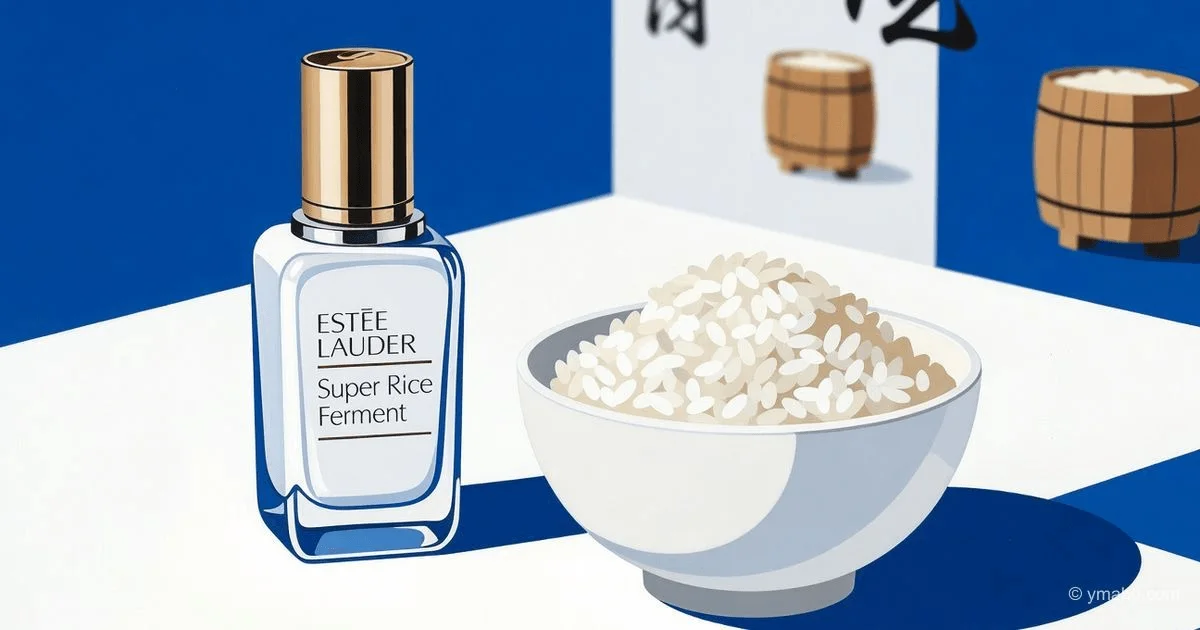
Estée Lauder Debuts Super Rice Ferment Line Aimed at Asia: Riding the Fermented Rice Wave
Following Korean brands, Estée Lauder has launched a line based on fermented rice, developed in collaboration with a Japanese sake producer. This is the only ingredient approved by Japan's Ministry of Health for improving skin barrier function.
American Giant Acknowledges Asia's Lead: Why Estée Lauder's Super Rice Ferment Line Is More Than a Product—It's a 180-Degree Strategic Pivot
You might think Estée Lauder simply released another "Asian" line to jump on the fermented rice trend. Just another Western brand "inspired" by K-Beauty and J-Beauty. That would be true, if not for the context.
In reality, what Estée Lauder did in September 2024 (the line itself isn't new, but the trend is gaining momentum now) represents both strategic surrender and aggressive expansion. The brand that for decades embodied "American luxury" (expensive creams in gold jars) created a line that is 100% made in Japan, developed by Japanese scientists, and approved by Japan's Ministry of Health as a "quasi-drug."
This isn't a collaboration. It's an admission that Japanese skincare science is currently stronger, and Estée Lauder is simply donning "Japanese uniform" to survive in the Asian market and sell that legitimacy back to the West.
[The Core]: What's Really Happening
What’s really happening is a reset of global R&D in cosmetics. Estée Lauder built its largest factory in Ibaraki Prefecture, which launched in 2024. The first product from this facility was the Aqua Charge line (known in Russian markets as Super Rice Ferment). This means the American giant has shifted its production center of gravity to Asia.
Why? Because Western standards of "clean beauty" (no parabens, no sulfates) are losing to Asia's philosophy of "functional beauty." In Japan, there's a "quasi-drug" category—products that sit between cosmetics and pharmaceuticals. They are officially approved by Japan's Ministry of Health, Labour and Welfare for specific clinical effects. Super Rice Ferment contains two such ingredients: Rice Power (fermented rice extract from sake producer Yushin Shuzo) and dipotassium glycyrrhizate (from licorice).
This isn't marketing. It's a certificate of efficacy. Clinical trials presented at ISID 2023 showed that the combination of rice extract and licorice increased hyaluronic acid concentration in a 3D skin model by 40%. In harsh conditions (10°C, 10% humidity), skin retained moisture far better. This isn't "ritual care"—it's engineered biology.
Non-obvious insight: Estée Lauder isn't just using rice. It's stealing SK-II's sacred cow. SK-II built its empire for decades on Pitera, a yeast ferment obtained during sake production. Now Estée Lauder is going straight to the source—to the sake producer Yushin Shuzo—and signing an exclusive contract for the Rice Power extract, which essentially serves as an alternative to Pitera but with a more "transparent" laboratory foundation. This is a declaration of "cold war" in the fermented luxury segment.
Timeline and Context
The timing of this line fits perfectly into the broader strategy by LVMH and Estée Lauder to "Asianize" their portfolios.
2021: Estée Lauder Companies begins construction of the Ibaraki factory—its first owned manufacturing complex in Japan. Investments run into hundreds of millions of dollars.
2023: At the International Society of Investigative Dermatology (ISID), Estée Lauder and Yushin Shuzo jointly present data showing a 40% increase in hyaluronic acid. This was an academic shot across the bow.
September 2024: The Aqua Charge line launches in Japan through department stores, online, and key partners. The goal is to "conquer Japan to win in Asia."
May 2026: The rice water skincare market is valued at $7.65 billion USD, with forecasts projecting growth to $13.95 billion by 2036 (CAGR 6.2%). China (CAGR 11.8%) and Japan (6.9%) are the key drivers, while the USA grows only 3.7%. This means the battle for fermented rice is the battle for Asia.
June 2026 (information wave): Although the line launched earlier, Western media (Vogue and others) are now picking up the "fermented rice" trend as a must-have, reviewing SK-II, Tatcha, Hanyul, and I’m From. Estée Lauder thus rides an already heated wave of consumer demand.
Winners and Losers
Winners:
- Yushin Shuzo (sake producer). The small brewery from Kagawa Prefecture hit the jackpot. They signed a licensing deal with the global giant for exclusive use of their Rice Power. Their technology will now be sold in thousands of locations worldwide. For them, this transforms a local supplier into an international ingredient player.
- The Japanese cosmetics industry overall. Estée Lauder building a factory in Japan and putting "Made in Japan" on the packaging legitimizes "Japanese quality" as a global premium standard. When an American legend uses Japanese technology, all of J-Beauty wins.
- Consumers seeking "medical-grade" cosmetics. The US and Europe lack a quasi-drug category. Estée Lauder is importing the concept. You get a cream officially approved for "improving wrinkles, hydration, firmness, and smoothness." This is a level of trust ordinary "anti-aging" creams with vague claims lack.
Losers:
- SK-II (Procter & Gamble brand). This is a direct hit on "Pitera." Estée Lauder enters the fermented sake extract space using the same cultural legend but with fresher scientific backing (ISID 2023 data). SK-II costs $200–300 per bottle. Aqua Charge will likely run $60–100, offering the same "fermentation" from a sake brewery but with quasi-drug certification. This is value dumping.
- American "clean beauty" brands (Drunk Elephant, Summer Fridays). Their rhetoric of "no chemicals" and "natural" doesn't work here. Consumers see Estée Lauder talking about "hyaluronic acid molecules" and "bioavailability," not "cute labels." When barrier function truly matters (e.g., on retinoids or with rosacea), consumers turn to "pharma-aesthetics," not "clean."
- Korean brands relying solely on "exotic appeal" without science. Koreans excel at rice toners. But Estée Lauder can now say: "Our formula increased hyaluronic acid by 40% in clinical trials." Many Korean mass-market brands lack budgets for such studies. They lose the race for "evidence-based cosmetics."
What the Media Isn't Saying
Media write: "Authentic Japanese rice for glowing skin." Nice. But they stay silent on three things.
First. The formula. Beyond the romance of sake, the cream contains dipotassium glycyrrhizate—a powerful anti-inflammatory (licorice extract). In cosmetics, licorice treats eczema, dermatitis, and rosacea. Estée Lauder isn't just "hydrating." They're treating irritated, dehydrated skin. They're targeting audiences whose barriers are damaged by retinoids, acid peels, or today's popular "acid" cosmetics.
Second. Where is the original Estée Lauder brand? Look at the Aqua Charge packaging design—minimalist, "Japanese" (white, blue, clear plastic), unlike classic gold-luxury Estée Lauder. The company deliberately hides its American "heaviness" behind Japanese pharmacy minimalism. Why? Because Gen Z in the US and Asia doesn't trust "their mom's brand" (Estée Lauder). They trust Japanese technology. Estée Lauder essentially created a side brand under its own name to bypass generational skepticism.
Third. How much rice is actually in there? Rice Power is a patented ingredient. But is it the star performer? Or is it marketing cover for simpler, clinically proven components (glycerin, betaine, jojoba oil)? Cosmetics giants often include 0.1% of a "miracle ingredient" and 20% "water and humectants," yet sell the miracle story. Without full concentration disclosure, we don't know if Rice Power truly works wonders or is just a pretty label on a jar with solid basic hydration.
Forecast: Next 30 Days and 90 Days
Next 30 Days (July 2026):
Western retailers (Sephora, Nordstrom, Douglas) will carve out dedicated shelves for "fermented" and "Japanese" lines. These zones will feature SK-II, Estée Lauder Aqua Charge, Tatcha, and Shiseido side by side. A "tester war" will begin. Sephora staff will receive training on selling "fermentation as technology."
Competitors—L’Oréal and Shiseido (the Japanese owners of Clé de Peau)—will issue press releases about their own "fermentation innovations." Shiseido will note it has done this for 150 years (which is true). Consumers will start confusing terms: Rice Power, Pitera, Galactomyces, Lactobacillus. The market will enter a "fermentation fever" phase.
Next 90 Days (Fall 2026):
Estée Lauder will run a major digital campaign with Japanese ambassadors. They will showcase the Ibaraki labs, the fermentation process, and Japanese aesthetics. The goal is to convince Western consumers that Made in Japan is the same as Made in Switzerland for watches—a mark of the highest quality.
However, the real test awaits in China. Japan and China have complex political relations, yet Chinese consumers love Japanese cosmetics (considered safer than Chinese and more effective than Korean). Aqua Charge will attempt to conquer Tmall. There it will battle local giants that have been making rice ferments for 5 years. They will need to price aggressively. If the line "hits" in China, Estée Lauder gains 11.8% annual growth in that market.
Final forecast: The Super Rice Ferment line will remain in the portfolio but is unlikely to become a blockbuster on the level of Advanced Night Repair. It matters as a Trojan horse. It penetrates the minds of younger audiences (who view Estée Lauder as outdated) through "Japanese" minimalism. If within a year Estée Lauder doesn't transfer the "quasi-drug" philosophy to its core lines (Night Repair, DayWear), this experiment remains an expensive hobby. But I believe they will. And then the entire premium cosmetics segment will become a little more "pharmacy" and a little less "luxury-fragrance."
— Editorial Team