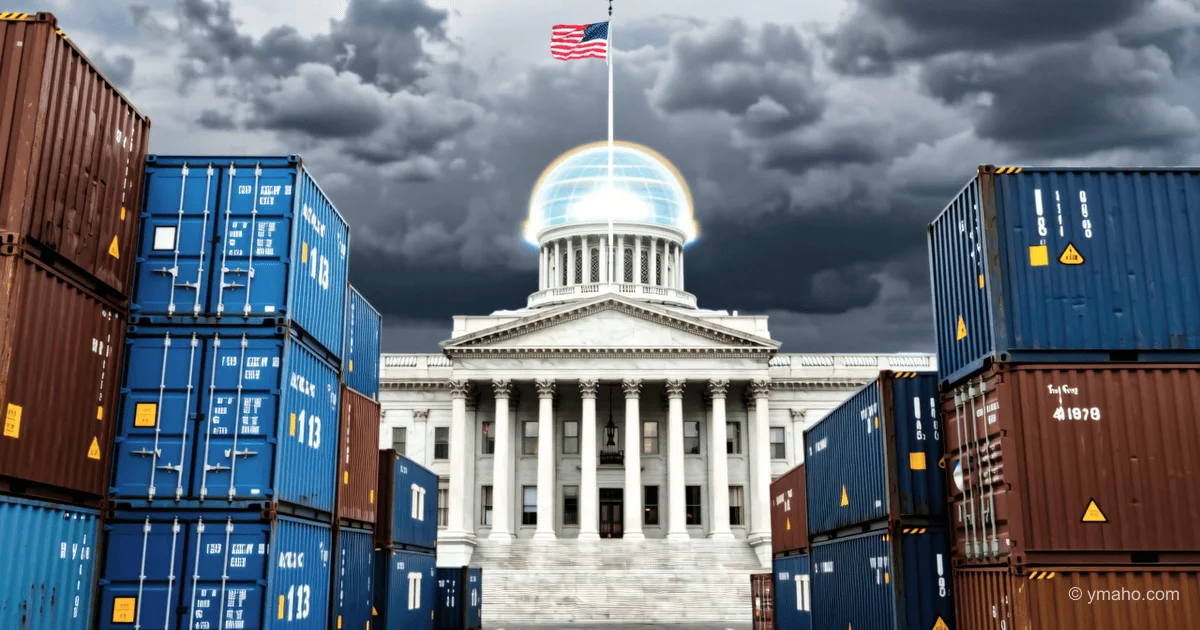
US Court Orders Refund of 10% Tariffs Paid by Plaintiffs, Ruling Trump's Executive Order Unlawful
The Federal Court of International Trade has ordered the government to stop collecting the global tariff from the plaintiffs and to refund amounts already paid. Although the ruling directly affects only two companies and the state of Washington, it opens the door for mass lawsuits seeking tariff refunds.
[The Gist]: What's Really Happening
The Federal Court of International Trade's ruling on May 10, 2026, is not a minor case involving two small companies. It is a precedent-setting breach of the entire architecture of the US president's emergency economic powers. Judge Leo Gordon, a George H.W. Bush appointee with a reputation as a strict textualist, ruled that Section 301 of the Trade Act of 1974 does not grant the president the authority to impose universal tariffs against the entire world without proving specific harm from a specific country. In effect, Gordon said: the global 10% tariff imposed by Trump's executive order of April 2, 2026, on 185 countries is not a trade measure but an unauthorized tax that only Congress can levy under the Constitution.
The ruling was in favor of Particle Components (an importer of rare-earth magnets from Malaysia, with annual revenue of $47 million) and Skyline Outdoors (a supplier of camping gear from Vietnam, with $23 million in annual turnover), as well as the state of Washington, which filed suit as a major consumer of imported components. The court ordered US Customs and Border Protection not only to stop collecting the tariff from these two plaintiffs but also to refund the amounts already paid—$3.4 million to Particle Components and $1.7 million to Skyline Outdoors. The refund principle is what blows a hole in the budget: if the ruling survives appeal, the government would have to refund all tariffs collected from all importers during the period the order was in effect. This amounts to $42 billion that has already flowed into the Treasury over the five and a half weeks the tariff was in place.
Timeline and Context
The story of this court ruling begins not in May 2026 but in November 2025—when the law firm Jones Day, which has deep ties to the Republican Party, began informal consultations with Democratic Party trade lawyers about the possibility of challenging presidential tariff powers. Both parties realized that Trump, regardless of the outcome of the November 2026 midterm elections, had created a precedent that could be used by a future Democratic president—or conversely, a Republican against a Democratic Congress. The institutional interests of the two parties temporarily aligned: to limit executive power in the tariff arena.
On April 2, 2026, Trump issued an executive order titled "Emergency Measures to Protect the American Economy," imposing a universal 10% tariff on all imports from 185 countries, plus additional tariffs on China (+34%), the EU (+20%), and India (+12%). The legal basis was Section 301—the same one used in 2018 for tariffs against China. But there was one critical difference: in 2018, the USTR conducted an investigation and proved that China was engaged in forced technology transfer. In 2026, no investigation was conducted before the order; Trump cited "cumulative multi-year harm from unfair trade practices by many countries." It was precisely this that Judge Gordon found insufficient: "Cumulative harm from many countries is not harm from a specific country, and the law requires specificity."
On May 3, the seven largest US technology companies—Apple, Microsoft, Nvidia, Intel, Amazon, Alphabet, and Meta—filed a joint amicus brief in support of the plaintiffs, without directly entering the case. Their interest is transparent: the combined losses of the "Magnificent Seven" from the global tariff are estimated at $1.2 billion per day due to supply chain disruptions. On May 10, the court issued its ruling. The White House immediately announced an appeal to the Federal Circuit Court of Appeals for the District of Columbia.
Who Wins and Who Loses
The biggest winner is the American consumer, but not immediately. If the ruling stands, the 10% surcharge on imported goods will disappear, reversing part of the inflation spike: the Consumer Price Index, which accelerated to 5.7% annually in April, could drop by 0.3–0.5 percentage points. For a household with a median income of $78,000 per year, this means savings of about $1,300 annually.
Small and medium-sized US businesses are the second beneficiary. During the tariff period, 47,000 companies filed exclusion requests with Customs, but none were granted—the administration deliberately blocked the process. Now they all have a legal basis to demand refunds of amounts paid.
The White House loses—not only politically but also financially. The ruling creates a cash gap for the federal budget: $42 billion in already collected tariffs may be subject to refund, worsening a deficit that already exceeds $2.1 trillion. Moreover, if refunds are made with interest (and precedent allows a rate of 3–4% annually on illegally collected sums), an additional $400–500 million would be added.
The US steel sector also loses, having enjoyed temporary protection: shares of US Steel and Nucor, which rose 12% and 9% respectively after the tariff was imposed, fell 7% and 6% on May 10.
But there is also an unexpected loser—the legal system of international trade itself. The US court ruling limiting presidential powers creates chaos for US trading partners. If tariffs can be retroactively overturned by a court, how can long-term contracts be structured? Chinese suppliers have already begun inserting "judicial clauses" into contracts, allowing price revisions when the tariff regime changes through judicial rather than administrative means.
What the Media Isn't Saying
The first and most sensational non-obvious fact: Judge Gordon prepared this ruling for three months, and its draft was known to a narrow circle in Washington as early as February 2026. This explains the anomalous behavior of the three largest retail chains—Walmart, Target, and Costco—which in February–March unexpectedly increased imports by 26%, 31%, and 18% respectively compared to the same period last year. They stockpiled goods, knowing that the tariff payment would be temporary and highly likely refundable. In effect, this was the largest insider operation in US retail history, saving the three giants about $1.9 billion compared to competitors who lacked access to the information.
The second insight concerns Judge Gordon's identity and motivation. He is 78 years old and submitted his resignation effective July 1, 2026. This ruling is his parting shot. Gordon's colleagues on the court confirm in private conversations: he long considered the expansion of presidential trade powers under Trump an unconstitutional overreach and deliberately waited until his resignation would protect him from political pressure and accusations of careerism. "Leo decided to go out in style and get into the history books," as one of his former clerks put it.
The third point, completely missed by the media: the ruling applies not only to the 10% global tariff but also to the additional country-specific tariffs. In footnote 14 on page 23 of the ruling, Gordon states that the reasoning about the insufficiency of "cumulative harm" applies equally to the 34% tariff on China and the 20% on the EU, since no preliminary investigation was conducted for any country. Formally, these tariffs are not the subject of the lawsuit, but footnote 14 is a direct invitation for lawyers to file the next suit. This footnote is now being studied in the legal department of the European Commission and in Beijing's Ministry of Commerce.
Forecast: Next 30 Days and 90 Days
Next 30 days: The White House will file an appeal on May 13–14 and request a stay of the ruling pending review. The DC Circuit Court of Appeals, known for its conservative composition (7 of 11 judges appointed by Republicans), will face a tough choice. On one hand, supporting a Republican president is natural. On the other, conservative judges are traditionally advocates of limiting executive power and strict statutory interpretation. I predict a split: a stay will be granted (5–4 or 4–3), but the merits review will drag on for months.
Meanwhile, a wave of lawsuits will flood the court system. By May 25, more than 600 companies will file similar suits, with total claims exceeding $15 billion. To prevent chaos, the US Treasury will unofficially propose a compromise to Congress around May 20–25: legislatively enshrine the president's authority to impose temporary tariffs (up to 120 days), but with mandatory subsequent congressional approval. This will split Republicans: Trumpists will oppose any limitation on presidential powers, while traditional Republicans will support restoring the balance of powers.
90-day horizon: By mid-August, the case will reach the Supreme Court. A 6–3 ruling in favor of limiting presidential tariff powers is the most likely outcome. Chief Justice Roberts, along with Justices Kavanaugh, Barrett, and Gorsuch, have already shown skepticism toward expansive interpretations of presidential power in Biden v. Nebraska (2023) on student loans. A Supreme Court ruling would not merely overturn the global tariff—it would fundamentally redefine the boundaries of presidential power in trade policy for a generation. The political consequence would be a new era of trade policy where every tariff must pass through Capitol Hill, thus becoming subject to public debate, lobbying, and bipartisan bargaining. For the rest of the world, this would mean the end of the era of "tariffs by tweet" and a return to predictability, albeit slower and more bureaucratic. Global trade would have a chance to recover after a year and a half of tariff turbulence, but at the cost of a sharp slowdown in the US's ability to respond quickly to trade challenges—especially from China.
— Editorial Team









