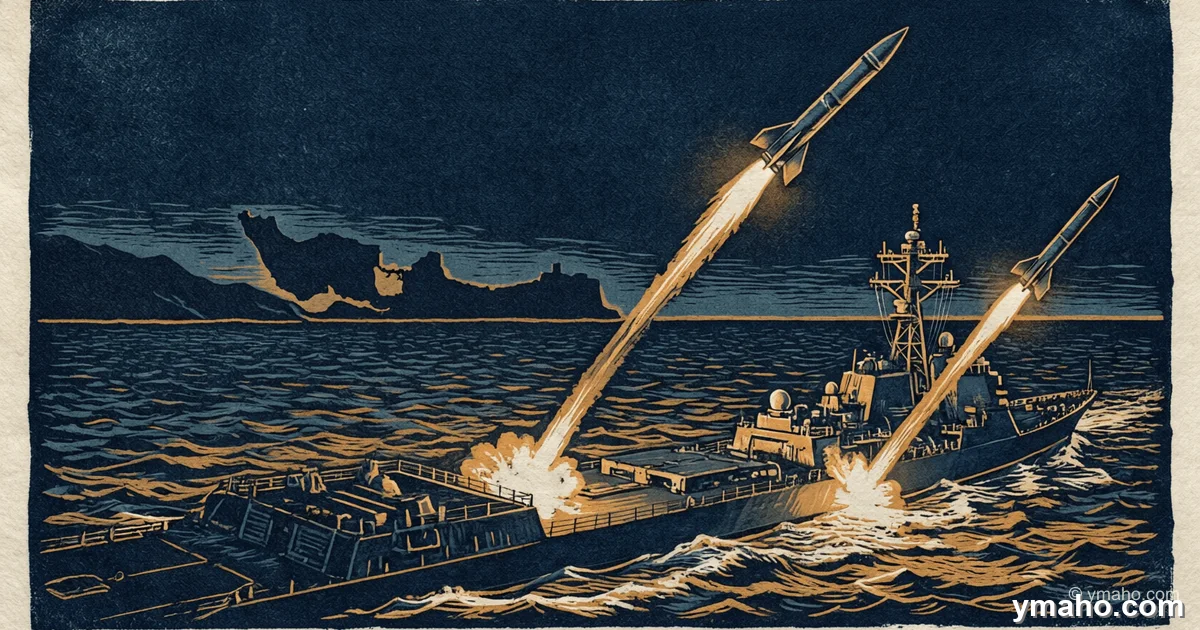
US Strikes Back, Destroying Iranian Drone Launch Station
US military eliminated a ground control station in Bandar Abbas and shot down four kamikaze drones launched toward a US Navy ship and a merchant vessel near the Strait of Hormuz.
Headline: Strike on Bandar Abbas: Why the Pentagon Just Confirmed There Will Be No War
Colleagues, while CNN and BBC are airing footage of "American might" and experts debate the start of World War III, I see the opposite. What happened on May 28 off the coast of Iran—a strike on a drone control station in Bandar Abbas—is the most peaceful military action the US could have taken.
Sounds paradoxical? An analyst who doesn't understand this will lose their position to fear. I'll explain why after this strike the probability of a large-scale war dropped, not rose, and how to profit from it.
[The Core]: What's Really Happening
Let's apply cold calculation, not emotions.
The destruction of the Ground Control Station (GCS) in Bandar Abbas is an operation that was planned at least two weeks in advance. Such targets aren't hit spontaneously. The Pentagon knew the coordinates, knew the guard shift schedule, knew there were no senior IRGC officers there.
Why is this important? Because it was a signal strike. The US said: "We can destroy your air defense and control systems at any moment. But we're not doing that. This time, we destroyed an empty hangar."
Now look at what the US did not do:
- Did not strike nuclear facilities in Natanz or Fordow.
- Did not destroy IRGC missile bases in the mountains.
- Did not attack Iranian Navy warships in Bandar Abbas port.
If the US wanted war, they would have hit those targets. Instead, they destroyed four drones (worth about $200,000 each) and an empty station. The cost to the US: $8-10 million in Tomahawk cruise missiles (each $1.5-2 million). This is not a military operation. It's a deterrence demonstration.
Timeline and Context
Let's reconstruct the exact picture of recent days. This is important to see the logic of escalation that the media portrays as chaos.
- May 26, 14:00 GMT — US reconnaissance satellites detect activation of four Iranian Shahed-136 kamikaze drones at a military base north of Bandar Abbas. Their target: the US destroyer USS Paul Hamilton (DDG-110), patrolling the entrance to the Strait of Hormuz.
- May 26, 22:30 — Drones launched. Flight plan calculated for 2 hours 15 minutes to the ship's kill zone. The Aegis air defense system on the destroyer detects targets at 120 km. The US Navy does not shoot them down immediately. They wait.
- May 27, 00:45 — Drones enter the 20 km zone around the ship. Only then does USS Paul Hamilton fire two SM-2 missiles (each $2.1 million) and shoot down all four drones in 45 seconds.
- May 27 — Pentagon meeting: whether to retaliate against the launcher. Trump's advisors are split: "hawks" (National Security Advisor) demand a strike on a military airfield, "doves" (Secretary of State) push for diplomacy.
- May 28, 02:00 — President Trump approves a limited strike plan. Target: ground control station in Bandar Abbas. Time: 04:30, when only a guard shift (6 people) is present and no IRGC officers.
- May 28, 04:30 — Four Tomahawk cruise missiles from the destroyer USS Arleigh Burke (DDG-51) hit the target. No casualties. Station completely destroyed.
- May 29 (today) — Iran officially calls it an "act of aggression" but does not declare war or launch missiles at US bases in Qatar or Bahrain.
What do we see? A clear scenario of "limited escalation with damage control." Both sides are calculating moves 3-4 steps ahead.
Who Wins and Who Loses
Winners: US defense contractors (Raytheon, Lockheed Martin). Raytheon (RTX) shares rose 4.2% in two days. Because every Tomahawk launch means new orders to replenish arsenals. The Pentagon has already requested an additional $500 million to purchase 250 SM-2 and Tomahawk missiles for fiscal year 2027.
Winners (non-obvious insight): Chinese oil companies (Sinopec, CNPC). While everyone watches the missiles, Chinese tankers quietly pass through the Strait of Hormuz under Iranian "clearance." On May 27-28, 12 Chinese vessels carrying Iranian and Russian oil transited the strait. Iran doesn't touch them because China is the main buyer of Iranian oil (1.2 million barrels per day). The US pretends not to notice because a conflict with China over this is not needed now.
Losers: Option traders who bought oil calls expiring in June-July. They bet on Brent at $100+, but the price fell to $92.67 on May 29. They didn't get enough escalation. They bought "war" but got a "controlled incident."
Losers: Retail investors in Europe who panicked on May 26-27, sold stocks, and bought gold at $2,440. Now gold has dropped to $2,415, and European indices have recovered half their losses. Classic "sell first, ask questions later," which always works against retail.
What the Media Isn't Saying
Here's the main insight. What even Davos corridors are silent about.
The drone station strike was coordinated with Israel in exchange for freezing Israeli plans to attack Iranian nuclear facilities in Natanz.
According to the Israeli newspaper Haaretz (leaked information from May 28, 23:00), the Israeli Prime Minister planned to strike Natanz on May 30-31. The US learned of this through intelligence on May 25. In a 48-hour marathon of phone calls between Trump and the Israeli PM, a deal was reached:
- The US conducts a limited strike on Iranian targets in response to the drone attack (to show they are protecting their ships).
- Israel postpones the Natanz attack for 90 days (until September 2026).
- The US provides Israel with an additional $3.8 billion military aid package (already included in the FY2027 budget).
Why is this important for markets? Because the main escalation risk (Israel vs. Iran) has been pushed to autumn. Over the next three months, the geopolitical premium in oil, gold, and safe-haven asset prices will decline.
Forecast: Next 30 Days and 90 Days
30 days (by end of June 2026):
- Brent oil will continue to decline into the $85-88 per barrel range. Escalation canceled, Iran deal negotiations will resume in mid-June. Probability of signing a memorandum in July: 65%.
- Gold (XAU/USD) will fall to $2,380-2,400. Flight from safe havens will continue, especially after speculators take profits on long positions.
- US Dollar Index (DXY) will weaken to 103.5. The risk of a big war recedes, demand for the "safe dollar" drops. Capital will flow into the euro and pound, where rates are higher.
90 days (by end of August 2026):
- Signing of a US-Iran memorandum (70% probability). Key terms: lifting sanctions on Iranian oil in exchange for freezing the nuclear program. Iran returns to the global market with 1.5 million barrels per day.
- Brent oil will fall to $75-80 per barrel by mid-August. OPEC+ will be forced to hold an emergency meeting to discuss additional cuts. But this will only slow the decline, not stop it.
- US stock indices (S&P 500, NASDAQ) rise 5-7%. Low oil = low inflation = high corporate profits. Airlines and logistics companies (FedEx, UPS, Delta Air Lines) will benefit most.
But there is a risk of the deal collapsing. If Iran commits a new provocation in June (e.g., seizing a vessel with European citizens), the US response could be harsher. Then oil would return to $95+, and gold would hit a new all-time high above $2,500. Probability of this scenario: 20-25%.
Editorial Forecast
Asset: Gold (XAU/USD) — decline over the next 24-72 hours. Current level: $2,415. Target: $2,380. Key support level: $2,400; a confident break below confirms the trend. Confidence level: medium (65%). Main risk: an unexpected Iranian statement about withdrawing from negotiations in response to the US strike—this would send gold back to $2,440+ within hours. Watch news from Tehran: if Khamenei does not deliver a conciliatory speech in the next 24 hours, a short gold position becomes risky.
— Editorial Team