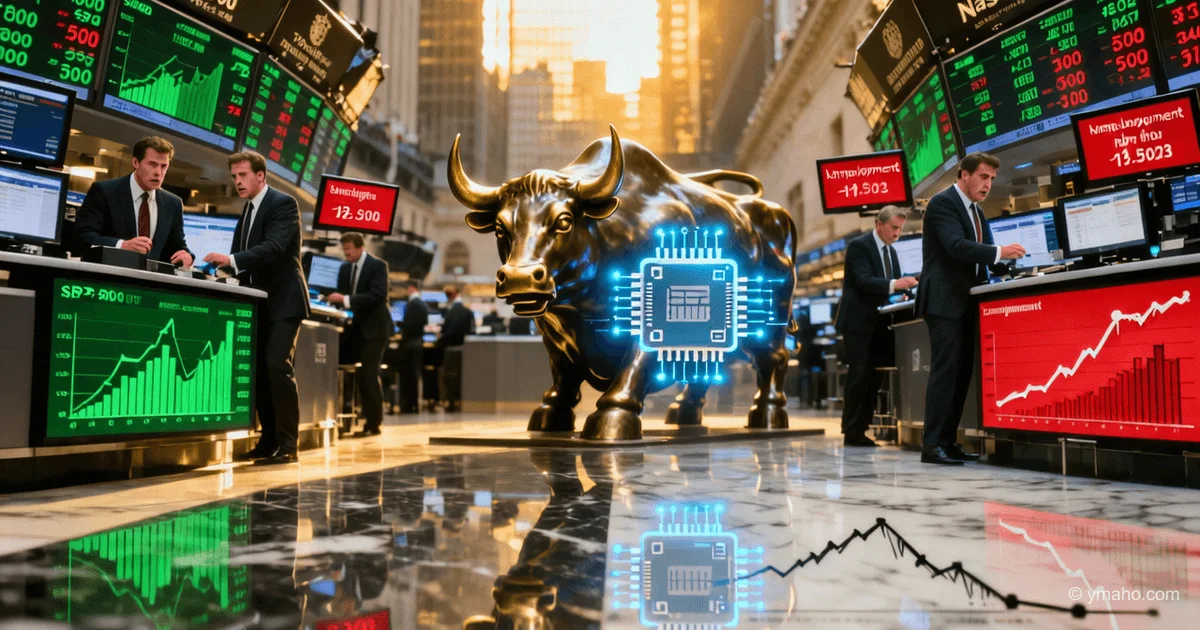
Wall Street indices rise on strong US labor market data
S&P 500 gained 0.8%, and the Nasdaq Composite rose 1.5% to record highs thanks to a jobs report that beat expectations, reinforcing the view that the Fed will not rush to change rates.
Wall Street records: why the market celebrates while the economy sends SOS signals
The gist: what's really happening
S&P 500 at 7,398.93 points, Nasdaq soared to 26,247.08 — both indices hit all-time highs, showing a sixth straight week of gains. At first glance, the reason is obvious: labor market data beat expectations. The consensus forecast was a meager 62,000 new jobs, but the actual figure came in at 115,000. Traders breathed a sigh of relief: recession is off the table, the Fed won't touch rates, the rally can continue.
The problem is that this narrative is a dangerous oversimplification. What happened on May 8 on US exchanges was not a reaction to a strong economy. It was a triumphant march of the AI sector, pulling indices higher while the rest of the market treads water. The Philadelphia Semiconductor Index surged 55% in the second quarter alone. The S&P 500 technology sector gained 2.7% in a single day, while the utilities sector fell 0.9%. This is not broad growth — it's a selective rally disguised as a general upturn.
Moreover, beneath the surface of the labor statistics lie alarming signals that the market chose to ignore. The number of people forced to work part-time for economic reasons jumped by 445,000 — the largest increase in 14 months. Household employment fell by 226,000 jobs. Another 92,000 people left the labor force. The labor force participation rate dropped to 61.8%. Without this decline, unemployment would have been 4.4%, not 4.3%.
KPMG Chief Economist Diane Swonk puts it bluntly: the labor market "looks better on paper than it feels for most workers." The broader U6 unemployment measure, which includes discouraged and underemployed workers, rose to 8.2% — the highest since December 2025.
Timeline and context
The May jobs report continues a series of volatile data that has plagued the labor market since mid-2025. In February, 156,000 jobs were lost; in March, a gain of 185,000 (revised upward); April delivered 115,000. The three-month average gain was just 48,000 — and that includes two consecutive "strong" months.
Meanwhile, growth drivers are extremely concentrated. Healthcare and social assistance added 53,900 jobs — nearly half of all private sector gains. Transportation and courier services added 30,300 positions — partly because Americans, spooked by gasoline prices, stopped driving to stores and switched to delivery. Retail trade grew by 21,800 jobs, but a significant portion came from warehouse clubs and building materials — due to the late Easter season.
At the same time, the technology sector (information services) has been shrinking for 16 consecutive months, and the federal government lost another 9,000 positions — a total of 348,000 jobs lost since the peak in October 2024.
The context for the Fed is critical here. Chairman Powell held his last meeting, and his successor Kevin Warsh inherits a committee more divided than ever. At the April FOMC meeting, three voting members opposed maintaining the easing bias in the statement — they wanted to lock in the possibility of both rate cuts and hikes. KPMG now forecasts two rate hikes by the end of summer.
Who wins and who loses
AI sector and chipmakers — absolute winners. One look at the numbers is enough: Nvidia rose 1.8%, Micron and Sandisk each surged more than 15% amid insatiable demand from data centers. Behind this is not hype but real money: capital expenditures on AI infrastructure are measured in tens of billions of dollars. S&P 500 earnings in the first quarter rose nearly 29% year-over-year, and the lion's share of this growth comes from AI heavyweights.
The market as a whole — tactical winner. Six weeks of continuous growth is the longest winning streak since October 2024. The S&P 500 is up 8% year-to-date, the Nasdaq has soared 13%. These are impressive numbers for a period when oil is at $106 a barrel and the Strait of Hormuz is blocked.
American workers — losers. The U6 rate at 8.2% is two full percentage points higher than in 2019. People who want full-time work are forced to accept part-time jobs. People who would like to enter the labor force cannot find work and drop out. Real household purchasing power is shrinking under pressure from fuel and goods prices.
The Federal Reserve — in a trap. The ISM services price index stands at 70.7 — the highest since October 2022 — for the second consecutive month. This means that services inflation, which forms the core of the consumer basket, is entrenched at four-year highs. Meanwhile, the Fed pays over $1 trillion a year in interest on the national debt. Raising rates would crush the debt burden; cutting rates would reignite inflation. A choice without a choice.
Kevin Warsh — future Fed chair in the most vulnerable position. His nomination was just approved by the Senate committee after tough hearings. Warsh is a proponent of "trimmed mean" as an inflation measure, which systematically yields lower readings, and a principled opponent of the Fed's large balance sheet. He will have to prove his independence and anti-inflation resolve to the bond market at a time when any decision will be perceived as political.
What the media doesn't say
Insight one: the market is celebrating not a strong economy, but a weak labor market.
Paradoxically, it is the weakness of the labor market that is the best friend of the current rally. Unemployment is not rising, wages are cooling: annual earnings growth was 3.6% — above March's 3.4%, but not enough to trigger a wage-price spiral. This allows the Fed to sit on its hands and not hinder the stock market rally. Traders understand this: the probability of rates staying unchanged at the June meeting is 97%. The market doesn't want a rate cut — it wants predictability.
Insight two: the AI rally hides the vulnerability of the rest of the market.
The S&P 500 technology sector rose 2.7%, while utilities fell 0.9%, and energy and materials were among the worst-performing sectors. The first quarter showed that roughly 30-35% of broad market earnings growth came from communication services, and 45-50% from information technology. This means that without the AI sector, the market would be in the red. This is extreme concentration, making indices vulnerable to any disappointment in the tech sector.
Insight three: the birth-death model distorts reality.
Economists increasingly point to problems with the "birth-death" model that the BLS uses to estimate job creation at new and closing firms. Since mid-2025, this model has created extreme volatility in the data, distorting the real picture. High turnover of newly created firms makes it difficult to estimate the actual number of jobs. Preliminary census data indicate that we face large downward revisions to 2025 data in early 2027.
Insight four: structural changes in the labor market are underestimated.
An aging population and declining immigration mean the economy needs to create between 0 and 50,000 jobs per month — not 150,000 as before — to maintain a stable unemployment rate. This structurally changes the game. Even a weak labor market does not produce dramatic unemployment increases, but that does not mean it is healthy.
Forecast: next 30 days and 90 days
Next 30 days (until June 9):
The AI sector rally will maintain momentum. The semiconductor index, up 55% in the quarter, could continue to rise — capital expenditures on data centers are scheduled years ahead. However, signs of overheating are appearing: the S&P 500 recorded 28 new highs against 30 new lows, the Nasdaq 134 highs against 119 lows. This indicates a narrowing market where a minority of stocks pull indices higher.
The key event is May 14-15, the meeting between Trump and Xi Jinping. On the agenda: the Middle East conflict, trade tensions, AI, and rare earth metals. Any hint of trade war escalation will hit the tech sector, dependent on Asian supply chains. Conversely, a diplomatic breakthrough could open the door for further growth.
By May 21, earnings season will end — Walmart reports last among major companies. After that, the market will lose its information driver and focus on geopolitics and the actions of the new Fed chair.
90-day horizon (until August 9):
This period will be determined by three factors. First: Kevin Warsh. His first meeting as FOMC chair will be in June. The bond market will test his resolve. If Warsh confirms his hawkish reputation, Treasury yields will rise, creating competition for stocks.
Second: the Strait of Hormuz. If the blockade drags on into June, recession risks will begin to materialize. Historically, the peak impact of oil shocks on GDP appears with a lag of four quarters, but the stock market reacts earlier.
Third: AI earnings for the second quarter. If earnings growth slows, the market will sober up. Concentration of growth in two sectors is not strength but vulnerability. Without the AI component, the broad market shows no fundamental strength.
KPMG forecasts two rate hikes by the end of summer. If this forecast materializes, the Nasdaq, pumped up by cheap money, will face its most serious correction since 2022. But if Warsh shows flexibility and geopolitics eases, we will see a continuation of what analysts call a "reluctantly bullish" market — where fundamentals look strong on the surface, but enough tension builds underneath to warrant caution.
Investors should watch not the headlines but the ratio between the technology and industrial sectors of the S&P 500. If the spread begins to narrow not due to industrial growth but due to tech falling, that will be the first signal that the party is over.
— Editorial Team









