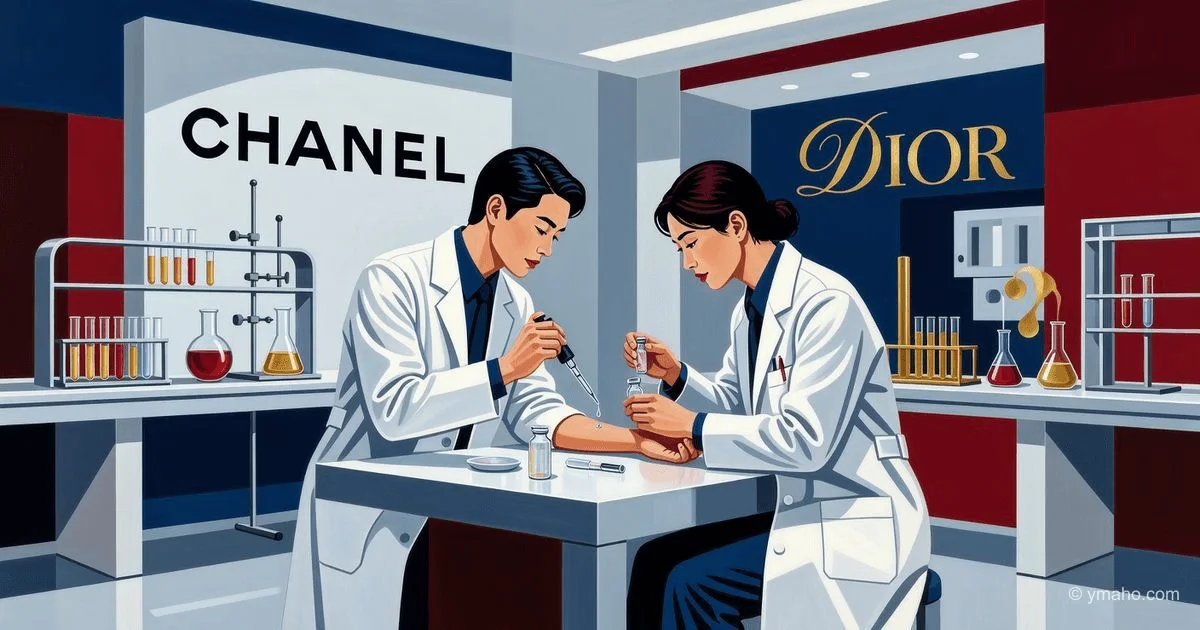
Chanel and Dior Establish R&D Centers in Tokyo: Japanese Science Drives Global Luxury
Western luxury brands keep pouring money into Japanese labs to develop anti-aging and brightening formulas. Japan is becoming the linchpin for innovative cosmeceuticals.
Paris Luxury Dead End: Why Chanel and Dior Open R&D in Tokyo but Never Admit It Publicly
You might think the news that Chanel and Dior are setting up research centers in Tokyo is just another PR stunt. “We draw inspiration from Japan,” “Japanese aesthetics shape our collections.” These are the same ritual phrases brands have repeated for decades. They mean nothing.
What is actually happening is far more fundamental—and unsettling for the Western brands themselves. Western cosmetic science, especially in anti-aging and pigmentation, has hit a wall. Japanese science, by contrast, sits at the cutting edge. Brands that once “taught the world beauty” are now traveling to Tokyo to learn from Asian researchers.
This is not simply “investing in the future.” It is an existential admission of scientific inadequacy. Chanel and Dior are hiring Japanese sensory researchers and building labs not because they “like cherry blossoms,” but because without Japanese data and Japanese understanding of skin their products will lose relevance within the next three to five years.
[The Core Issue]: What Is Really Going On
Power over knowledge is shifting from West to Asia. The old success formula was simple: a French or American brand developed a product in Paris or New York, tweaked the packaging and added seaweed extract for the “Asian mindset,” and sold it. That model no longer works.
Why? Because Asian consumers—and especially Japanese consumers—have become the most demanding in the world. Japanese skin has distinct characteristics: higher melanocyte density, greater tendency toward hyperpigmentation, a thinner stratum corneum, yet more active sebum production. To create a formula that performs on Japanese skin, it must be tested in Japan, on Japanese subjects, using Japanese protocols. Otherwise the product will flop in a market that accounts for 10–12 % of the global luxury beauty segment.
Public job postings confirm the trend. Dior Parfums has advertised a Sensory Research Coordinator role in Tokyo—a specialist who will run sensory analysis with trained Japanese panels. This is not an entry-level position. It sits inside CEECI (the International Center for Cosmetic Evaluation) / Asia Innovation Centre. Requirements include business-level Japanese and English plus mastery of statistical software (SIMS 2000, XLSTAT, FIZZ, SAS). The hire will not merely translate; they will channel Japanese consumer feedback straight into the lab and dictate which formulas reach production.
Non-obvious insight: Chanel and Dior are effectively handing veto power to Japanese focus groups. If a trained Japanese sensory panel finds a formula insufficiently “silky” or “gliding” on their skin, the product will not launch. Japanese quality standards are becoming global standards.
Timeline and Context
Decades of groundwork preceded this moment, but events have accelerated sharply in the last two to three years.
2022 (data for 2021): Japan ranked second worldwide in cosmetics market size after the USA—$35 billion versus $80 billion. Luxury-segment growth in Japan reached 8 % annually, outpacing the global average.
2024 (construction): Estée Lauder completed a plant in Ibaraki and an Aqua Charge line built on Japanese technology. Competitors took notice.
Early 2025: 74 % of Japanese consumers now view “imported” brands as less effective than local ones (including Shiseido, Kao, and Pola). The statistic shocked Western management.
February 2026: Dior opened the Bamboo Pavilion in Tokyo’s Daikanyama district—1,800 square meters, bamboo façade, garden by landscape designer Seijun Nishihata, installations by Azuma Makoto, and cuisine by Anne-Sophie Pic. This is not merely a store; it is the physical embodiment of courtship. Dior literally built a “Japanese pavilion” to demonstrate loyalty.
February–May 2026: Dior posted the Sensory Research Coordinator role. The Bamboo Pavilion opened to the public. Press coverage celebrated the “dialogue of cultures.”
June 2026 (now): The trend is unmistakable. Chanel, according to industry sources, is likewise expanding its R&D center in Tokyo, focusing on brightening ingredients and melanin-suppression technologies. Japan has been officially designated a “key link in innovative cosmeceuticals.”
Winners and Losers
Winners:
- Japanese sensory researchers and formulation engineers. Previously employed by Shiseido and Kao at average salaries, they are now being pursued by LVMH, Chanel, and Estée Lauder. Senior Sensory Researcher compensation in Tokyo can reach 15–20 million yen annually (roughly $100,000–$130,000). The talent market is exploding.
- Japanese ingredient suppliers and biotech labs. Companies such as Nagase, Hayashibara, and Kyowa Hakko, which spent decades developing enzymes, amino acids, and peptides for the domestic market, are becoming strategic partners to global giants. Their valuations are rising sharply.
- Shiseido as a brand. Irony: Western giants arriving in Japan legitimize the “Japanese standard” as the world standard, boosting Shiseido’s prestige—the longtime engine of Japanese cosmetic science. Western shoppers now seek “Japanese quality” at Sephora, and Shiseido benefits.
Losers:
- European laboratories (France, Italy, Switzerland). Funds once earmarked for Lyon or Milan now flow to Tokyo. R&D teams in Paris receive smaller budgets; decision-making shifts to Asia. European chemists and biologists watch their work become “second-tier.”
- Korean luxury brands (Sulwhasoo from Amorepacific, The History of Whoo from LG). Koreans dominate the mass-prestige K-Beauty segment, but Japanese science has long held the edge in true luxury (prices starting at $150). When Chanel and Dior bet on Japan, they sideline Korean luxury brands on the global stage. Investors are already rotating capital from Korean to Japanese assets.
- U.S. “clean beauty.” While Americans debate parabens and sulfates, Japanese researchers quietly create quasi-pharmaceuticals cleared by the Ministry of Health. The push for “evidence-based cosmetics” will bury “clean beauty” as a premium category. Consumers willing to pay $200 for a cream will choose the product carrying a Japanese efficacy certificate over one that merely claims “no 3,000 harmful ingredients.”
What the Media Leaves Out
Media describe the Dior Bamboo Pavilion as an “architectural masterpiece” and a “dialogue of cultures.” No one mentions that it represents a direct threat to French cultural sovereignty in beauty.
First. Control of sensory evaluation. Dior is hiring a Japanese specialist to “assess formulas with trained Japanese panels” and “issue precise recommendations to the relevant departments.” Those departments sit in Paris. A Japanese researcher now holds the power to tell French chemists how to reformulate. The French product is no longer fully French; it is “developed in Paris, approved in Tokyo.” That is a serious blow to prestige.
Second. The Bamboo Pavilion itself. Dior spent millions on the project—beautiful, eco-friendly, complete with gardens and art. It is not philanthropy. It is regulatory-risk insurance. Japan maintains strict cosmetics import standards. By opening the pavilion, Dior creates local jobs, invests in the economy, and builds relationships with authorities. Should Japan tighten rules for foreign brands, Dior can say, “But we are part of you.” It is political protection.
Third. What remains in Paris? All the “creative” elements—packaging, fragrance, concept—stay in France. The “scientific” and “technological” core moves to Asia. French luxury beauty is gradually becoming a wrapper around Japanese content. The same pattern that occurred with watches (Swiss branding, Japanese quartz movements in lower segments) is now happening with cosmetics. France keeps the myth; Japan keeps the technology. In the long run, technology owns the value.
Forecast: Next 30 Days and 90 Days
Next 30 days (July 2026):
Expect Chanel to announce an expansion of its existing Tokyo R&D center—framed as “strengthening commitment” rather than “catching up.” The press release will speak of “dedication to innovation” and “respect for Japanese culture.” Between the lines it will read: “We are worried that Dior got ahead.”
Third-tier competitors (Lancôme, Clarins, Givenchy) will also announce “partnerships” with Japanese labs and form joint ventures. They cannot match the billions of yen being spent by Dior and Chanel, so they will simply buy ready-made Japanese ingredients and label them “Japanese technology.” Consumers will quickly learn to distinguish marketing Japaneseness (sakura on the box) from genuine Japaneseness (development and testing in Tokyo).
Next 90 days (Autumn 2026):
A talent migration will begin. Top Japanese chemists from Shiseido and Kao will receive offers from Dior and Chanel at 1.5–2 times their current pay. Shiseido and Kao will file lawsuits over non-compete violations. It will be a messy war for minds.
By the end of 2026, the first products developed entirely in Tokyo—from formula through clinical trials—will reach limited release under the Dior or Chanel name, initially only in Japan. The test: will Japanese consumers see the product as “theirs,” or will they still view the brands as foreign?
If the test succeeds, within twelve months these products will roll out to China, Korea, then the USA and Europe. We will have officially entered the era of “Japanese luxury under French names.” France will remain queen of fragrance, where aesthetics matter more than science. In skincare, where results matter, hegemony will shift to Japan. Chanel and Dior are merely carrying that banner for now. Can they ever reclaim scientific leadership for France? No. The French scientific school in cosmetics has not led for the past twenty years. The move to Tokyo is the final admission of that fact.
— Editorial Team