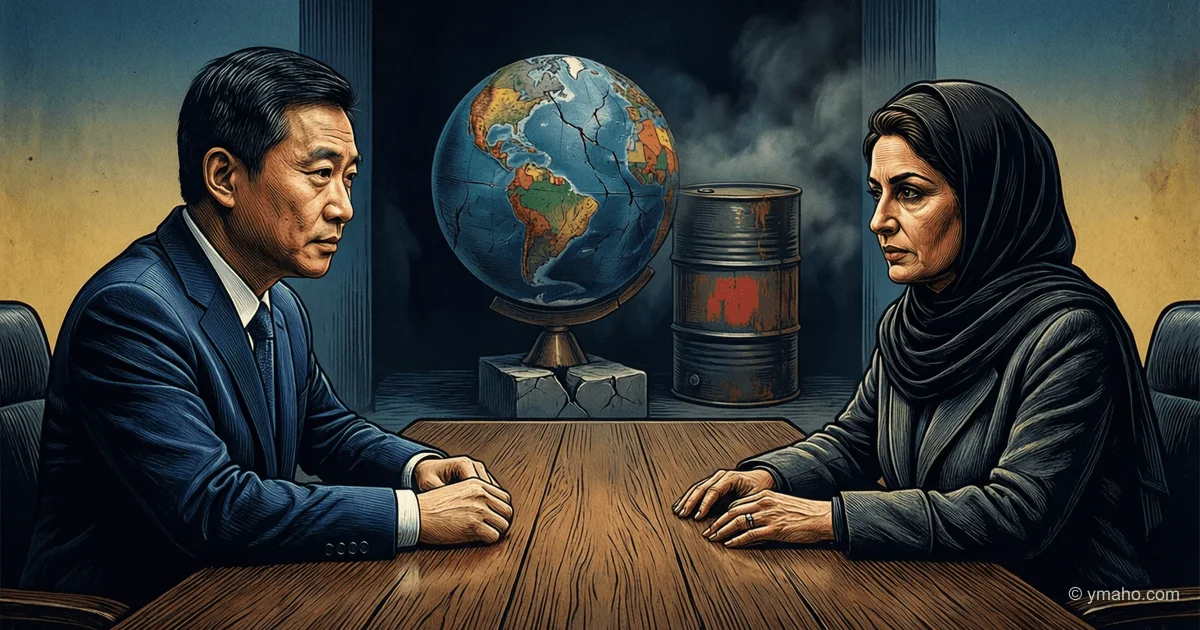
China Calls for Swift Resolution of the Middle East Crisis
Chinese Foreign Ministry spokesperson Mao Ning stated that ending the conflict benefits all parties, including the US and Iran. Beijing reaffirmed its unchanged position that the confrontation 'should never have arisen.'
'A Conflict That Should Never Have Happened': How Beijing Is Buying Up Assets Under the Cover of Diplomacy
While Western markets freeze at every statement from Trump or Rubio, Chinese diplomacy does what it does best: uttering perfectly correct words and taking perfectly correct actions in complete silence. Mao Ning's statement on May 25 that the conflict 'should never have arisen' is not just another passage from Beijing's Foreign Ministry. It is an official fixation of a position that allows Chinese state-owned companies and funds to operate with 'political cover' amid the chaos.
Let's break down what actually lies behind these words.
[The Gist]: What Is Really Happening
Formally, Mao Ning reiterated China's long-standing line: dialogue, negotiations, non-use of force, freedom of navigation. But there are two details that escape a superficial glance.
First, the phrase 'this is a conflict that should never have happened' is not abstract pacifism. It is a legal and political construct that allows China to distance itself from any obligations related to post-war settlement that may be unfavorable. Beijing did not sign on to US actions, did not support them, and now has the right to demand a 'special status' in any negotiations on the division of influence.
Second, the key word is 'swift.' China does not say 'immediate ceasefire at any cost.' It says 'swift' — meaning on terms that suit all parties, including Iran. This is a diplomatic euphemism behind which lies a message to Tehran: 'Don't give up too quickly; we have a plan.'
Why is this important? Because on the same day, May 25, while Mao Ning was talking about peace, satellite images captured the unloading of a fourth Chinese vessel with food and medicine at the Iranian port of Bandar Abbas. A humanitarian corridor, formally. In reality — support for the regime in exchange for long-term oil contracts at a fixed price in yuan, which Western media don't even report on.
[Timeline and Context]
Beijing is playing the long game, and this is evident from the dates.
- May 6, 2026: Foreign Minister Wang Yi meets with Iranian Foreign Minister Abbas Araghchi in Beijing. China promises to play a 'greater role' in ending hostilities. Western media pass it by, focusing on Trump's talks with Xi Jinping on May 14-15 (which, by the way, yielded no concrete results).
- May 19: Xi Jinping
— Editorial Team