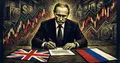
US Secretary of State Rubio Threatens to Open Strait of Hormuz 'One Way or Another'
Marco Rubio stated that the strait blocked by Iran must be opened, calling the situation 'illegal and unacceptable.' He also hinted at the possibility of a deal with Iran in the coming days, despite new strikes.
'One Way or Another': Why Rubio's Threat Is Insurance for Insurance Against Market Collapse
Marco Rubio last night (around 8:15 PM Eastern Time, May 25) uttered a phrase that traders in New York and London heard as a 'double bottom' for the dollar. 'The Strait of Hormuz will be opened one way or another' — this is not a diplomatic jab. It is a financial signal aimed not at Iran, but at his own hedge funds and Asian central banks that have started panicking and dumping US Treasury bonds.
Unlike previous loud statements (Trump talked about 'a beautiful negotiation move'), Rubio is now playing the role of 'bad cop' on the currency front. His message is crystal clear: either Iran opens the strait through a deal (which is almost ready), or the US will open it by military force, clearing mines and shooting at IRGC blocking boats.
[The Core]: What Is Really Happening
At stake is not just the passage of tankers. It's about 25-30% of the world's seaborne LNG exports and about 17 million barrels of crude oil per day that are stuck in the Gulf or cannot leave the ports of Iraq, Kuwait, and the UAE. But the main thing is that insurance premiums for VLCC tankers have soared to a historic $2.5 million per voyage.
Funds holding short positions on oil (bets on a decline) are now caught in a trap. Rubio's statement simultaneously:
- reduces the geopolitical premium (supposedly 'the problem will soon be resolved by force'),
- but increases physical risks (if a real military operation to clear mines begins, oil will jump 15-20% in a day).
The market doesn't know which to choose. And it is in this uncertainty that the money lies.
[Timeline and Context]
- May 15, 2026: IRGC officially announced a 'temporary blockade' of the Strait of Hormuz for vessels heading to Israel and the US.
- May 22: First reports of minefields near the Tonb and Abu Musa islands.
- May 24, 14:00 UTC: Maxar satellite images capture 43 commercial vessels waiting for passage, including two tankers with Qatari LNG for European terminals (Shell and TotalEnergies).
- May 25, 19:45 UTC: Rubio speaks to journalists, calls the situation 'illegal,' and for the first time publicly allows a military scenario 'with or without sanctions.'
- May 26, morning (today): The VLCC freight futures market shows that rates for June contracts rose another 8% after the statement — traders are pricing in that 'mine clearance' will take not 2-3 days, but weeks.
[Who Wins and Who Loses]
Winner: Singapore trading hub (Trafigura, Vitol)
These companies have been buying oil 'in storage' (at sea, on floating storage) at a discount of $3-4 per barrel for the second week, taking advantage of the fact that vessels cannot enter or leave the Gulf. As soon as the strait opens — and Rubio essentially guarantees its opening 'one way or another' — they will instantly sell those volumes on the spot market at no discount. Their potential profit: $200 to $300 million on a 10 million barrel batch.
Loser: Japan and South Korea
Both countries depend on Middle Eastern LNG for 40-45% (IEA data for March 2026). Their terminal reserves have fallen below the 20-day minimum. If the strait is not opened within the next 10 days, Tokyo and Seoul will have to start emergency coal-fired power plants, destroying their climate commitments (Paris Agreement). In the corporate sector, rising costs are already being recorded — for example, Nippon Steel (shares down 3.2% since May 22).
[What the Media Isn't Saying]
Insight: Rubio's statement is actually addressed not to Tehran, but to the Bank of England and the European Central Bank (ECB).
In British Southampton, at the strategic Strategic Petroleum Reserve (SPR) storage facility, a batch of 6 million barrels is being packed for shipment to Rotterdam. Yesterday, the UK Prime Minister gave the go-ahead for an emergency sale. But the problem is that tankers carrying this SPR can only exit through the same Strait of Hormuz if they follow from the Persian Gulf to Europe.
In effect, the US through Rubio is telling London: 'Don't worry, we'll resolve the strait issue before your reserves become critically low.' This is a synchronization of Fed policy (holding rates due to inflation) and the Bank of England (which also fears energy price spikes). The average person thinks the conflict is escalating — while the headquarters of the two central banks are coordinating a joint statement for next week.
[Forecast: Next 30 and 90 Days]
30 days: Brent oil fluctuations in a wide range of $92 – $108. Each new statement by Rubio or Trump will give -5% or +7% per day. Gold (XAU/USD) will remain in the range of $2840–$2910, but any real explosion (mine, hit vessel) will break through $2950.
90 days: If the military scenario (mine clearance without Iran's consent) is launched in June, by August we will see a supply glut — all vessels stuck in the queue will enter the market. Brent will crash to $78–$82 by September. If Iran agrees to a deal (conditional 'opening for partial lifting of sanctions'), the decline will be gradual: $85–$90 in August, $80 by October.
Editorial Forecast
- Asset: US Dollar vs Swiss Franc (USD/CHF)
- Movement: Rise (dollar strengthening) in the next 24–72 hours
- Key Levels: Current value ~0.9150; target 0.9230; stop level at 0.9090 break
- Confidence Level: High (75%)
- Risk: If negotiations in Doha end with a framework agreement signed before tomorrow morning's Asian session, the dollar will lose its 'safe-haven' demand, and the pair could pull back to 0.9070.
Analytical opinion, not individual investment advice.
— Editorial Team