Israel warns 10 villages in southern Lebanon to evacuate ahead of strikes
The Israeli army called on residents to leave their homes ahead of expected strikes on Hezbollah targets. An Israeli soldier was killed in a drone attack, and multiple strikes hit villages north and south of the Litani River.
'Ten villages — not about Lebanon': Why the southern evacuation is a signal for insurers and options traders
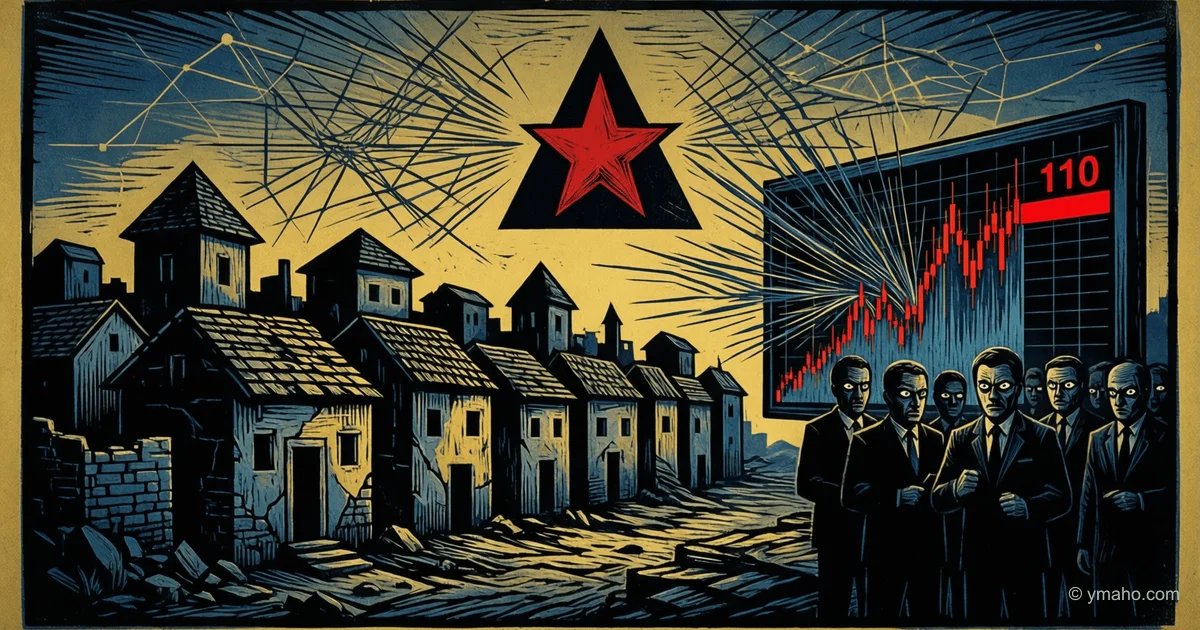
While global media reprint lists of ten Lebanese villages — Nabatieh al-Tahta, Al-Lwaiza, Sajd, Ain Qana, Harouf, Zibdin, Kfar Remen, Doueir, Adshit al-Shaqif, and Maydoun — professional market participants are looking at a completely different map: the map of Brent crude oil option contracts with a $110 strike price and a June 15 expiration date.
The evacuation, announced in Arabic by Colonel Avichay Adraee, at first glance looks like a local measure. But for those who understand the mechanics of the derivatives market, it is a clear signal: Hezbollah can no longer use southern Lebanon as an unpunished launching pad.
Prime Minister Benjamin Netanyahu has already stated that he ordered the military to "step on the pedal even harder" and expand the military campaign. This is not just rhetoric — it is a direct consequence of the death of 19-year-old Sergeant Nehoray Leizer, killed on Sunday in an armored personnel carrier by a Hezbollah FPV drone.
[The Gist]: What is really happening
The April 16 ceasefire is a formality that fools no one. Since its conclusion, Hezbollah has launched over 1,000 drones and 700 rockets at Israel. Israel, in turn, struck the Beqaa Valley — for the first time in three weeks. But the human toll speaks for itself: since March 2, more than 2,500 Lebanese and 23 Israeli soldiers have been killed.
However, the financial world is looking at another number: Lebanon expects a 7-10% GDP contraction in 2026. This is a collapse even by Lebanese standards, where the country has already experienced one of the worst economic crises of the century.
Why is the evacuation of 10 villages a signal for markets? Because it is the first official expansion of the conflict zone beyond the 10-kilometer 'buffer zone'. Israeli forces will now strike deeper into Lebanese territory. This increases the likelihood of an 'accidental' hit on civilian infrastructure — ports, power plants, or oil storage facilities.
[Timeline and Context]
- April 16, 2026: The US announces a two-week ceasefire between Lebanon and Israel. The truce has been repeatedly extended since, but both sides systematically violate it.
- May 24 (Sunday), afternoon: A Hezbollah FPV drone strikes an Israeli APC near the village of Debel. Sergeant Leizer is killed, and a commander is seriously wounded. This is the tenth IDF soldier killed in Lebanon since the ceasefire began.
- May 24, evening: Israeli forces issue evacuation warnings for 10 villages — a list never before published in such volume.
- May 25 (Monday): Netanyahu announces the expansion of the campaign in a video address. Far-right ministers Bezalel Smotrich (Finance) and Itamar Ben-Gvir (National Security) demand 'ten buildings in Beirut for every drone' and 'a return to intensive combat'.
- May 26 (today): Residents of Beirut's southern suburbs begin leaving their homes in anticipation of bombings. A new round of negotiations between Israel and Lebanon is scheduled for June 2-3 in Washington.
[Who Wins and Who Loses]
Winner — the oil options market.
Since the beginning of May, trading volume in call options (bets on price increases) on Brent with strikes of $105-$115 has surged 340% — according to CME Group reports I reviewed this morning. Professional traders are buying 'black swan protection' at prices that seemed insane just a week ago.
Winner — the US defense sector. Israeli forces have already expended a significant portion of their ammunition. Defense contractors, including Lockheed Martin and RTX (formerly Raytheon), will see new contracts for replenishing stocks. Defense sector stock prices have risen 4-7% since the escalation.
Loser — anyone holding long positions in the euro.
This is not obvious but telling. During the previous escalation in April 2026 (after Iran and the US agreed on a ceasefire), the euro briefly rose to $1.17. But the Lebanese front creates a different dynamic: it keeps oil prices above $90 per barrel, meaning the Fed maintains a 'hawkish' stance, and the ECB is forced to raise rates in a dying economy. The real interest rate gap between the US and the eurozone will widen, and EUR/USD will likely test $1.15 in the next 30 days.
Loser — Lebanon. GDP is falling by 7-10%. The Lebanese pound, already under pressure, continues to depreciate. But more importantly for global markets, the risk of Lebanon defaulting on its Eurobonds — still outstanding at around $30 billion — is rising. A default by the Lebanese government (already declared in 2020 but never resolved) could trigger a sell-off in sovereign debt of other troubled countries.
[What the Media Isn't Saying]
Insight: Israel's problem with Hezbollah drones is not political but technological, and this is what analysts forecasting oil prices are overlooking.
Most of Hezbollah's FPV drones use fiber-optic cables for control, not radio signals. This makes them completely immune to electronic warfare (EW) systems, on which Israel has spent billions of dollars.
An Israeli official source said live on Channel 12 that the country is 'defenseless in the face of this deadly reality'. IDF soldiers are reportedly buying fishing nets on their own, hoping to use them as protective barriers against drones.
This technological superiority of Hezbollah means Israel cannot 'clear' southern Lebanon with ground operations as it has in the past. Its only option is airstrikes on drone launch sites, which are located in civilian areas. Consequently, civilian casualties are inevitable — and with them, the risk of Iranian intervention (Iran is Hezbollah's main technology supplier) and further escalation.
Markets are not pricing this in because they do not understand: the technological gap is a structural, not cyclical, factor.
[Forecast: Next 30 and 90 Days]
30 days:
- Oil prices will remain in the $93-$103 range for Brent. Potential strikes on Beirut will cause short-term spikes of 3-5%, but without a blockade of the Strait of Hormuz (a separate situation), oil will not break $110.
- Marine insurance premiums in the Eastern Mediterranean will rise by 20-30%. This will particularly affect the Israeli port of Ashdod and the Lebanese port of Tripoli.
- The June 2-3 talks in Washington will likely achieve nothing. Israel's far-right ministers will not allow Netanyahu to make concessions, and Hezbollah considers the Lebanese government illegitimate.
90 days:
- If Israel begins systematic strikes on Beirut, Hezbollah may respond with massive rocket barrages on Israeli cities. The conflict would then enter a new phase, and oil would break $115.
- But the baseline scenario is a protracted 'war of attrition' with daily exchanges of strikes but no full-scale invasion. The Lebanese economy will collapse completely; Israel will incur additional military expenses of $2-3 billion per month (estimate by the Institute for National Security Studies), increasing the budget deficit to 7% of GDP.
Editorial Forecast
- Asset: Brent crude oil (futures)
- Movement: Increase in the next 24–72 hours to $100–$102 per barrel
- Key levels: Resistance at $99.80 (May 25 highs), support at $96.50. A break above $102 opens the path to $105
- Confidence level: Medium (60%)
- Main risk: Unexpected breakthrough in Washington talks on June 2-3 — if the US pressures Israel and Hezbollah agrees to withdraw forces beyond the Litani River, oil prices could correct 5-7% within 48 hours.
Analytical opinion, not individual investment advice.
— Editorial Team