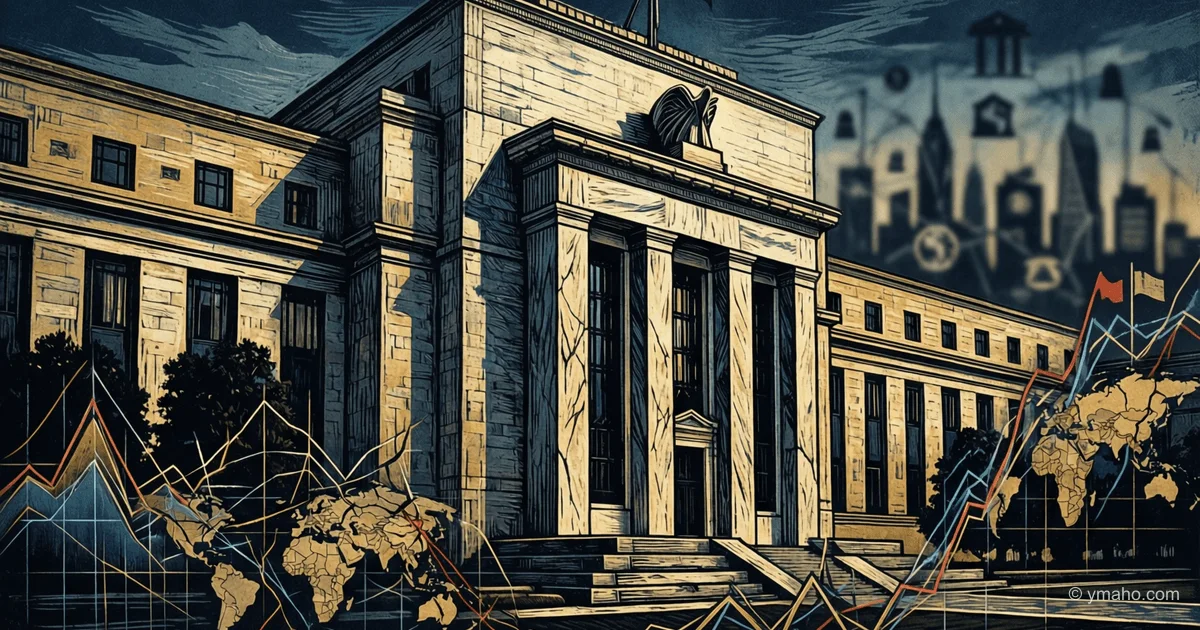
Hawkish Sentiment Intensifies at the Fed, Focus Shifts to Keeping Rates High
Minutes from the April FOMC meeting revealed a shift in stance: the committee now emphasizes the need for a prolonged pause due to high inflation and geopolitical risks. The market is pricing in a rate hike by end-2026.
The Committee Plays the Long Game: Why the Fed's 'Hawkish Pause' Is a Stealth Tightening of 50 Basis Points
While headlines scream about a 'hawkish pivot' and the April FOMC minutes, the bond market has been digesting information that was available to the attentive as early as May 20 for two days now. The minutes, released last Wednesday, showed not just a 'shift in sentiment' — they captured a tectonic shift in the Fed's operating model that most investors are only realizing now, nearly a week later.
The Fed isn't just holding the rate at 3.5-3.75% — it has effectively frozen the market in anticipation, and the geopolitical escalation in the Strait of Hormuz has provided the Committee with the perfect excuse for the longest pause in two decades. But the true reason runs deeper than war and oil prices.
[The Core]: What's Really Happening
The key phrase from the minutes: 'an overwhelming majority of participants noted an elevated risk that inflation would return to the 2% target later than they had anticipated.' This is diplomatic language for admitting that the Fed's base case of a soft landing has collapsed. Committee members, including three regional presidents (Hammack from Cleveland, Kashkari from Minneapolis, and another undisclosed hawk), insisted on removing language about 'carefully assessing' risks from the statement as early as the April meeting.
But the real insight not in the news: the federal funds futures market is now pricing in roughly a 38% probability of a rate hike by March 2027. That's up from 21% just days before the minutes were released. However, I argue these numbers are laughably low.
Why? Two-year U.S. Treasury notes, the most Fed-policy-sensitive instrument, are yielding 4.1%. That's 35-60 basis points above the current Fed rate. The bond market has been the best predictor of central bank decisions for years. And right now, it's screaming that the rate should be at least 50 points higher.
[Timeline and Context]
- April 29-30, 2026: The Fed holds rates steady for the third consecutive time. The vote is 8-4, the deepest split since October 1992. Jerome Powell chairs his last meeting.
- May 15: Powell's term expires. Kevin Warsh, Trump's nominee, officially takes office, promising to review the Fed's economic models and communication strategy.
- May 20, 2:00 PM Washington: Release of the April FOMC minutes. The market sees in black and white for the first time: 'some further policy firming likely would become appropriate.'
- May 21-22: Analysts at TD Securities and Ed Yardeni (Yardeni Research) confirm: the hawkish momentum is building, and a July rate hike becomes the base case.
- May 25 (two days ago): U.S. and Israeli strikes on Iranian vessels near Larak Island. Brent jumps above $98.
- May 26 (today): Markets price in a rate hike by end-2026. The 10-year Treasury yield holds above 4.4%.
[Who Wins and Who Loses]
Winner: Kevin Warsh and the hawks within the FOMC.
Warsh received a perfect gift: the Middle East conflict fuels inflation, giving him political cover for the toughest start in Fed history. He can raise rates in July (probability high, per Yardeni Research estimates) and blame Iran and the Strait of Hormuz, not the White House.
Winner: The U.S. Dollar (DXY).
The dollar index broke late-April highs and is heading toward 100. The two-year EUR:USD swap spread has widened to -100 basis points, removing a key driver of euro resilience that relied on the ECB's hawkish repricing relative to the Fed. Deutsche Bank confirms: the Fed's hawkish revision directly supports the dollar.
Loser: The U.S. stock market (S&P 500).
Ed Yardeni, one of the few remaining optimists, admits that 10-year yields around 4.6% look 'critical.' If they move to 4.75%, tech stocks and high-debt sectors will come under pressure. Capital rotation from overheated semiconductors into defensive assets has already begun.
Loser: The European Central Bank.
The ECB is forced to raise rates (the market expects +25 basis points in June) to protect the euro from collapse. But the eurozone economy, choking on expensive energy, cannot handle it. The ECB is trapped: imported inflation demands tightening, while recession demands easing. Brussels officials now envy the Fed, which has a 'trump card' — a strong domestic market and energy independence.
[What the Media Isn't Saying]
Insight: The Fed minutes directly point to a new, previously undiscussed inflationary factor — 'large investments in artificial intelligence.'
Yes, you heard that right. The Fed has included AI in its list of risks to price stability. Several FOMC members noted that 'price pressures associated with large investments in AI are likely to raise costs in a number of industries.'
What does this mean in practice? Hyperscale data centers from Microsoft, Google, Amazon, and Meta consume enormous amounts of electricity and specialized equipment (Nvidia chips, cooling systems). Demand for copper, aluminum, rare earth metals, and electricity has soared. The Fed is acknowledging for the first time that the tech boom itself is becoming a pro-inflationary factor, independent of geopolitics and oil.
This is why the 'pause' will last longer than anyone expects. Even if the Strait of Hormuz opens tomorrow, AI investments will continue to drive up commodity and energy prices. The Fed is now fighting not cyclical but structural inflation.
[Forecast: Next 30 and 90 Days]
30 days:
- The June FOMC meeting (June 16-17) will be a 'warm-up' — Warsh formalizes the abandonment of the dovish bias but leaves rates unchanged.
- The 10-year Treasury yield will rise to 4.6-4.7% on expectations of a July hike.
- EUR/USD will break 1.16 and test 1.15. This creates risks for European exporters.
90 days:
- If inflation does not slow by August (and with oil prices above $95 for Brent, it won't), the Fed will raise rates in July by 25 basis points.
- Probability of this scenario: around 65%. Warsh needs a 'first shot' to show markets he means business.
- The dollar will strengthen another 2-3% against a basket of currencies. Gold (XAU/USD) could rise to $2950 as investors seek protection from both inflation and a hawkish Fed simultaneously — an anomalous correlation that breaks classic models.
Editorial Forecast
- Asset: U.S. Dollar Index (DXY)
- Direction: Up in the next 24–72 hours
- Key Levels: Current ~99.20, next target 100.00, on break 100.80. Support at 98.70
- Confidence Level: High (80%)
- Main Risk: An unexpected U.S.-Iran agreement on the Strait of Hormuz (e.g., in the next 2-3 days). If oil crashes below $90, markets will pivot to expectations of imminent Fed rate cuts, and the dollar will lose 1-1.5% in a day.
Analytical opinion, not individual investment advice.
— Editorial Team