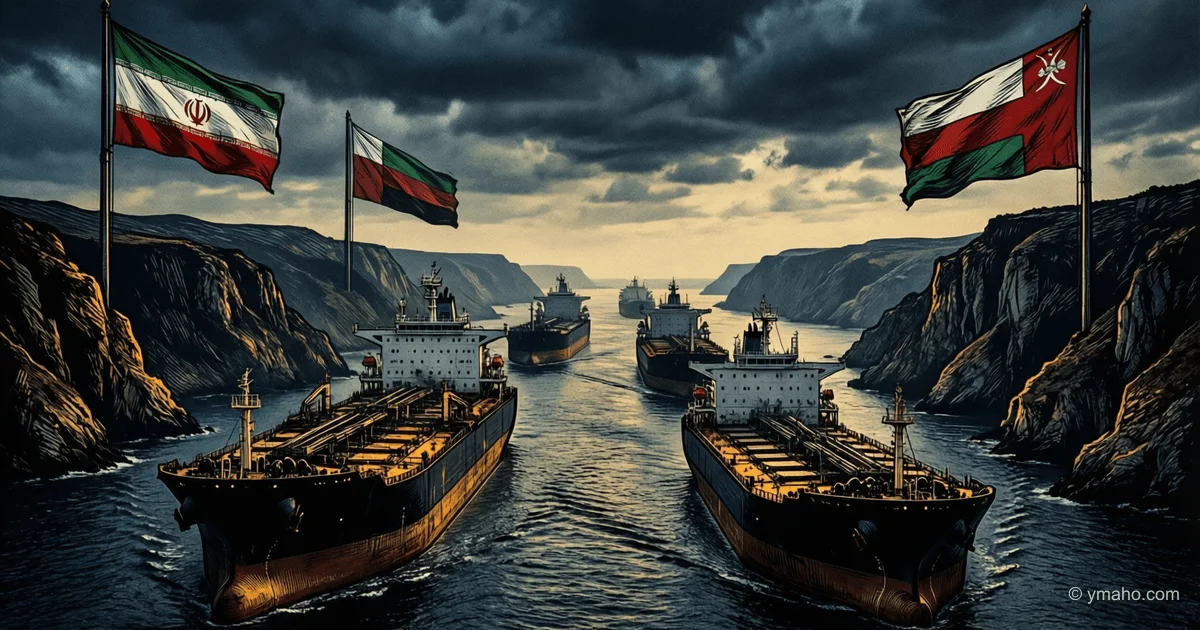
Iran Discusses with Oman the Introduction of a Fee for Passage Through the Strait of Hormuz
Tehran is in dialogue with Oman about the possibility of introducing a fee for ships passing through the Strait of Hormuz, which is unacceptable to Washington and creates additional obstacles in negotiations.
The Hormuz Tax: Why Oman Agrees to a Deal with Iran, and Markets Look the Other Way
[The Gist]: What's Really Happening
The news that Iran is discussing with Oman a joint system for collecting fees for passage through the Strait of Hormuz is being presented as a "complication in negotiations." "Unacceptable to Washington." "Creates obstacles."
As a financial analyst tracking real flows of "gray" money, I'll tell you: this is not an obstacle. It's the final bargaining over a share in the new world order of shipping.
Notice the key detail that almost everyone misses. Iran insists on the legal wording "service fee" rather than "toll." Under international maritime law (UNCLOS), direct transit tolls in international straits are prohibited. But fees for actual services rendered—navigation assistance, pilotage, waste disposal—are permitted.
Iran isn't inventing anything new. It's simply taking a ready-made legal scheme that works in the Suez and Panama Canals and trying to apply it to Hormuz. The difference is that the Panama Canal is a man-made structure, while Hormuz is a natural strait. But Iran doesn't care about the difference.
Amin-Nejad, Iran's ambassador to France, told Bloomberg outright: those who want to benefit from this traffic must pay. The US says "no." But Oman, which sits on the opposite shore, is already negotiating its share.
Timeline and Context
Let's reconstruct how we got here.
Early March 2026 — Iran unilaterally begins blocking the Strait of Hormuz in response to the US operation "Epic Fury." Traffic drops from 120–140 ships per day to just over 20.
April 2026 — Iran officially announces the creation of the Persian Gulf Strait Authority (PGSA). This bureaucratic structure will issue permits and collect money.
May 20, 2026 — Iran's ambassador to France, Amin-Nejad, gives an interview to Bloomberg, publicly confirming negotiations with Oman for the first time.
May 21, 2026 — PGSA publishes a map on social media expanding Iran's control zone in the strait, encroaching on the waters of the UAE and Oman.
May 21–22, 2026 — Marco Rubio and Donald Trump publicly reject the idea of any fees. "We want it to be open and free," Trump says. Rubio adds, "This is impossible. It would make a diplomatic deal unworkable."
May 22–23, 2026 — The NYT publishes details: Oman, which previously rejected joint management, is now discussing its share of revenues, having realized the potential economic benefits.
Non-obvious insight: Oman isn't just "discussing." Oman has already agreed; the sides are just arguing over the percentage. According to two Iranian sources cited by the NYT, Oman told the Iranians it is ready to use its influence on Gulf neighbors and the US to promote this scheme. Oman is a US ally. It hosts the port of Duqm, used by the Pentagon. And it is this ally that is now bargaining with Iran over how to split the revenue from the strait tax.
This is not a "complication in negotiations." It's a signal to Washington: any deal to reopen the strait will include the "Hormuz tax" as a given. The only question is how much Oman gets and how it will be legally structured.
Who Wins and Who Loses
Oman wins — and it's the main non-obvious beneficiary. The sultanate gets a steady stream of income for doing nothing. Its ports are already used for transit. Now it will collect a commission on every tanker passing through the strait. That's billions of dollars a year. And Oman saves face: officially, it's "joint security management," not extortion.
Iran wins — economically. Even with traffic at 20 ships per day and a fee of up to $2 million per vessel (figures reported by Bloomberg), that's $40 million per day, or $1.2 billion per month. If traffic recovers to pre-war levels of 120–140 ships, revenue could rise to $250–300 million per day. That's comparable to Iran's oil revenues before the war.
Insurers win. Lloyd's and P&I clubs will treat the "service fee" as an insured risk, building it into premiums. The higher the official fees, the higher the insurers' commissions.
Global trade loses — and this is a long-term trend. If Hormuz becomes tolled, a precedent is set. The Strait of Malacca, Gibraltar, the Bosporus — all chokepoints will want their share. Container freight rates will rise by 10–20% in the long term. This is an inflationary factor that no one is yet pricing in.
The Trump administration loses publicly but wins in practice. Trump says "no taxes." But behind closed doors, his team has already agreed that the scheme with Oman is the "lesser evil." Better to pay Iran through Oman than to fight for every tanker.
What the Media Leaves Out
The first omission, and the most important: payments are already happening. Iranian sources claim that about 30 ships, including tankers under Chinese and South Korean flags, have already passed through the strait after paying "fees." It doesn't matter whether Beijing and Seoul officially confirm this. What matters is that ships are moving. The system is already working. The negotiations with Oman are an attempt to legalize what is already happening.
The second omission: the legal framework is already thought out. Iran will not charge a "transit toll." It will charge an "environmental fee," a "pilotage fee," a "navigation fee." And this will be hard to challenge because services are formally provided. Professor James Kraska of the US Naval War College called this "extortion disguised as a service fee." But international law has no enforcement mechanisms when Iran simply ignores UNCLOS (it is not a party to the convention).
The third omission: RPST is not just a map. On May 21, PGSA published a map showing Iran's control zone encroaching on the waters of the UAE and Oman. This is a direct annexation of other countries' territorial waters. But neither the UAE nor Oman declared war. They are negotiating. Because they understand: Iran de facto already controls the strait. Resistance would only increase losses.
Forecast: Next 30 Days and 90 Days
30 days: The "service fee via Oman" scheme will be agreed within 1–2 weeks after the signing of a 60-day ceasefire. Oman will get 15–20% of the fees for "administration." The US will publicly state that it "does not support the fees" but will not block the scheme because it is implemented through an ally. Traffic in the strait will begin to recover to 50–60 ships per day by the end of June.
90 days: Traffic normalizes to 80–100 ships per day. The "Hormuz tax" becomes a permanent fixture — from $500,000 to $2 million per tanker depending on size and cargo. Global trade adapts; oil prices will maintain a premium of $5–10 per barrel over pre-war levels due to new costs. The legality of the scheme will be mired in lengthy litigation, but ships will continue to pay because there is no alternative.
Editorial Forecast
Asset and direction: War risk insurance premiums in the Persian Gulf — short-term decline, but will remain above pre-war levels.
News of Iran's negotiations with Oman signals a gradual normalization of shipping, but also the formalization of a "transit tax." Insurance companies will begin to adjust their risk models downward in the next 48–72 hours, but the base premium will remain 2–3% above pre-war levels due to lingering geopolitical uncertainty and new fees.
Key levels: Current premiums are 3–5% of vessel value per voyage. We expect a decline to 2–3% by the end of next week.
Confidence level: Medium (60%). Negotiations are in an active phase, but final details (including Oman's share) have not yet been agreed.
Main risk to the forecast: If the US publicly announces secondary sanctions against Oman for participating in the scheme — which is unlikely but cannot be ruled out — insurance premiums will spike back to 5–7% within 24 hours. Watch for State Department statements in the next 48 hours. Any mention of Oman in the context of "unacceptable behavior" will be a red flag.
— Editorial Team









