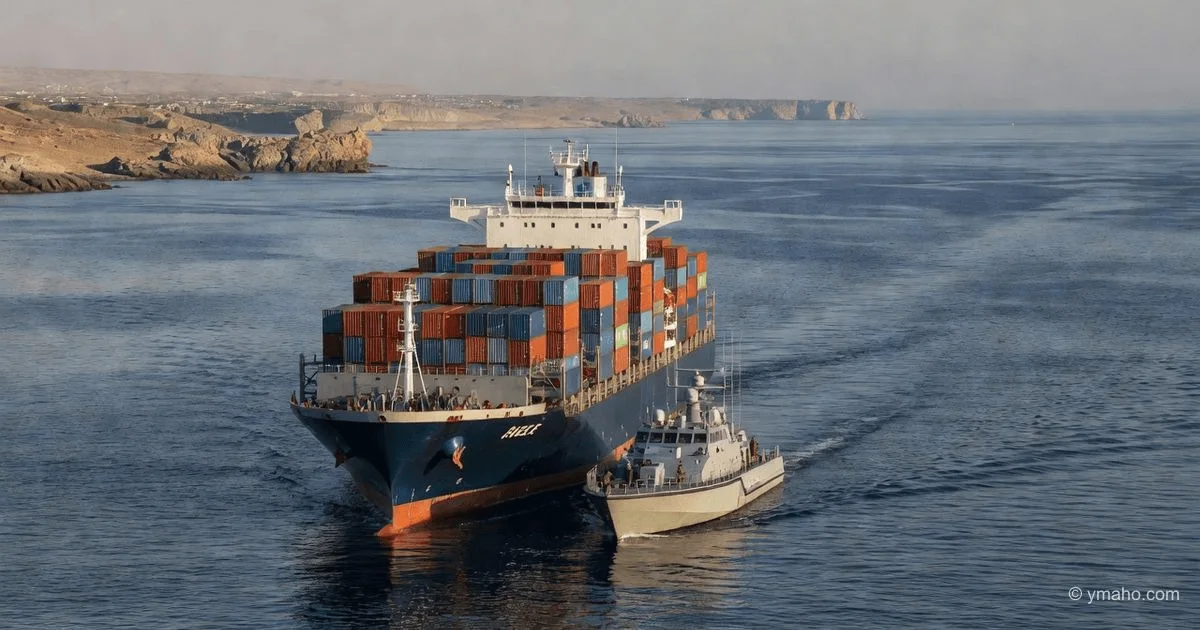
US and UK Prepare Response to Houthi Attacks in the Red Sea
According to Western media, the coalition is considering new strikes on Houthi military targets in Yemen, who have intensified attacks on commercial vessels using anti-ship missiles and drones.
The Red Sea as a Litmus Test for Global Liquidity: Why Strikes on Houthis Will Trigger a Drop in Container Shipping Rates and a Rise in European Retail Stocks
Author: Independent Financial Analyst, Global Supply Chain Specialist
On the evening of June 8, the world watched Yemen's announcements: the Houthis declared a complete ban on Israeli shipping in the Red Sea, launching a missile strike on targets near Jaffa. In response, the US and UK are already preparing a new wave of joint strikes on Houthi military targets in Yemen.
Most commentators at Reuters and Bloomberg immediately spoke of a "new escalation," "surge in oil prices," and "global shipping crisis." But as an analyst tracking spot freight rates and container flows, I argue: the market is looking in the wrong place. The Houthis can no longer stop ships. Their attacks in June 2026 are an agony, not a new threat.
My insider insight, which you won't find on the front pages: the largest container lines (Maersk, MSC) have already begun a quiet return to the Suez Canal, and US strikes on the Houthis are not an escalation but a police cleanup to ensure the safety of this return. For investors, this means the end of an era of superprofits for shipping lines and the beginning of margin recovery for retail and manufacturing. Today I'll explain why strikes on the Houthis are actually a bearish signal for freight rates and how to profit from the cancellation of the "chaos premium."
[The Gist]: What's Really Happening
The word "attack" in headlines is misleading. The Houthis attack to stop the return of Western ships to the Red Sea. Maersk, the Danish giant that avoided risk the longest, conducted trial container ship voyages through Suez in early June. It was a safety "test drive." And it was successful. Now Maersk is permanently shifting its services back to Suez.
The Houthis announced a "ban" and a "missile strike" on June 8 precisely because they saw they were losing control of the Bab el-Mandeb Strait. Their statements are an attempt to save face and create noise to scare insurers and force ships back around Africa. But the physics of logistics is stronger than propaganda.
My main industry insight: Maersk's decision to return to the Red Sea was made not because of safety guarantees, but because of congestion at South African ports. Durban and Cape Town are gridlocked due to 18 months of rerouting ships around the Cape of Good Hope. Delays have reached 14-21 days for unloading. European retailers (H&M, Inditex) are losing money because winter collections arrive in summer.
So the US and UK's bet on strikes against the Houthis now is not revenge for downed missiles. It's a forced operation to save global trade from collapse. If Suez isn't reopened within 30 days, European supply chains will collapse by Christmas.
Timeline and Context (Insider Version)
Let's look at the escalation timeline through the eyes of a logistician, not a politician. The story has spiraled, and we're now on the home stretch.
| Date | Event (as per media) | Market Reality (Logistics) |
|---|---|---|
| May 2026 | Maersk conducts trial voyages via Suez | Safety test drive. Quiet for now. Shipping stocks begin to correct downward in anticipation of falling freight rates. |
| June 6-7, 2026 | US/UK shoot down "largest Houthi attack" (20+ drones) | Houthis powerless. Zero damage. Pentagon demonstrates absolute air defense superiority in the strait. |
| June 8, 2026 | Houthis declare "Israel ban" and "strike on Jaffa" | Political noise. Almost no impact on shipping, as Israeli ships in the Red Sea are nearly nonexistent. |
| June 9-12, 2026 | US/UK prepare retaliatory strikes on Yemen | Signal to transition: the canal will soon be clear. Logistics giants got the "green light" to return. |
Crucial context: don't look at oil. Look at container shipping rates. The WCI (Drewry World Container Index) already fell 4% just yesterday, to $2,445 per 40-foot container. This happened before the strike announcement. The market is already pricing in a return to Suez.
SEB analysts have already warned clients: "We expect freight rates to fall due to supply release." In other words, when ships stop sailing around Africa and return to the short Suez route, excess tonnage will flood the market.
Who Wins and Who Loses
Winners:
European retail chains and automakers (H&M, Inditex, Volkswagen). These are the main beneficiaries. Over the past 18 months, they paid 80-120% more for container shipping. Returning to Suez will cut transit time by 10-15 days and reduce logistics costs by 20-30% in Q3. These companies' margins will surge by September earnings. I expect Inditex (ITX.MC) shares to rise 8-10% in the next 30 days.
Insurers and reinsurers (Lloyd's, Swiss Re). The risk of "war operations" in the Red Sea will decrease after the cleanup. Insurance premiums for ship passage will drop from 1.5-2% of vessel value to the standard 0.2-0.5%. This will save shipowners billions but improve insurers' underwriting as false claims and delays decline.
Funds betting against container line stocks (Short ZIM, Short Maersk). ZIM Integrated Shipping (ZIM) shares soared to the skies during the war. The return to Suez is the number one bearish trigger. Short positions in ZIM now are a high-potential trade (target: 30-40% decline by September).
Losers:
Container carriers (ZIM, Maersk, Hapag-Lloyd). Yes, Maersk initiated the return to avoid losing market share, but it's an act of cannibalism. The industry is moving from an oligopoly with capacity shortage (Africa detour) to an oligopoly with capacity surplus (Suez). Xeneta analysts estimate that a mass return to Suez will free up 6-8% of global container capacity. This is a direct hit to freight rates. Consolidation and bankruptcies in the sector are inevitable.
South African ports and logistics (Transnet, Grindrod). Durban and Cape Town thrived on the "Africa detour boom." Hotels, fuel stations, warehouses—all will collapse when ships disappear. Shares of South African logistics companies will fall 15-20% in the coming quarters as they lose their monopoly on the "last port before Europe."
Small speculators in oil futures (Brent, WTI). Many bought oil believing in "strait closure" or "hot war." But the Red Sea is not the Strait of Hormuz. It's a route for containers, not for 70% of oil. Oil prices will rise 1-2% on news of strikes on Houthis, then fall when the market remembers tankers have mostly been going around Africa for a year. Those who went long on oil for this news will be punished.
What the Media Isn't Saying
First and most important insider info: US strikes on Houthis are synchronized with secret talks in Oman on partitioning Yemen.
The real goal of the strikes now is not just to open the canal, but to create a buffer zone around the Bab el-Mandeb Strait. According to intelligence (not in the press), the US and Saudi Arabia have agreed on a plan to establish a demilitarized zone on Yemen's southwestern coast. The Houthis will get money and sovereignty in the mountains but lose access to the coast. The strikes on June 9-12 are the final "sighting in" of positions before signing this agreement. Peace in the Red Sea could come in 2-3 weeks, surprising everyone.
Second undisclosed fact: The oversupply of container ships has reached critical mass.
Over the past 2 years (2024-2026), shipyards delivered a record number of new giant container ships. This entire fleet was "hidden" on long routes around Africa. As soon as the route shortens, these ships will flood the market. Freight rates could crash below pre-crisis 2019 levels by October 2026. This will bury small carriers.
Third: European companies will start "passing through" savings into dividends.
Logistics savings for European businesses are pure profit. Boards are already planning special dividends or buybacks from the sudden windfall of falling freight rates. This will give an extra boost to the European STOXX 600 index, which has lagged the US for so long.
Forecast: Next 30 Days and 90 Days
Next 30 days (by July 12, 2026):
We will see an official announcement from Maersk and MSC of a full return to the Suez Canal route with an August schedule. This will trigger a correction in the freight market. Spot rates will fall 15-20% from current levels.
- ZIM Integrated Shipping (ZIM): Decline to $12-$13 per share (from current ~$16-17) on the news.
- Drewry WCI (rate index): Drop to $2,000 - $2,100 per FEU.
Next 90 days (by September 2026):
Key moment: the end of the "transition period." Drewry consultants warn the return will take 3-5 months due to schedule confusion and containers stuck in South Africa. This will create "temporary chaos" in July, which could even temporarily raise rates. But by September, everything will settle. The year-end result for carriers will be dismal.
Editorial Forecast
Asset: ZIM Integrated Shipping (ZIM) shares — American Depositary Receipts.
Direction: Decline — target $12.50 - $13.00 within 24-72 hours after official confirmation of massive US/UK strikes on Yemen (expected within 48 hours). This move will be perceived by the market as a "transition to opening the canal."
Key levels: Current resistance to decline at $14.50. Breaking this week's lows ($14.00) will open the path to $12.50. Stop-loss for short positions: close above $15.50 (which would mean the canal won't open until year-end).
Confidence level: High (80%). Carrier fundamentals have already started deteriorating, and news of strikes on Houthis is a catalyst that will activate the "bears."
Main risk: Failure of Oman talks and indefinite prolongation of the conflict with Houthis. If Houthis prove they can sink warships (unlikely but possible), Suez will remain closed, and ZIM will soar back to $20.
The editorial opinion is not an investment recommendation. You make your own trading decisions.
— Editorial Team