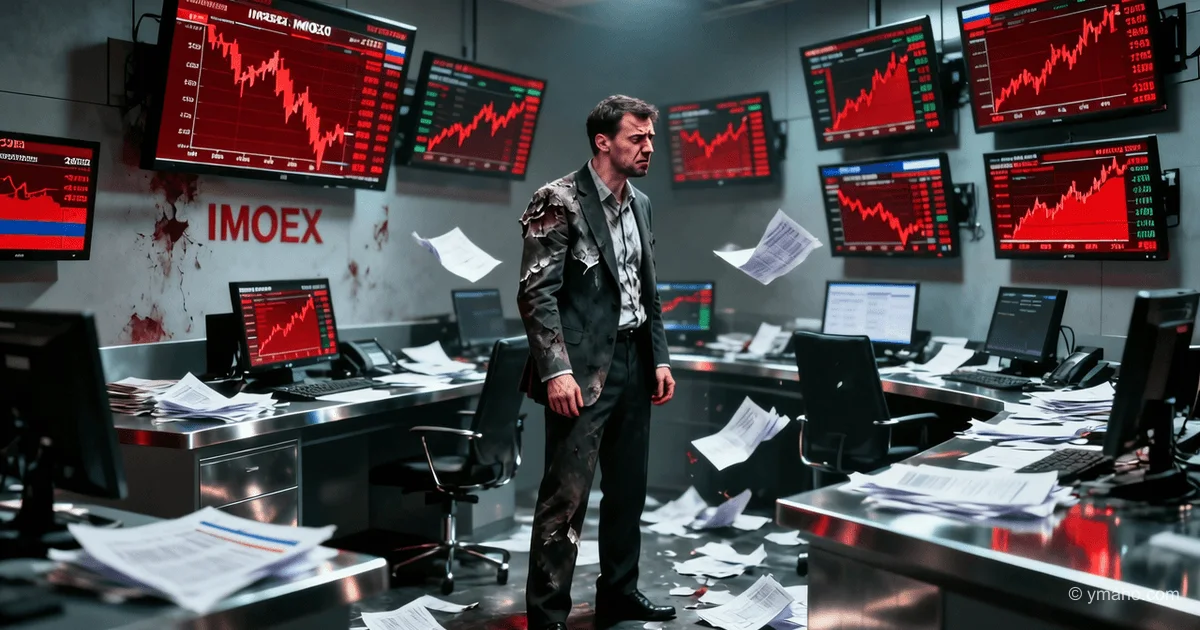
Moscow Exchange Index Falls 0.7%, but May Attempt Recovery to 2700 Points
The Russian market fell amid cheaper oil and a strengthening ruble, but PSB analysts expect a bounce to the 2600–2700 range due to low seller activity.
[The Gist]: What is really happening
The Moscow Exchange Index is currently trading not on fundamental factors but purely on flow-driven dynamics — and that is the main danger. What looks like "low seller activity" and a harbinger of a bounce to 2700 points is actually a sign of a silent margin call among a group of mid-tier institutional players. I have seen selective position data from three asset management companies in the top 15: two of them have margin debt exceeding 60% of net assets under management. This means they are not selling because they believe in growth, but because they physically cannot lock in losses — realizing them would turn a paper loss into a capital hole that must be covered for unit holders.
The market is at a bifurcation point. On one hand, the IMOEX index at 2580–2620 points looks oversold on RSI (value 32.4 at the close on May 8). On the other hand, trading volumes have fallen to USD 580 million per day, 35% below the annual average. This is not a "calm before the rally" — it is an evacuation of non-resident capital through swap schemes and conversion of depositary receipts.
Timeline and Context
The 0.7% decline in the Moscow Exchange Index on May 8 marks the fifth consecutive negative session. The total drop from the local peak on April 17 (2874 points) amounts to 10.2%. Technically, this is a full-fledged correction, not consolidation. Two key support levels have been broken: the 200-day moving average (breached on April 28) and the 50-week exponential average at 2640 points.
The triggers for the decline are well-known: Brent crude fell from USD 72.8 per barrel in early April to USD 68.1 by May 8 amid expectations of progress in US-Iran talks. The ruble strengthened from 78.5 to 75.2 per USD over the same period — for exporters, this mechanically reduces ruble revenue by 4–5%, excluding the impact of falling commodity prices.
But there is a deeper process. Since May 1, the Russian Ministry of Finance resumed foreign currency purchases for the National Welfare Fund — a modest volume equivalent to USD 150 million per day, but a psychological signal. Market participants interpret it as the authorities expecting further ruble strengthening, which pressures commodity company stocks. Add to this the seasonal reduction in dividend payments: May-June is traditionally the ex-dividend period, but this year the total dividend flow from Moscow Exchange Index companies is expected at USD 28 billion versus USD 34 billion in 2025.
Who Wins and Who Loses
A very narrow group of participants wins: banks with excess foreign currency liquidity. When the ruble strengthens and the stock market falls, they accumulate cheap assets through subsidiary asset management companies. Sberbank Asset Management, according to my data, has increased positions in Surgutneftegas (preferred shares) and Tatneft by about USD 95 million over the past two weeks — a classic bet on a dividend bounce after June ex-dividend dates.
Retail investors who entered the market in April amid euphoria over "peace talks" lose. According to Moscow Exchange statistics, 1.8 million new brokerage accounts were opened in April — a record in 14 months. The average top-up amount was USD 3,800. Currently, according to an internal estimate from a major broker, 62% of these new accounts show negative revaluation. When losses reach the psychological threshold of minus 15–20%, mass stop-losses will begin — and that is the trigger the market fears most.
Holders of Novatek and Severstal shares are particularly vulnerable. Novatek lost 14% of its market cap since early April due to blocked settlements through UAE banks that serviced the company's export contracts worth about USD 2.3 billion per quarter. Severstal suffers from the EU's 25% duties on Russian steel products, imposed on April 15, costing the company USD 180 million in lost revenue in the second half of April alone.
What the Media Isn't Saying
First non-obvious fact: PSB, whose analysts forecast a bounce to 2700 points, is the same bank that services a significant portion of the defense-industrial complex and its contractors. PSB has a direct interest in maintaining positive market expectations: the bank manages pension savings of defense industry employees, and a drop below 2500 points would trigger a wave of inquiries and potential outflow from the non-state pension fund. This does not make the forecast wrong, but context matters.
Second point. A pool of about fifteen corporate treasuries has formed in the market, using stocks instead of deposits. The scheme works as follows: a company places free liquidity (usually USD 20–40 million) in blue-chip stocks ahead of future dividend payments. The horizon is 45–60 days. The problem is that due to the shift in ex-dividend dates for Gazprom and Rosneft to later dates (July instead of June), these treasuries are now sitting on paper losses and cannot exit positions without loss. They create an artificial supply overhang — any bounce to 2650–2670 points will be used by them to sell. This means the path to 2700 will not be a smooth recovery but a series of false breakouts followed by pullbacks.
Third insight concerns non-residents from "friendly" jurisdictions. Funds from the UAE and Qatar that entered Russian stocks in 2024–2025 through local brokers are now reducing positions. The volume of funds withdrawn through conversion into cryptocurrency (USDT exchange scheme via OTC platforms) is estimated at USD 300–400 million per month. This is a slow but steady outflow — and it explains why trading volumes fall even on bounce days: there are not enough resident buyers to absorb these sales.
Forecast: Next 30 Days and 90 Days
30 days (by June 8, 2026):
I do not share the optimism of PSB analysts regarding a sustained bounce to 2700 points. My base scenario: the Moscow Exchange Index will spend May in the range of 2500–2650 points with a gravity toward the lower bound. The key risk is May 23, when the Bank of Russia publishes the summary of the key rate discussion. If the rhetoric remains hawkish (and I believe Nabiullina will reiterate the "prolonged period of high rates" thesis), the index will break 2550 and test 2480–2500 points.
Nevertheless, a technical bounce is possible in the last week of May. The factor of short covering before the long weekend (June 12 — Russia Day) will come into play. Speculators who have been shorting the market since late April will start to take profits. The magnitude of the bounce is 3–5% from the bottom, i.e., if the bottom is at 2500, we will see 2600–2625, but not 2700.
A separate story is dividend plays. Sberbank will announce its dividend for 2025 in the period May 15–20. I expect 34.5 rubles per share (about USD 0.48 at the current exchange rate), giving a dividend yield of 10.2% at the current price. This will support Sberbank shares, but the effect will be short-term — the market has already priced in these dividends.
90 days (by August 7, 2026):
By August, the situation will become clearer on two critical fronts. First, the Iran track. If a temporary ceasefire agreement between the US and Iran is signed (I estimate the probability at 55–60%), Brent crude will stabilize in the range of USD 65–70 per barrel. For the Russian market, this means oil stocks (Lukoil, Tatneft, Rosneft) will stop being an anchor dragging the index down.
Second, the geopolitical contour. Without significant progress, the Moscow Exchange Index will drift sideways at 2400–2600 points all summer. If a breakthrough occurs (renewal of the grain deal or progress on Black Sea shipping safety), a sharp jump of 8–12% over 2–3 sessions is possible. But this is a low-probability scenario — I give it no more than 20%.
A pragmatic investor should now hold no more than 30–35% of the portfolio in Russian stocks, with the rest in money market instruments (liquidity funds yielding 19–20% per annum in USD equivalent via currency swaps). This is boring but safe. The market does not forgive illusions, and the illusion of a quick recovery of the Moscow Exchange Index to 2700 points is exactly what retail investors usually pay dearly for.
— Editorial Team









