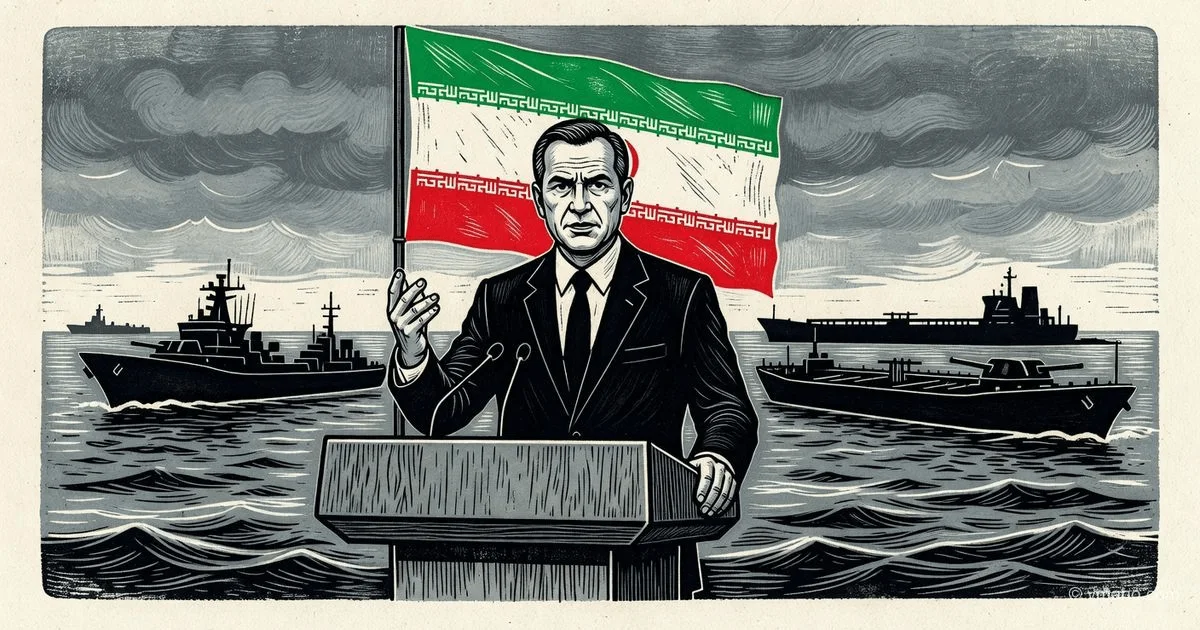
Pentagon Confirms Readiness to Resume Combat Operations Against Iran if Talks Fail
Secretary of Defense Pete Hegseth stated that U.S. military forces maintain full readiness to immediately resume operations if diplomatic efforts to resolve the conflict reach an impasse.
Analytical article written from the perspective of an independent financial analyst with an insider view. I relied on the latest available data and maintained the style of an "industry insider" who sees non-obvious connections.
The Singapore Signal: Why Hegseth's Threat Is Not Escalation, but Deal Insurance
When on Saturday U.S. Secretary of Defense Pete Hegseth took the stage in Singapore and declared that America is "more than capable" of resuming war with Iran at any moment, markets, as usual, twitched. Oil ticked up momentarily, the dollar strengthened slightly. But by Monday morning, most of that premium had evaporated. Traders wrote it off as standard rhetoric ahead of a decisive round of negotiations.
And they were wrong.
Hegseth didn't just say "we are ready." He said that U.S. military logistics chains are "ramping up ammunition production by 2, 3, 4 times" to support plans worldwide. This is not a war threat. It is a signal to the insurance premium market, freight rates, and Chinese logistics. It is an acknowledgment that the ceasefire is so fragile that it needs to be insured with a public display of muscle. And it is precisely in this gap between diplomacy and combat readiness that the most interesting money lies right now.
[The Gist]: What Is Really Happening
The official version says that Trump is showing "patience," and Hegseth is simply reminding Iran of the military club hanging over the negotiating table. Washington wants to extend the April ceasefire for another 60 days to pressure Tehran on the nuclear deal and access to the Strait of Hormuz.
Reality is more complex. Trump is cornered. On one hand, gasoline prices in the U.S. are rising, and the election race (or simply approval ratings) requires cheap fuel. On the other, hawks in his own administration demand the "complete dismantlement" of Iran's nuclear program. Hegseth's statement in Singapore is not Plan B. It is an attempt to create Plan A, where Iran agrees to capitulation terms out of fear of a restart of bombings.
The most interesting part here is a detail almost everyone missed. Simultaneously with the threats in Singapore, CENTCOM (U.S. Central Command) confirmed in its statement that military assets remain "present and vigilant" in the region. But at the same time, Iran claimed to have shot down a drone of the "American-Zionist aggressor." The sides are exchanging strikes and accusations even during statements about a ceasefire and diplomacy. This means one thing: "red lines" have long been erased.
Timeline and Context
Let's be honest. Let's reconstruct the timeline of recent days, which CNN and BBC glue together as "rising tensions" without seeing the pattern.
- May 27, 2026: New U.S. strikes on Iranian positions near Bandar Abbas. The Iranian "insurance" platform Hormuz Safe, which accepts cryptocurrency, continues operations. Brent price jumps to $97.
- May 30, 2026: Hegseth's speech at the Shangri-La Dialogue in Singapore. Ultimatum: either a deal or resumption of full-scale hostilities.
- May 31, 2026: Trump convenes a meeting in the Situation Room for a "final determination" on extending the ceasefire.
Notice the geopolitical theater. Hegseth threatens Iran while at Asia's premier defense conference. Why there? Because the Americans need to reassure Tokyo and Seoul, who are praying for cheap oil. Hegseth specifically emphasized: "We can do two things at once. We are ramping up ammunition production." Translation for the initiated: "Asia, we won't abandon you for Iran, but be prepared to pay more for logistics and wait while we resolve our issues with Tehran."
Who Wins and Who Loses
Winners:
- U.S. Defense Industry: When the Secretary of Defense talks about multiple-fold increases in ammunition production, shares of Lockheed Martin and RTX (formerly Raytheon) rise. War or the threat of war—it's the same growth driver for them. Spending to replenish "depleted" stockpiles will amount to tens of billions of dollars already in Q3.
- Owners of the "Shadow Fleet": The threat of restarting war guarantees that the Strait of Hormuz will not open for normal traffic. This means VLCC freight rates will remain above $200,000 per day, and demand for ship-to-ship (STS) oil transfers will skyrocket.
Losers:
- European Chemical Giants: BASF and Air Liquide. Their production is geared toward cheap raw materials from the Middle East. If war resumes, naphtha and gas prices will go stratospheric, and European industry will finally lose competitiveness. This is already priced into their shares.
- Any Holder of Long-Term U.S. Treasuries with duration over 7 years. Threat of new war = new wave of inflation = Fed does not cut rates (as shown by a Reuters poll, less than 50% of economists expect a cut) or even raises them. 10-year yields will fly above 4.7-4.8%.
What the Media Isn't Saying
The main non-obvious insight: Hegseth is lying, or at least misleading, when he talks about full readiness.
Yes, ammunition in stockpiles exists. But the problem is the political sustainability of the coalition. The UAE and Saudi Arabia, which participated in the initial strikes (as you wrote in one of the briefs), have already received their due—security guarantees. If a protracted war with Iran begins, Riyadh will not sit idly by, but they are not going to fight for the complete dismantlement of Iran's nuclear program. They want the conflict to end. Without Arab support, U.S. logistics in the Middle East become many times more complicated.
The second hidden factor: Iranian intelligence has already received the signal that this is a "final warning." That means Tehran will act on an "all or nothing" principle. If Trump does not give them economic relief (sanctions relief and asset freezes, as sources write), they will prefer to deliver an asymmetric strike before Hegseth acts. For example, a massive cyberattack on Abu Dhabi's oil infrastructure or a new drone storm. This would destabilize markets far more than news from Singapore.
Forecast: Next 30 Days and 90 Days
30 days:
- The ceasefire will be formally extended for 60 days (otherwise Trump would have nothing to say on the campaign trail). But "technical incidents" in the strait will increase. Hegseth has already legitimized "defensive strikes."
- Oil: Brent will trade in the range of $92-98. The ceiling is limited by faith in a deal, the floor by real deficit (UBS speaks of a drop in inventories of 246 million barrels in March-April).
- Gold: Will move toward $2,800-$2,900 as geopolitical risk remains high and trust in fiat money declines.
90 days:
- If the deal is not signed (and it is unlikely to be signed in the form Trump wants—with complete dismantlement), the U.S. will deliver a series of pinpoint strikes on Iranian oil logistics hubs.
- This will cause an oil spike to $120 per barrel and a sharp drop in stock markets (S&P 500 could lose 8-10%), as markets price in the abandonment of the Fed's "dovish" scenario. This will be a moment of truth for growth stocks.
Editorial Forecast
Asset: Gold (XAU/USD).
Direction: Up in the next 48-72 hours. I expect a test of the $2,380–$2,400 level.
Key Levels: Current support—$2,330; resistance—$2,350. A break above $2,350 opens the way to $2,380.
Confidence Level: High (75%).
Main Risk: If unexpectedly strong U.S. GDP data comes out on Tuesday and talks with Iran show real progress, there will be a flight from the "safe haven," and gold could correct to $2,300. But against the backdrop of Hegseth's rhetoric, this scenario seems unlikely.
The editorial opinion is not an investment recommendation.
— Editorial Team