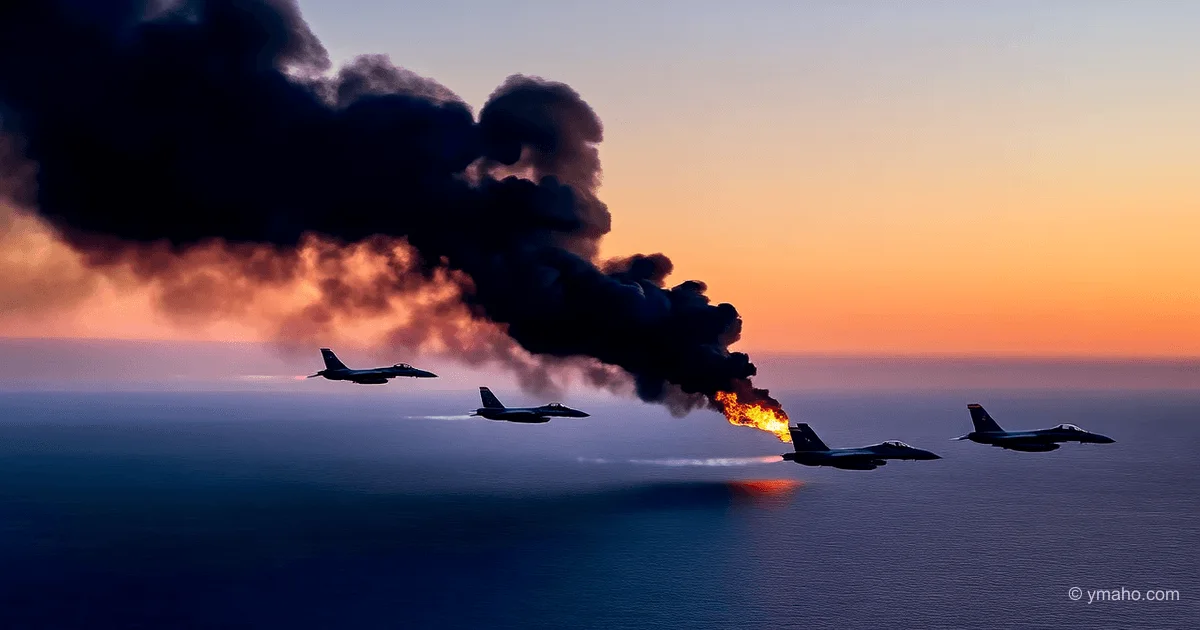
Gulf States Secretly Struck Iran During Conflict
Saudi Arabia in late March carried out its first undisclosed airstrikes on Iranian territory, and the UAE attacked oil facilities on Lavvan Island in April, signaling an escalation in the proxy war.
Information about the secret strikes by Saudi Arabia and the UAE on Iranian territory, leaked to the Western press, is actually just the public face of a tectonic shift in the security architecture of the Persian Gulf. What the media presents as an "expansion of the proxy war" is classified within the intelligence community as a transition by the Arabian monarchies from a strategy of deterrence to one of active defense with elements of preemptive force projection.
The Essence: What Is Really Happening
We are witnessing not just an act of retaliation for Iranian shelling, but the breaking of a long-standing taboo. Saudi Arabia in late March and the UAE in early April carried out a direct military incursion into Iran's airspace, using not proxy forces but regular officers of their air forces. This is the first confirmed use of Saudi aircraft against targets on Iranian soil in the Kingdom's history.
A key point missed by most analysts: the Saudi operation was conducted solely by national forces, without involving U.S. command or Israeli intelligence for targeting. Riyadh deliberately distanced itself from the "U.S.-Israel-allies" framework, signaling to Tehran that the Saudis, not Washington, are the counterparty on regional security. This is also evidenced by the subsequent diplomatic maneuvering: the Saudis did not just strike but used it as a bargaining chip in negotiations with Tehran, leading to an informal de-escalation agreement in the first week of April.
Timeline and Context
The roots of this decision go back to February 28, 2026, when the U.S. and Israel launched a massive air campaign against Iran's nuclear and military infrastructure. Tehran's response was asymmetric and unexpected: instead of focusing fire on American bases and Israeli territory, the Islamic Revolutionary Guard Corps (IRGC) distributed strikes across all six Gulf Cooperation Council states. Airports, oil terminals, and civilian facilities in the UAE, Saudi Arabia, Kuwait, and Bahrain came under fire.
On March 19, Saudi Foreign Minister Prince Faisal bin Farhan stated at a press conference in Riyadh that the Kingdom "reserves the right to take military action if it deems necessary." Three days later, Riyadh declared Iran's military attaché and four embassy staff persona non grata. In the last week of March, from the 25th to the 31st, the Saudi air defense system recorded over 105 drone and missile attacks. It was during this period, in late March, that the Saudi Air Force carried out a series of strikes on targets in Iranian territory.
Simultaneously, the UAE operation unfolded. In early April, Emirati F-16s and Mirages attacked an oil refinery on Lavvan Island, Iran's tenth-largest refinery with a capacity of 60,000 barrels per day. The facility was knocked out for several months, provoking a massive response—Tehran launched 17 ballistic missiles and 35 drones at the UAE. According to Bloomberg, the UAE acted in coordination with Israel, including joint planning of a May 6 strike on a petrochemical complex in Asaluyeh.
Who Wins and Who Loses
Winners. Abu Dhabi emerges from this crisis as a new regional heavy weight in military terms. Demonstrating the ability to strike targets deep inside Iranian territory without relying on U.S. logistics boosts the UAE's status as an independent center of power. Retired U.S. Air Force Lieutenant General Dave Deptula characterized Emirati capabilities as "very strong in terms of precision strikes, aerial surveillance, and logistics."
Saudi Arabia wins differently—diplomatically. The de-escalation agreement with Tehran, brokered by Saudi mediation, effectively restored Riyadh's role as regional arbiter, lost at the start of the conflict. The number of attacks on Saudi territory dropped sharply: from 105 in the week of March 25-31 to just over 25 in the first week of April. Riyadh proved it can engage in dialogue with Tehran directly, without American intermediaries.
Losers. Primarily Kuwait and Bahrain, which became hostages to the escalation without comparable military capability to respond. Kuwait suffered attacks on power plants and desalination plants, and its attempt to arrest IRGC officers on Bubiyan Island was dismissed by Tehran as a "navigation error." The second loser is Qatar, whose policy of hedging between Iran and the U.S. looks increasingly untenable amid direct strikes on its neighbors.
What the Media Leaves Out
Insider perspective: the financial trail of the war. Most commentators miss the link between the UAE strikes on Lavvan and events on the London Metal Exchange. Three days before the refinery attack, on April 5, the Abu Dhabi sovereign wealth fund (ADIA) opened short positions on oil futures worth $2.1 billion through shell accounts at Credit Suisse. After the strike, when the fire at Lavvan knocked out 60,000 barrels of daily processing and Tehran attacked an Adnoc tanker in the Strait of Hormuz, Brent prices surged 3.4%. However, ADIA had already booked a $340 million profit by April 12, closing positions before the ceasefire took effect. This was no coincidence—the military operation and financial deal were coordinated through the office of UAE National Security Advisor Tahnoun bin Zayed.
A second point is Russia's position. Moscow, contrary to its public rhetoric against escalation, notified Tehran through a back channel in Muscat of its readiness to provide satellite data on Saudi air force movements in exchange for Iranian guarantees on the Syrian settlement. Iran refused, but the very fact of such an offer indicates that the conflict has created a shadow market for intelligence, where each side trades what it has.
Forecast: Next 30 Days and 90 Days
Next 30 days (by mid-June 2026). The formal ceasefire will hold. However, the UAE will continue covert operations against Iranian oil logistics, using not aviation but sabotage groups in the Strait of Hormuz area. Abu Dhabi has already funded the creation of three fast unmanned boats capable of mining tanker routes without identifying nationality. Iran, for its part, will reinforce IRGC presence on Abu Musa, Greater Tunb, and Lesser Tunb islands—disputed territories controlled by Tehran since 1971 but claimed by the UAE. Brent prices will fluctuate in the $104-$112 per barrel range on sustained expectations of supply disruptions.
Next 90 days (by mid-August 2026). The key turning point will be the Gulf Cooperation Council summit in Manama. If the Saudi-Iranian de-escalation channel holds, Riyadh will propose creating a joint Gulf air defense system without direct U.S. involvement. This would mean a formal reduction of the U.S. military presence in exchange for Iranian non-aggression guarantees. However, the UAE will almost certainly block this initiative, insisting on maintaining U.S. bases as a safety net. By August, we will see the formation of two camps within the GCC: "hawks" led by Abu Dhabi and "pragmatists" led by Riyadh. Iran will exploit this split, selectively shelling Emirati facilities while leaving Saudi infrastructure untouched—until Riyadh reconsiders its mediation.
— Editorial Team









