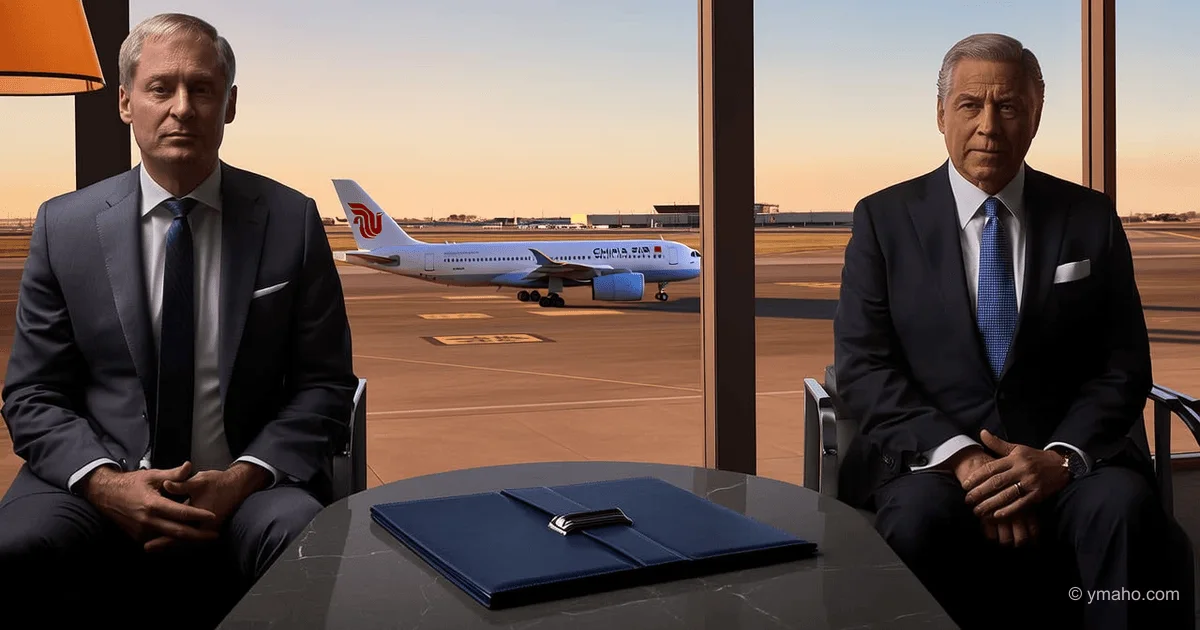
Bloomberg Learns of US-China Talks in Seoul on Iran Issue Ahead of Trump-Xi Summit
US Treasury Secretary Scott Bessent and Chinese Vice Premier He Lifeng held a meeting to prepare the agenda for Trump's state visit to Beijing. Key topics were the war with Iran and a renegotiation of trade relations.
The Essence: What Is Really Happening
The meeting between Scott Bessent and He Lifeng at Seoul's Incheon Airport on May 13 is not a technical check-in but a moment of truth that will determine whether the conflict with Iran is resolved or spirals into a protracted war of attrition. The US finds itself trapped by its own strategy: on one hand, the US Navy is blockading the Strait of Hormuz and preparing for possible resumption of hostilities (as Trump contemplates); on the other, China is buying 90% of Iran's oil and financially supporting Tehran, rendering US sanctions ineffective. Bessent came to Seoul not to offer concessions to China but to deliver an ultimatum: either Beijing uses its influence over Tehran to reopen the strait, or the US will strike Chinese financial infrastructure through secondary sanctions. This undeclared ultimatum is the true substance of the talks.
Timeline and Context
The Trump-Xi summit, scheduled for May 14-15, was originally planned for late March but was postponed precisely because of the start of US and Israeli military operations against Iran. Thus, the current summit is the result of four months of escalation that began in late February and by May brought the world to the brink of an energy collapse.
The diplomatic preparation for the summit includes several key milestones. The seventh round of Bessent-He talks was the culmination of a series of contacts that began with Trump's return to the White House. Unlike previous meetings that lasted two days, the Incheon meeting was scheduled for just three hours and ended around 3:50 PM local time. This indicates that the positions of both sides are already crystal clear, and there is nothing left to negotiate—only to record disagreements or accept terms.
Concurrently, the US launched Operation Economic Fury: the Treasury imposed sanctions on Iranian exchange offices converting yuan from oil sales into currency for the IRGC, and blacklisted the second-largest Chinese "tea" refinery processing Iranian oil. Two Chinese credit institutions have already received letters from the US Treasury with a direct warning: any transfer of Iranian funds will result in disconnection from the dollar system. This is not diplomacy—it is financial warfare on the offensive.
Who Wins and Who Loses
The main beneficiary at this stage is China, for three reasons. First, while Saudi, Kuwaiti, and Emirati tankers idle at the entrance to the Strait of Hormuz, Iranian oil continues to flow to China via a "shadow fleet" with transponders turned off and forged documents. According to TankerTrackers.com, since the start of the war, Iran has shipped at least 11.7 million barrels to China. Second, payments for this oil are made in yuan through the CIPS system, accelerating the formation of an alternative financial architecture to the dollar. Iran has even proposed conditioning ship passage through the strait on payments in yuan—a proposal that is de facto already being implemented. Third, China gets massive discounts on oil while the rest of the world pays $120 per barrel.
Surprisingly, the losers are US allies. South Korea, hosting the talks, depends on the Strait of Hormuz for 70% of its oil imports and finds itself in a desperate position. President Lee Jae-myung, who received both negotiators, is trying to position Seoul as a constructive venue, but in essence, Korea is a hostage to the conflict with no leverage over either Washington or Beijing. India, Japan, and the Philippines have vainly asked the US to extend the 30-day exemption from sanctions on Iranian oil—Washington refused all.
The US itself is losing strategically. The naval blockade operation costs $380 million weekly, and the economic war is pushing Beijing to accelerate the creation of dollar alternatives. Each new sanctions package is another incentive for Global South countries to move away from SWIFT and dollar-based settlements.
What the Media Is Not Saying
The main hidden story is the true role of Seoul as the meeting venue. Officially, Korea is positioned as a neutral ground, but the reality is different: President Lee Jae-myung is using the moment to demonstrate his indispensability as a mediator between the US and China precisely when his own administration faces a domestic political crisis due to the energy collapse. The Incheon meeting is Lee's attempt to show Korean voters: "I am the one solving problems, not creating them."
The second hidden story is Boeing. At first glance, China's order of 200 aircraft looks like a commercial deal designed to create a positive backdrop for the summit. But behind it lies a complex financial structure: China will pay for the planes partly in yuan, partly through barter schemes, allowing Beijing to effectively finance US exports without spending dollar reserves. For Boeing, whose shares have fallen 22% since the start of the conflict due to supply chain disruptions, this contract is a lifeline, but for the US overall, it is a hidden form of financing its own competitor.
The third point, completely absent from public discussions, is the link between the Iran settlement and semiconductor export controls. The US wants China to pressure Tehran. China wants the lifting of chip restrictions. This is a classic trade-off, but it is disadvantageous to the US military-industrial complex, which has an interest in prolonging the conflict. It is representatives of the defense lobby, including figures in the National Security Advisor's office, who torpedo any attempts by Trump to offer Beijing real concessions on the technology front.
Forecast: The Next 30 Days and 90 Days
On a 30-day horizon (by June 15, 2026), I expect the following dynamics. The Trump-Xi summit will end with loud declarations about "fantastic deals" and "a shared vision of a world without an Iranian nuclear bomb." China will agree to purchase US agricultural products worth tens of billions of dollars and place an order with Boeing, but on the issue of pressuring Iran, Beijing will limit itself to ritual calls for de-escalation without taking on specific commitments. Trump will return to Washington, declare the summit a historic victory, but two weeks later the Pentagon will conduct a new series of strikes against Iranian proxies in Yemen or Iraq—and the diplomatic process will return to square one.
On a 90-day horizon (by August 15, 2026), the scenario will depend on whether Trump's bet on secondary sanctions against Chinese banks pays off. If the US actually disconnects one of the major Chinese banks from the dollar system, it will trigger an unprecedented crisis in US-China relations. In response, China may fully switch payments for Iranian oil to yuan and gold, officially launching the "petroyuan" as an alternative to the dollar. If Trump does not take this step, Iran will maintain its financial lifeline and can keep the Strait of Hormuz closed for months. In any case, the era when one country could control global financial flows with a single click at OFAC is coming to an end—and meetings like the one in Seoul only hasten that finale.
— Editorial Team









