US Consumer Sentiment Plunges to Historic Low
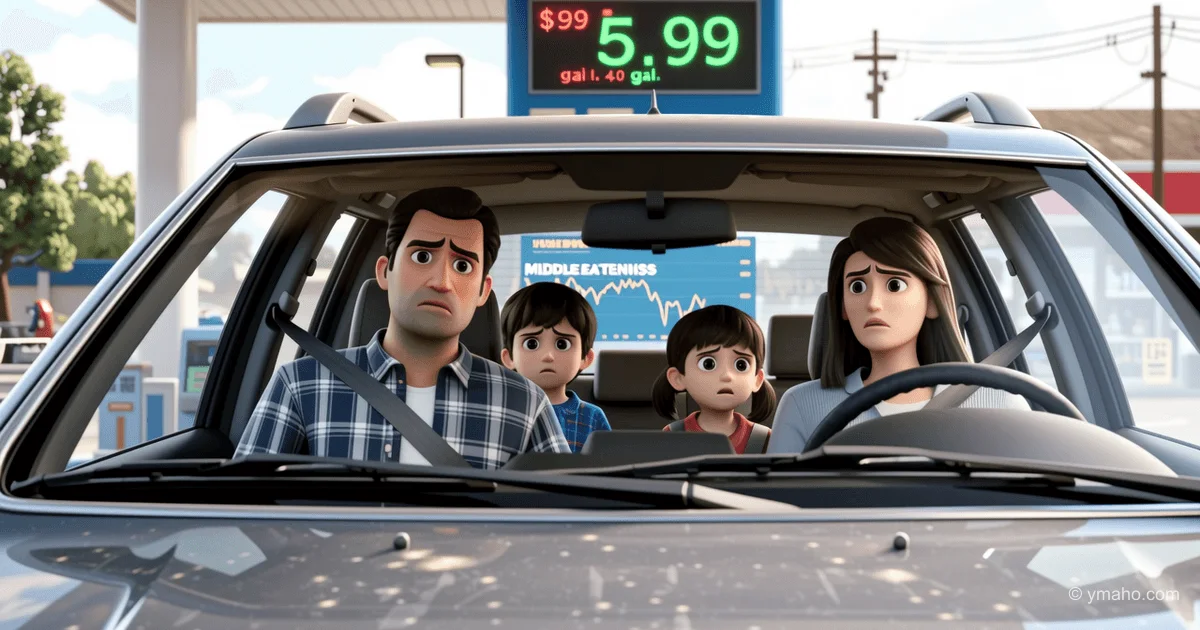
The preliminary University of Michigan Consumer Sentiment Index for May collapsed to a record low of 48.2 points, down from 49.8 in April. The report notes that households are complaining about a sharp rise in fuel prices due to the conflict in the Middle East, while year-ahead inflation expectations edged down to 4.5%.
Analytical Note
May 10, 2026
Confidential
The Gist: What's Really Happening
The drop in the University of Michigan Consumer Sentiment Index to 48.2 points is not just a reaction to expensive gasoline. It is the culmination of a process where economic reality and political identity have become so intertwined that the index itself is barely useful for assessing the real state of the economy.
Formally, we have the lowest reading in the index's 74-year history—worse than during the height of the 2008 financial crisis, worse than in COVID-ridden 2020, worse than at the peak of inflation in June 2022. Yet unemployment stands at 4.3%, annual inflation holds at 3.3%, and real wages are rising. Three of the four lowest readings in the index's history have occurred in the last nine months. The two simply do not align.
The explanation lies in the partisan polarization of responses. April data showed a 55-point gap between Democrats and Republicans: Democrats rated the situation at 31.8, Republicans at 87.1. For comparison, at the height of the real financial crisis in 2009 under Obama, the partisan gap was only 4 points. Today's index measures not households' economic situation but their political self-identification. When the administration changes, the partisan affiliation of optimists and pessimists flips instantly—fundamental economic indicators have nothing to do with it.
At the same time, the Conference Board publishes its own Consumer Confidence Index, which rose to 92.8 in March—the third consecutive monthly increase. Two surveys, the same population, the same month, opposite signals. They measure fundamentally different things: the Board focuses on the labor market and current circumstances, while Michigan focuses on prices and personal finances, making it significantly more sensitive to the media narrative.
Timeline and Context
The collapse in consumer sentiment is clearly chronologically tied to the Middle East conflict. Before it began, in February 2026, year-ahead inflation expectations were 3.4%. The May figure of 4.5% is the result of three months of escalation in the Persian Gulf. Survey director Joanne Hsu puts it bluntly: "Events in the Middle East are unlikely to substantially improve sentiment until supply disruptions are fully resolved and energy prices fall."
Gasoline prices are the main driver of consumer anxiety. According to AAA, since the start of the Iran war, the average price per gallon has risen by more than $1.50 and is approaching $5.00 nationwide. In California, average prices have already exceeded $6.00 per gallon. The increase from pre-war levels is over 50%. About a third of respondents spontaneously mention gasoline prices in their answers, and another roughly 30% mention tariffs.
The current conditions index plunged to 47.8—an absolute historical low. Assessments of personal finances fell to their lowest level since 2009, and conditions for major purchases hit a five-month low. Meanwhile, the expectations index rose slightly to 48.5—a signal that consumers see light at the end of the tunnel but do not believe it is close.
Important context: real consumer spending, adjusted for inflation, has been declining throughout Trump's second term. Pantheon Macroeconomics senior economist Oliver Allen notes that recent consumption resilience was supported by a temporary factor—strong tax refunds—which masked the blow to real incomes from high gasoline prices. He expects a significant drop in spending in May-June.
Who Wins and Who Loses
Losers first and foremost:
- Low- and middle-income households living paycheck to paycheck. For them, a $1.50 per gallon increase in gasoline prices means an additional $120–180 in monthly expenses—money pulled from budgets for durable goods, entertainment, and savings. The divergence between large stock holders and households without savings has reached extreme levels.
- The Trump administration. Consumer sentiment at a historic low six months before midterm elections is a political toxin. Moody's Analytics chief economist Mark Zandi directly links the record-low sentiment to the November elections: "People feel very uncomfortable, and that affects the collective psyche" of ordinary Americans.
- Discretionary retailers. Morgan Stanley notes a clear split: consumers plan to increase spending on groceries, gasoline, and household goods but cut back on electronics, computers, and alcohol. Analysts are lowering forecasts for Home Depot and Best Buy—consumer discretionary stocks are already underperforming the S&P 500.
Paradoxically, winners:
- The stock market. While consumer sentiment was hitting record lows, traders on Wall Street were popping champagne—the S&P 500 and Nasdaq hit new highs on strong corporate profits and AI investments. This creates an unprecedented gap between financial markets and the real economy that cannot persist indefinitely.
- Investors in consumer staples. While the discretionary sector suffers, staples benefit from consumers' forced shift to essential spending categories.
What the Media Isn't Saying
The first non-obvious insight concerns the quality of the index itself as a monetary policy tool. The Fed officially considers inflation expectations based on the Michigan survey when making rate decisions. At the April FOMC meeting, five-year expectations of 3.9% were directly cited as a reason to keep rates at 3.5–3.75%.
The problem is that the Fed makes rate decisions based on data contaminated by partisan signals. If 4.7% annual expectations consist of 7% from Democrats and 2.5% from Republicans, that's not a forecast but a political flag with a number. A Brookings Institution study as early as 2023 showed that in 2021–2022, Democrats' inflation expectations barely changed as real inflation rose, while Republicans' expectations shot up. Now the situation is reversed: Democrats systematically overestimate forecasts, Republicans underestimate them, and the amplitude has grown.
Meanwhile, Nobel laureate Paul Krugman diagnosed the phenomenon of a "vibecession" back in November 2025—a situation where consumers believe the economy is in crisis even though macro indicators do not confirm it. May 2026 could be called a "vibecession on steroids."
The second point that is hardly covered: the Fed has an alternative to the Michigan survey, and it is literally on the table. The Fed's own research, published this year, showed that prediction markets like Kalshi are as accurate as the New York Fed's Survey of Market Expectations and outperform the Bloomberg consensus forecast for annual CPI inflation. The mechanism is fundamentally different: in a prediction market, partisan players face arbitrageurs for whom profit matters, not political identity. If a contract price deviates from the true probability, professional traders buy and sell until the distribution approaches the truth. In a survey, there is no correction mechanism: a respondent who states 8% inflation expectations bears no cost when actual inflation turns out to be 3%.
Third: Morgan Stanley notes that 57% of Americans cite inflation as the top problem, but their actual consumer behavior contradicts the stated anxiety. Actual spending on necessities is rising, while discretionary categories should be contracting if inflation expectations were truly 4.5%. This is evidence that surveys capture not intentions but sentiment—two completely different economic phenomena.
Yardeni Research chief Ed Yardeni articulates the main risk: if Brent stays above $100 per barrel for an extended period, real income growth will be squeezed so much that aggregate demand will start to slow, and then the "vibecession" risks materializing into a real one.
Forecast: Next 30 Days and 90 Days
Next 30 days (through June 10):
- The Consumer Sentiment Index will remain in the 47–50 point range. Even if a US-Iran ceasefire is reached, gasoline prices will not drop instantly—the lag between geopolitical détente and retail pump prices is 2–4 weeks. Consumers will have paid their May and June bills before they see relief.
- Consumer spending will begin to contract. The tax refund factor that masked the blow to real incomes has exhausted itself. May retail sales data will show a decline in discretionary categories of 1.5–2.5% month-over-month.
- The Fed at its June meeting will find itself in a trap: Michigan inflation expectations are high and demand a hawkish stance, but the real economy is starting to slow. I expect rates to remain unchanged, but with softer rhetoric from Powell—he has already hinted that "policymakers do not see confirmation of the Michigan numbers in other surveys or bond markets."
- The S&P 500 and Nasdaq will continue to decouple from the consumer economy. Q2 corporate profits will be strong enough to sustain optimism on the trading desk, even as pessimism grows on Main Street.
Next 90 days (through August 10):
- The fate of consumer sentiment depends entirely on the Strait of Hormuz and the price of Brent. Scenario A (55% probability): a US-Iran framework ceasefire is reached by mid-July. Brent retreats to $78–82. Gasoline at US pumps drops to $3.80–4.10 per gallon by August. The Consumer Sentiment Index rebounds to 55–58 points. The Trump administration gains an electoral window of opportunity before November.
- Scenario B (30% probability): no ceasefire, Brent stays above $100 for weeks. Consumer sentiment falls to 44–46 points—territory from which elections are not won. Real consumer spending contracts by 0.5–0.8% quarter-on-quarter. The "vibecession" begins to turn into a real recession.
- Scenario C (15% probability): a ceasefire is reached, but gasoline prices do not fall due to the persistence of Iran's "Strait of Hormuz Administration" and uncertainty over tanker insurance. Consumer sentiment gets stuck at 50–53 points—not enough for a political catastrophe, but not enough for a consumer boom.
- The key indicator to watch is not the Michigan index itself, but the gap between it and the Conference Board. If the Board also starts to decline while Michigan remains low, that would mean pessimism has shifted from the political-media level to the fundamental labor market. That moment would be the signal for a real recession. As long as the Board stays above 90, the economy is fine, even if consumers say otherwise.
- For the Fed, the moment of truth arrives. If by the August FOMC meeting there is no progress in resolving the Middle East conflict and inflation expectations remain at 4.5%, the Committee will face a choice: continue to rely on the partisan-infected Michigan index or acknowledge that a key policy tool no longer works as it should. Prediction markets, TIPS spreads, and the New York Fed's Survey of Consumer Expectations should be given formally greater weight in the decision-making process—and the sooner this happens publicly, the less damage to the Fed's credibility.
— Editorial Team









