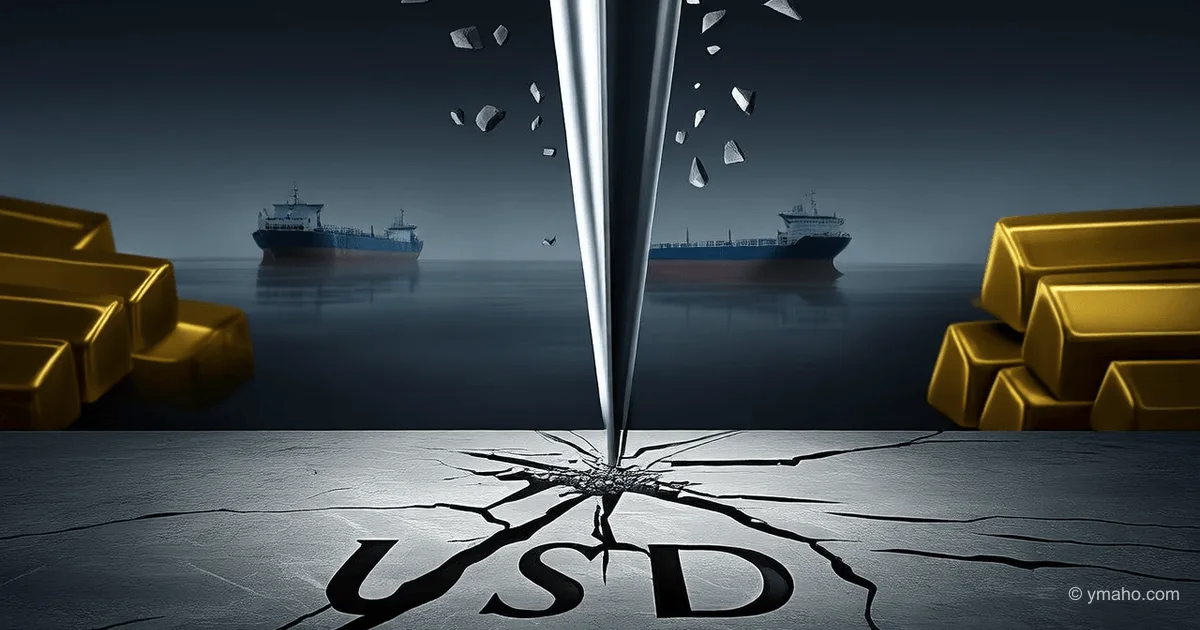
US Dollar Continues to Decline Amid Geopolitical Uncertainty and Inflation Data Expectations
The US Dollar Index ended its second consecutive week of decline, dropping to 97.84, as demand for safe-haven assets fell amid signals of "significant progress" in US-Iran talks and a temporary lull.
The dollar index falling below 98 points at first glance looks like a classic reaction to hopes for peace—a ceasefire, de-escalation, reduced demand for safe havens. But if you dig deeper, we see a tectonic shift in the global financial architecture. The dollar is weakening not because the world is becoming safer. It is weakening because the very system of dollar dominance has cracked at a moment when Washington has become not a guarantor of stability, but its main destroyer.
The Essence: What Is Really Happening
The DXY index closed Friday down 0.433% at 97.84. This is the fifth decline in six weeks, bringing the index to two-month lows. The formal explanation is signals of "significant progress" in talks with Iran and a temporary lull in the conflict zone. But this is merely a pretext, not the cause.
The reality is this: the dollar no longer behaves like a classic safe asset. Historically, any war in the Middle East triggered capital inflows into the US currency. Now it is different. Geopolitical tensions are at extreme levels, Brent crude trades above $100 per barrel, and the dollar index is below the level where it started the year. Economist Peter Schiff, commenting on the DXY decline, stated bluntly: "The dollar's best days are behind it. The muted safe-haven rally in response to war shows its glory days are over."
The key mechanism that the media misses is a structural trap. The conflict in the Persian Gulf has driven up energy prices. This fuels inflation in the US (tomorrow's CPI could show a rise to 3.7-4.0%). High inflation forces the Fed to keep rates high, slowing the economy. But at the same time, rising US military spending—Peter Schiff estimates its potential at over $1 trillion—swells the budget deficit. The market sees this fiscal gap and begins to doubt Washington's creditworthiness. The dollar index falling to 97.84 is not a reaction to peace, but a reaction to the realization that the only beneficiary of US military adventures is not the US currency, but gold, which is consolidating around $4,700 per ounce.
Timeline and Context
If we reconstruct the chain of events, the picture becomes clear:
- February 28, 2026: Start of the active phase of the US-Israel conflict against Iran.
- March-April: The dollar index briefly spikes above 100 on a wave of panic, but this move proves false. By the end of April, DXY loses all its war gains and falls below 98.
- May 3-9: Reports emerge of "significant progress" in US-Iran talks via Pakistani mediators. Oil and currency markets react with cautious optimism.
- May 10-11: The US April employment report is released—115,000 new jobs versus an expected 62,000. Strong data reduces the likelihood of an imminent Fed rate cut. The dollar should have strengthened, but instead continues to fall.
- May 11: Trump publicly rejects Iranian proposals, calling them "unacceptable" and "garbage." The ceasefire, he says, is on "life support" with a 1% chance of survival. Oil rises again, but the dollar does not.
- May 12: The dollar index holds around 97.84. The market awaits CPI data, but the structural weakening trend is already established.
Who Wins and Who Loses
Winners:
- Gold holders. The precious metal consolidates around $4,700 per ounce. Any hint of accelerating inflation or failed talks pushes it higher.
- European exporters. The euro trades at 1.1780 against the dollar. A strong European currency cheapens imports of dollar-denominated energy.
- Emerging markets not involved in the conflict. A weaker dollar reduces the debt burden for countries with foreign currency obligations.
Losers:
- The Federal Reserve. The leadership change from Powell to Warsh occurs at a time of maximum turbulence. The new chair inherits a currency losing trust and inflation driven by geopolitics.
- US importers. A weak dollar combined with high oil prices creates a double blow to the cost of goods, further fueling the inflationary spiral.
- The Japanese economy. The USDJPY pair rose to 157.21. The yen weakens against the dollar despite the overall DXY decline, pushing Japan's energy import costs to critical levels.
What the Media Is Not Saying
Now for the inside scoop that changes the whole picture. Everyone is discussing US-Iran talks, but almost no one noticed that on May 10-11, on the eve of the Trump-Xi summit, the US Treasury imposed sanctions on 12 individuals and entities for helping Iran ship oil to China.
This link is key. While news feeds are full of headlines about "progress" in talks, Washington is striking at the only real channel of Iranian financing. China buys Iranian oil at a discount, refines it at its plants, and pays in yuan. This scheme allows Tehran to survive even under a naval blockade and sanctions. Sanctions against intermediaries are not just "pressure." They are an attempt to strangle the "shadow fleet" and "gray" financial flows at a moment when official Tehran is considering whether to accept US terms.
The dollar's decline in this context takes on a new dimension. The more aggressively the US uses the dollar as a weapon (sanctions, blocking payments), the faster Asian and Middle Eastern countries seek alternatives. The yuan and digital currencies gain momentum. De-dollarization, talked about for the last five years, ceases to be a theory. DXY at 97.84 is its quantitative reflection.
Moreover, few have linked the dollar index decline to domestic British events. Prime Minister Keir Starmer, after a crushing Labour defeat in local elections, announced a "new direction for Britain" based on rapprochement with the European Union. This means London will coordinate its fiscal and monetary policy with the EU, strengthening the euro and weakening the dollar's position as the sole beneficiary of transatlantic tensions. The GBPUSD pair corrected to 1.3612, but the potential for further dollar decline against the pound remains significant.
Forecast: Next 30 Days and 90 Days
Next 30 days (until June 11, 2026):
The dollar index will continue to fluctuate in the range of 96.50-98.65. The key event will be today's CPI release. If inflation exceeds 3.5%, paradoxically it will not strengthen the dollar but instead accelerate its decline to the 96.50 level, as markets will see signs of stagflation. Warsh, upon taking office, will be forced to take a hawkish stance, but this will only temporarily slow the decline. If US-China talks at the summit lead to reduced tensions in the Strait of Hormuz, DXY could briefly bounce to 99, but that will be a sell on the rise.
Next 90 days (until mid-August 2026):
The structural trend toward de-dollarization will intensify. BRICS countries will step up settlements in national currencies for oil supplies. If the conflict with Iran enters a low-intensity phase (Goldman Sachs' baseline scenario for a "moderately negative" outcome), Brent crude will settle in the $100-105 range, and the dollar index will drift toward 95. If talks completely fail and a full-scale blockade of Hormuz begins, DXY could briefly spike above 100 on a wave of panic, but this move will be quickly offset by the reaction of Asian central banks, which will accelerate reserve diversification. By August 2026, we will see a new landscape: the euro around 1.20, the yuan as a regional reserve currency for oil settlements, and gold testing $5,000 per ounce. The dollar will retain its status as the main reserve currency, but its share in global settlements will shrink to lows not seen since the turn of the century.
— Editorial Team









