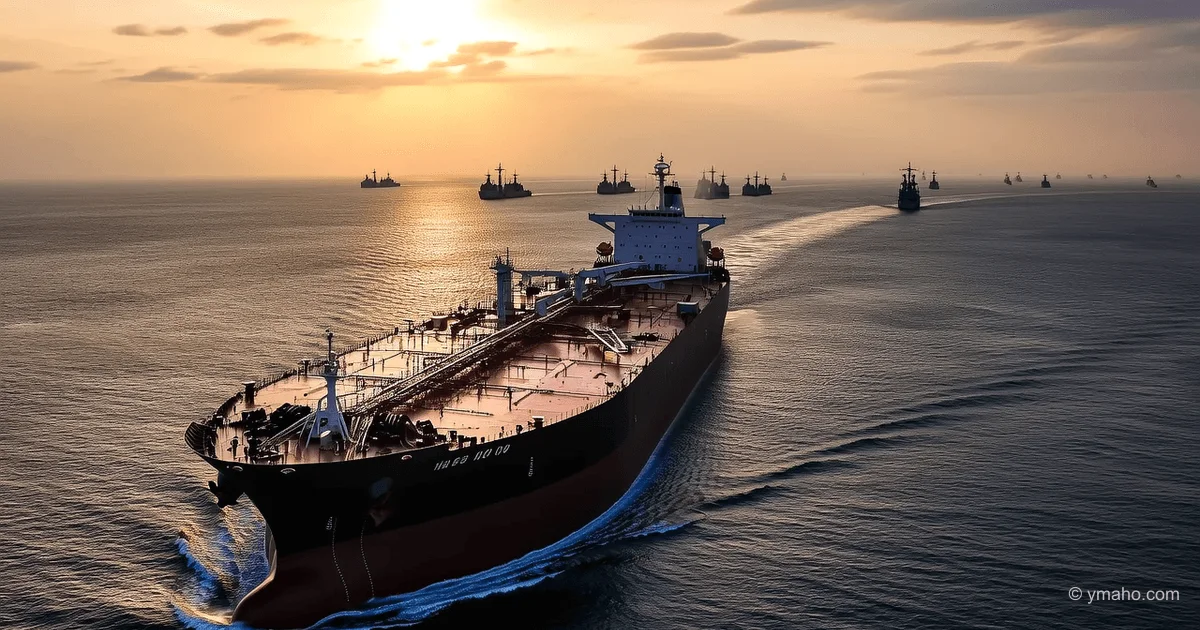
Brent crude jumps above $109 as doubts grow over swift US-Iran conflict resolution
Brent crude oil prices rose 3.35% to $109.26 per barrel after Donald Trump said his patience with Iran was running out, and the US and China demanded that Iran be prevented from acquiring nuclear weapons and that the Strait of Hormuz be reopened.
I am writing this analysis as Brent is already hovering around $109, but the market still does not seem to fully realize that we are witnessing not just another "geopolitical spike" but a tectonic shift in the architecture of global energy trade. This is not a temporary disruption; it is a permanent reset.
The essence: what is really happening
Formally, the 3.35% rise to $109.26 per barrel is a reaction to Trump's hawkish rhetoric and the retaliatory statements by Iranian Foreign Minister Araghchi about a lack of trust in Washington. But the real reason runs deeper: the market has begun to price in not just a prolonged conflict, but a fundamental restructuring of the marine insurance and freight system in the Persian Gulf. Lloyd's of London insurance syndicates raised war risk premiums for vessels transiting the Strait of Hormuz to 8% of cargo value as early as May 12—that's roughly $9-10 million for a VLCC tanker. With that math, even partial transit becomes economically unviable for most operators, and it is this, not just politicians' words, that is driving prices up.
Morgan Stanley calls it a "race against time." Saudi Aramco's Amin Nasser warned that stability in the oil market may not return until 2027. And when the CEO of the world's largest oil company says that out loud, it is not speculation—it is a signal.
Timeline and context
On February 28, the US and Israel struck Iranian targets. The Strait of Hormuz was effectively blocked for several days. On May 11, Trump publicly rejected Iran's peace proposal, writing on Truth Social "TOTALLY UNACCEPTABLE." Brent reacted instantly—up $2.71 in that session—and prices have only gained since.
By May 13-14, glimmers of hope emerged: Iranian state media reported the passage of about 30 vessels, including a Chinese supertanker carrying 2 million barrels of Iraqi oil and a Panamanian tanker operated by Japan's Eneos. The market breathed a sigh of relief for a moment—Brent corrected to $105.63. But on May 15-16, Trump's and Araghchi's rhetoric again ratcheted up tension: "zero trust," "patience running out," "Iran must not get nuclear weapons." The US-China summit in Beijing ended without a concrete de-escalation plan, only a general statement about the need to reopen the strait. Brent—back above $109.
Behind these dates lies a simple but sobering fact: according to the Energy Transitions Commission, the closure of Hormuz has disrupted flows of 18.4 million barrels of oil per day and 110 billion cubic meters of LNG per year. This is the largest single supply shock in history—nearly double the peak losses during the 1973 Arab oil embargo.
Who wins and who loses
Winners are producers outside the Persian Gulf. US shale companies—ExxonMobil, Chevron, ConocoPhillips—have received an unexpected gift: their discount to Brent has virtually disappeared, and export volumes are hitting records. Winners also include Norway's Equinor and Brazil's Petrobras. Essentially, anyone pumping oil not through Hormuz is now earning a super-margin of $20-25 per barrel—a pure geopolitical wealth transfer estimated at about $360 million daily.
Losers are Asian economies. Japan, which imported 95% of its oil through Hormuz before the conflict, has had to send Prime Minister Takaiichi to personally negotiate with Pezeshkian for the passage of individual tankers. Asian LNG prices have soared from $10-12 to $25 per million BTU. Ursula von der Leyen estimates the EU's daily losses at nearly €500 million per day. This is an invisible but very real cost of a protracted crisis.
Losers are fuel consumers worldwide. In the US, gasoline is already so expensive that, according to polls, the war with Iran is becoming a toxic issue for Republicans ahead of the midterms.
What the media is not saying
The first non-obvious insight concerns the mechanism of "selective passage" through Hormuz. Iran has de facto turned the strait into a tool of political bargaining: Chinese and Japanese tankers get through, but not for free. Eneos officially denies paying any "toll" to Iran, but trade sources in Dubai admit that Tehran collects "administrative fees" of $3-4 per barrel, routed through a chain of shell companies in Iraq and Pakistan. In effect, this is the world's largest informal energy flow taxation scheme, which all governments keep quiet about because public acknowledgment would mean having to impose sanctions on their own allies.
The second insight: QatarEnergy has already lost about 17% of its liquefaction capacity due to missile attacks, and repairs will take three to five years, but this information is deliberately downplayed to avoid panic in the Asian spot LNG market. If the true scale of the damage became known, the Asian JKM would instantly break $30 per million BTU.
The third point concerns the insurance market. Major underwriters—Munich Re, Swiss Re, Lloyd's—are holding closed-door talks to create a public-private pool to cover war risks in the Persian Gulf, similar to the one established after the 9/11 attacks for aviation. If this pool is not formed by the end of May, about 40% of the tanker fleet operating on spot terms will simply refuse to enter the Gulf. In that scenario, Brent would almost instantly move to $125.
Forecast: the next 30 and 90 days
Next 30 days (by June 15). Base case: US-Iran talks via Chinese intermediaries will stall. Trump needs a win, but not at any cost—he cannot afford to sign a deal that leaves Iran with nuclear capability. Iran, for its part, will not give up uranium enrichment without guarantees of sanctions relief and compensation. This is a classic deadlock, and Brent will settle in the $108-115 range. I expect that by mid-June we will see a test of $112-113 on the next round of escalation.
Morgan Stanley warns: if Hormuz remains closed until June, buffer stocks will begin to deplete at an alarming rate. The IEA has already recorded a drop in global supply of about 8 million barrels per day in March, and this gap will only widen.
Next 90 days (by mid-August). Here is a fork. If by July a mechanism for partial reopening of the strait is agreed—at least for humanitarian cargo, food, and limited oil volumes—Brent will correct to $95-100, but will not return to the pre-war $70 because the "Hormuz risk premium" will become a permanent component of the price. If the conflict drags on in full force, the $125-130 target becomes realistic. The Energy Transitions Commission has already stated that the current crisis is "the largest in history" in terms of supply disruption, and I have no reason to argue with them.
The long-term outcome of this crisis is already predetermined: acceleration of the energy transition. The same ETC report forecasts that by 2035, clean energy technologies could displace more than 20% of global oil and gas demand—exactly the amount that currently passes through Hormuz. In other words, Iran, unwittingly, is becoming the main driver of decarbonization of the global economy.
— Editorial Team









