Eli Lilly Announces Acquisition of Biotech Maze Therapeutics for $2.1 Billion
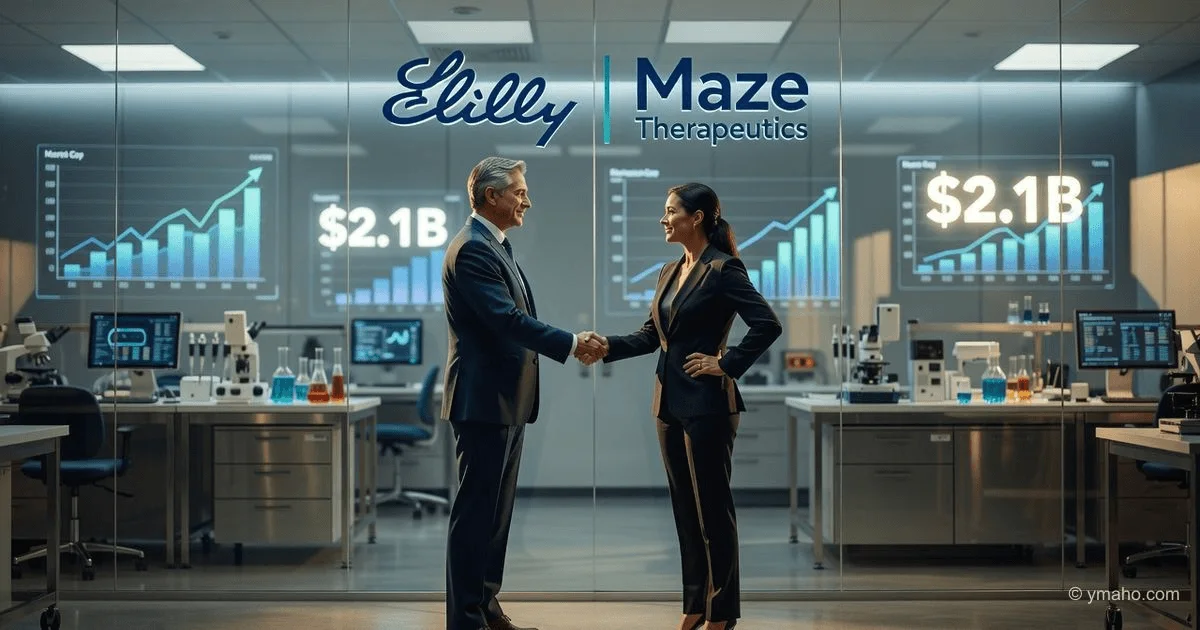
Eli Lilly (LLY) acquires Maze Therapeutics with a late-stage obesity drug. The M&A deal is valued at $2.1 billion, Maze shares surged 72%, Lilly shares gained 1.8%.
A Quiet $2.1 Billion Deal: Why Eli Lilly Is Buying Insurance, Not a Drug
[The Gist]: What's Really Happening
On June 11, 2026, Eli Lilly (LLY) announced the acquisition of Maze Therapeutics for $2.1 billion. The stated reason is a late-stage obesity drug. Maze shares skyrocketed 72% in a single session, while Lilly shares posted a modest 1.8% gain. The market reacted as if nothing special had happened. That's a mistake.
The real essence of the deal isn't another weight-loss drug; it's that Eli Lilly is paying $2.1 billion for an asset that just raised $150 million on the public market at $23.50 per share. A 300% premium to the April offering is not a standard biotech premium. It's either a price of desperation or brilliant foresight. Likely the latter.
Maze Therapeutics is not a startup with a single trendy candidate. It's a platform company using human genetics to find drug targets. Its portfolio includes MZE829 for APOL1-mediated kidney disease (showed positive phase 2 data in March 2026) and MZE782 for phenylketonuria. The obesity drug, supposedly the reason for Lilly's deal, is merely an add-on.
What really matters: Eli Lilly is in M&A blitzkrieg mode. In 2026 alone, the company announced deals with Ventyx Biosciences ($1.2 billion), Orna Therapeutics ($2.4 billion), Centessa Pharmaceuticals ($7.8 billion), CrossBridge Bio ($300 million), Kelonia Therapeutics ($7 billion), Ajax Therapeutics ($2.3 billion), and three vaccine companies (Curevo, LimmaTech, Vaccine Company) for up to $3.83 billion. Maze is the eighth or ninth deal in six months. In total, Lilly has committed to spending over $25 billion on M&A in 2026.
| Metric | Maze Therapeutics | Eli Lilly |
|---|---|---|
| Deal value | $2.1 billion | — |
| Premium to April 2026 offering price ($23.50) | 300% | — |
| Premium to pre-announcement market price (~$25) | ~150% | — |
| Stock reaction | +72% | +1.8% |
| Cash on Maze's balance sheet at deal time | ~$360 million | — |
Timeline and Context
Maze Therapeutics' story is a classic biotech path from venture startup to public company followed by acquisition. Founded in 2018, it listed on Nasdaq in late 2025 under the ticker MAZE. By April 2026, its market cap was about $1.43 billion at a share price of $25.95.
On April 21, 2026, Maze conducted a public offering of $150 million, selling 5.54 million shares at $23.50 and issuing warrants. Buyers included Farallon, T. Rowe Price, Frazier Life Sciences, and Janus Henderson. The offering extended the company's financial runway into 2029. It seemed Maze was preparing to go it alone.
On April 6, 2026, Maze reported first-quarter results. The numbers, to put it mildly, were unimpressive: a net loss of $24.2 million, or $0.45 per share. Revenue was $20 million, but that was a one-time payment from partner Shionogi for achieving a clinical milestone, not operational sales. The company burned $27 million per quarter on R&D without a single approved drug.
Then, on June 11, 2026, Eli Lilly announced the acquisition. An insider deal the market hadn't priced in. Two weeks earlier, Maze's President of R&D, Harold Bernstein, sold all his 15,000 company shares at about $49 each, netting $736,000. At the time of sale, shares traded around $48. Now, after the acquisition announcement, they're worth about $72. Selling two weeks before the deal looks, at the very least, awkward.
| Date | Event | MAZE Price | Note |
|---|---|---|---|
| April 2026 | Public offering of $150 million | $23.50 | Runway to 2029 |
| March 20, 2026 | Maze President sells all his shares | ~$49 | 15,000 shares, proceeds $736K |
| April 6, 2026 | Q1 report: loss of $24.2 million | ~$47 | One-time revenue from Shionogi |
| June 11, 2026 | Eli Lilly announces acquisition | ~$72 | +72% in one day |
Who Wins and Who Loses
Biggest winners: Maze shareholders, especially those who entered at the April offering price of $23.50. In seven weeks, their investment grew 206% to $72 per share. Funds that participated in the round—Farallon, T. Rowe Price, Janus Henderson—are sitting on multibillion-dollar paper profits.
Second winner: Eli Lilly. Paying $2.1 billion for a company with a platform, three clinical candidates, and $360 million in cash is not overpaying; it's a reasonable premium for entry into a genetically validated platform. For comparison, Pfizer paid $10 billion for Metsera in November 2025. Novo Nordisk shelled out $4.7 billion for Akero Therapeutics. In this context, $2.1 billion for Maze looks cheap.
Losers: investors who sold Maze before the announcement. Especially company President Bernstein, who sold all his shares at $49. His opportunity cost is about $345,000 if he had waited two weeks. Also losing are short sellers who bet against MAZE after the April offering. According to S3 Partners, short interest in Maze was about 8% of free float. Those positions were closed at a loss of $50-70 million.
Third hidden loser: Novo Nordisk. Lilly strengthens its obesity position through Maze while simultaneously diversifying into oncology, neuroscience, infectious diseases, and vaccines via other deals. Novo, by contrast, is mostly focused on obesity and diabetes. In the long run, Lilly's more diversified portfolio gives it an edge.
| Participant | Win/Loss | Amount |
|---|---|---|
| Maze shareholders (April offering) | +206% in 7 weeks | Entry $23.50, exit $72 |
| Maze President (Bernstein) | Opportunity cost ~$345K | Sold at $49 instead of $72 |
| MAZE short sellers | Loss $50-70 million | Positions closed June 11 |
| Eli Lilly (LLY) | +1.8% on deal day | Market cap increased by $12 billion |
What the Media Isn't Saying
First and most important non-obvious insight: the Maze deal is less about obesity and more about protecting against patent expirations for Zepbound and Mounjaro. Key patents for tirzepatide expire in the early 2030s. Lilly needs assets that will start generating revenue by 2030-2032. Maze, with its genetic targeting platform, could be a source of such assets. But the market doesn't see this because most funds' investment horizon is 12-18 months, not 5-7 years.
Second fact missing from mainstream headlines: Maze is also a bet on gene therapies and rare diseases. MZE829 for APOL1-mediated kidney disease is a potential blockbuster in a niche with no current competitors. The disease primarily affects African Americans with APOL1 mutations (about 5 million carriers in the US). The FDA will likely grant accelerated approval if phase 3 confirms phase 2 data. That could happen as early as 2028-2029.
Third hidden factor: internal friction at Maze that Lilly bought along with the assets. The company burns $27 million per quarter. After the deal, that $360 million cash on Maze's balance sheet becomes Lilly's money. But the culture of a biotech startup and that of a pharma giant are two different worlds. Many key Maze employees, including scientific leaders, may leave within a year of deal closing. Integration risks are high, but that's not being reported.
| Hidden Factor | Risk/Opportunity | Horizon |
|---|---|---|
| Zepbound patent expiration (2030-32) | Lilly insures future revenue | 5-7 years |
| MZE829 for kidney disease | Potential niche blockbuster | 2028-2029 |
| Maze integration into Lilly | High risk of talent drain | 12-18 months |
| Compass platform (genetic targeting) | New targets for other diseases | 3-5 years |
Forecast: Next 30 Days and 90 Days
30 days. Eli Lilly shares will likely continue to consolidate in the $850-900 range. The Maze deal is positive, but it's the eighth deal this year, and the market is tired of Lilly's M&A news. The key driver in the next 30 days will not be Maze but June sales data for Foundayo (oral GLP-1). Analysts expect $1.2-1.5 billion in quarterly sales. If the figure is higher, shares could break $920.
90 days. By September 2026, Lilly will close the Maze deal (expected in Q3). After closing, the market will start assessing synergies. I expect Lilly to announce an acceleration of MZE829 development, moving it to phase 3 by end of 2026. That could be a catalyst for shares in Q4. Base case: LLY price around $950-1000 in 3 months. Bull case: $1050 if Foundayo continues to break records. Bear case: $800 if the FDA imposes restrictions on GLP-1s due to side effects.
| Period | Bear | Base | Bull |
|---|---|---|---|
| 30 days | $820-860 | $850-900 | $900-930 |
| 90 days | $780-830 | $920-970 | $970-1050 |
| Key driver | GLP-1 regulatory risks | Foundayo sales | Deal close + synergies |
| Probability | 20% | 60% | 20% |
Editorial Forecast
Eli Lilly (LLY) shares will continue modest growth over the next 24-72 hours, reaching $870-880 on positive deal sentiment and expectations of strong June Foundayo sales. Key level: breakout above resistance at $885, which was breached in May. Confidence level: medium (55%), as the deal is already priced in and the market awaits the quarterly report in late July. Main risk: competitor news—if Viking Therapeutics announces positive phase 3 data for VK2735 by week's end, it could cool enthusiasm around Lilly. This is an editorial opinion, not an investment recommendation.
— Editorial Team