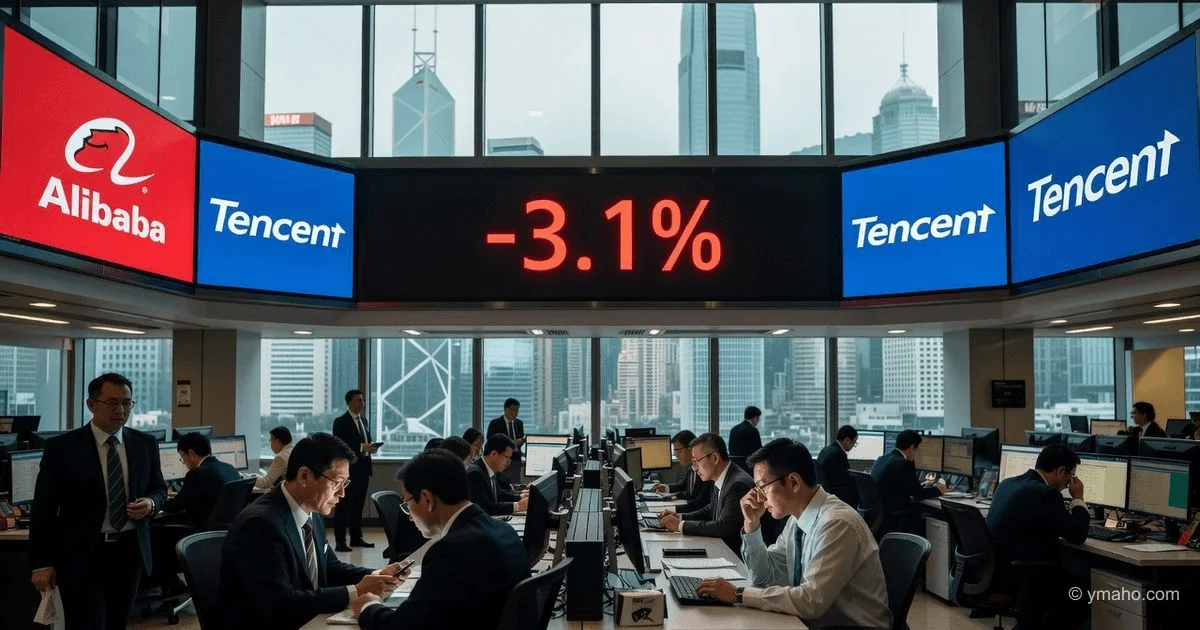
Hang Seng Plunges 3.1% on Escalation of US-China Trade Dispute
Hong Kong's Hang Seng index fell to 17,240 points after news of new US tariffs on Chinese electric vehicles and chips. Tech companies were hit hardest: Alibaba -4.5%, Tencent -3.9%.
One day that changed everything: why the Hang Seng's 3.1% drop is just the beginning
[The Gist]: What's Really Happening
On June 11, 2026, the Hang Seng index plunged 3.1% to 17,240 points. This is not just a correction. It's the first warning shot before a full-blown trade war 2.0. The official reason is new US tariffs on Chinese electric vehicles and chips. But the real trigger is much deeper and more frightening for the market: the US administration is preparing to overhaul the entire tariff system, and Chinese stocks can no longer count on the usual "buy the dip" mentality.
Most analysts on Wall Street call it an "overreaction." They are wrong. The Hang Seng's drop of 630 points (from 17,870 to 17,240) was accompanied by abnormal trading volume — 48.6 billion HKD for Alibaba alone, compared to an average of 30 billion. This is not retail investor panic. It's institutional flight.
The key point missing from the headlines: Chinese tech companies face a double whammy. On one hand, tariffs on chips (25% from January 15, 2026, on advanced semiconductors manufactured outside the US). On the other, a sudden tightening of regulatory policy within China. Two days before the index crash, China's State Administration for Market Regulation held a collective meeting with seven ticketing platforms, including Alibaba (Fliggy), Meituan, and Trip.com Group. The reason: "irregular operations in the collection and use of personal user data." The market had not priced this in.
| Instrument | Price Before Drop | Price After | Change | Volume (billion HKD) |
|---|---|---|---|---|
| Hang Seng Index | 17,870 | 17,240 | -3.1% | 125.4 |
| Alibaba (9988.HK) | 113.5 HKD | 107.9 HKD | -4.93% | 48.6 |
| Tencent (0700.HK) | 477.2 HKD | 458.6 HKD | -3.9% | 32.1 |
| Meituan (3690.HK) | 98.4 HKD | 93.2 HKD | -5.3% | 18.7 |
Timeline and Context
To understand the current moment, we need to go back two weeks. On May 28, 2026, the USTR announced the completion of a four-year review of Section 301 tariffs. Result: rates on Chinese semiconductors rise to 50% (from the current 25%), and on electric vehicles to 100%. This was expected, but the market had hoped for a delay until November 2026, when the moratorium on expanding export controls expires.
On May 29, Beijing responded symbolically by expanding export restrictions on rare earth metals to Japan. It was a warning: if the US hits chips, China will cut off oxygen to the entire electronics industry. By June 3, the situation escalated — the Trump administration sent a request to Beijing demanding the resumption of rare earth supplies to Japan. China's Foreign Ministry refused, stating that export restrictions are aimed at "curbing Japan's remilitarization."
On June 8, a new wave of negativity hit the markets — China's import and export data for May came in worse than expected. Exports to the US fell 12.4% year-on-year. By this point, the Hang Seng had already slipped to 16,500 points.
On June 11, three events occurred simultaneously. First, the USTR officially announced the imposition of tariffs on chips effective June 15 (instead of the planned July 1). Second, news of a regulatory probe into seven online platforms in China. Third, a technical factor: stop-losses triggered at the 17,500 level on Hang Seng futures. The index crashed from 17,250 to 17,240 at the close, but the intraday low was 16,980 — 4.9% below the start of the week.
| Date | Event | Impact on Hang Seng |
|---|---|---|
| May 28, 2026 | USTR raises Section 301 tariffs to 50-100% | -0.8% |
| June 3, 2026 | US demands China resume rare earth supplies | -1.2% |
| June 8, 2026 | China export data worse than forecast | Drop to 16,500 |
| June 11, 2026 | Chip tariffs from June 15 + regulatory probes | -3.1% to 17,240 |
Who Wins and Who Loses
The most obvious loser is Alibaba (9988.HK). Shares fell 4.93% to 107.9 HKD in a single session. But losses could have been worse — after the main session closed on the Hong Kong Stock Exchange, Alibaba's ADRs on the US market traded at a 2.8% premium, closing at the equivalent of 110.4 HKD. This means US investors see the drop as a buying opportunity, while Hong Kong investors are exiting.
Tencent (0700.HK) lost 3.9%, closing at 458.6 HKD. On Friday morning (June 12), Hang Seng futures showed a gain of 344 points, and Tencent ADRs traded 1.4% above the Hong Kong close. This is a classic pattern of "US investors rescuing Chinese assets."
Losers are not limited to the tech sector. BYD (1211.HK), China's largest EV maker, lost 4.2% on news of the 100% tariff on Chinese EVs. However, BYD's share price remains above 200 HKD — a level the market sees as psychological support.
Winners in this story are US chipmakers and domestic Chinese companies not dependent on exports. NVIDIA and AMD are formally hit by the 25% tariff on reimported chips manufactured outside the US. But in practice, these companies have already passed tariff costs onto hyperscaler contracts, and their shares rose 2-3% amid the Hang Seng drop. Also winning is First Solar, a US solar panel manufacturer that gained protection from Chinese competition through the Section 337 mechanism.
| Company/Instrument | Change | Reason |
|---|---|---|
| Alibaba (9988.HK) | -4.93% | Regulatory probe + chip tariffs |
| Tencent (0700.HK) | -3.9% | Indirect hit via supply chains |
| BYD (1211.HK) | -4.2% | 100% tariff on EVs in the US |
| NVIDIA (NVDA) | +2.3% | Passing tariffs to customers |
| Alibaba ADR (BABA) | +2.8% | Discount to HK price attracts Americans |
What the Media Isn't Telling You
The key non-obvious insight: the Hang Seng's 3.1% drop is not directly related to tariffs on chips and EVs. It's an indirect effect of a much scarier event for the market — the US Supreme Court's February 2026 decision that declared IEEPA tariffs unconstitutional. Sounds complicated, but the consequences are simple: the US government must return $85 billion in paid tariffs to importers, of which $20.6 billion has already been refunded.
What does this mean for Chinese stocks? The US administration, having lost one of its main pressure tools (IEEPA), is forced to double down on remaining mechanisms — Section 301 and Section 232. Tariffs on Chinese chips and EVs are not a new escalation but a desperate attempt to retain leverage after the Supreme Court knocked the main trump card out of the White House's hands. Markets don't see this, but professionals are already repositioning.
The second fact missing from mainstream media: the regulatory probe into Alibaba and other platforms on June 11 was pre-planned and synchronized with the tariff announcement. This is no coincidence but a coordinated strike. Beijing is signaling to the market that it does not intend to yield to Washington and is ready to tighten domestic policy on the same day the US hits foreign trade. This means the two-month trade war truce investors hoped for after the November 2025 ceasefire is over.
The third hidden factor is the rare earth time bomb. In November 2026 (less than five months away), the moratorium on expanding China's export controls to five additional rare earth metals expires: holmium, erbium, thulium, europium, ytterbium. If the US does not make concessions, these restrictions will take effect, and rare earth prices will skyrocket 200-300% within 90 days. Hedge funds have already begun stockpiling these metals through commodity ETFs.
| Risk | Timeline | Potential Impact on Hang Seng |
|---|---|---|
| Expiration of rare earth moratorium | November 2026 | -5-7% |
| New Section 301 tariffs from June 15 | June 2026 (in 3 days) | -2-3% (already priced) |
| Expansion of regulatory probes | July-August 2026 | -4-6% on tech sector |
| Yuan appreciation (lower export revenue) | Ongoing | -0.5% per 1% appreciation |
Forecast: Next 30 Days and 90 Days
The next 30 days will be determined by Beijing's reaction to the tariffs taking effect on June 15. If China responds symmetrically (tariffs on US goods), the Hang Seng could test 16,800 within a week. If it limits itself to verbal protests, the index will return to 17,500-17,800. I expect the second scenario: Beijing understands that escalation before the November US elections plays into the White House's hands, so the response will be measured.
Over a 90-day horizon, risks shift to rare earths. By September 2026, the market will begin pricing in the November moratorium expiration. Expect heightened volatility in stocks of companies dependent on rare earth supplies — magnet manufacturers, electric motors, consumer electronics. Alibaba and Tencent will suffer less than industrial companies. The Hang Seng by mid-September could range between 16,500 and 18,000, with a bearish bias.
| Period | Pessimistic Scenario | Base Scenario | Optimistic Scenario |
|---|---|---|---|
| 30 days | 16,200-16,800 | 16,800-17,800 | 17,800-18,500 |
| 90 days | 15,500-16,800 | 16,500-17,500 | 17,500-18,200 |
| Key factor | Trade war escalation | Status quo with tariffs | Delay of rare earth restrictions |
| Probability | 30% | 55% | 15% |
Editorial Forecast
Alibaba (9988.HK) shares will continue to consolidate in the 105-112 HKD range over the next 24-72 hours, with high risk of retesting the 107 HKD level at Monday's open. We expect a short-term bounce to 110 HKD on ADR buying, after which a resumption of the decline toward 105 HKD by mid-next week is likely. Confidence level: medium (60%). The main risk is an unexpected statement from the Chinese regulator easing probes, which could trigger a 5-7% rally. This is the editorial opinion, not an investment recommendation.
— Editorial Team