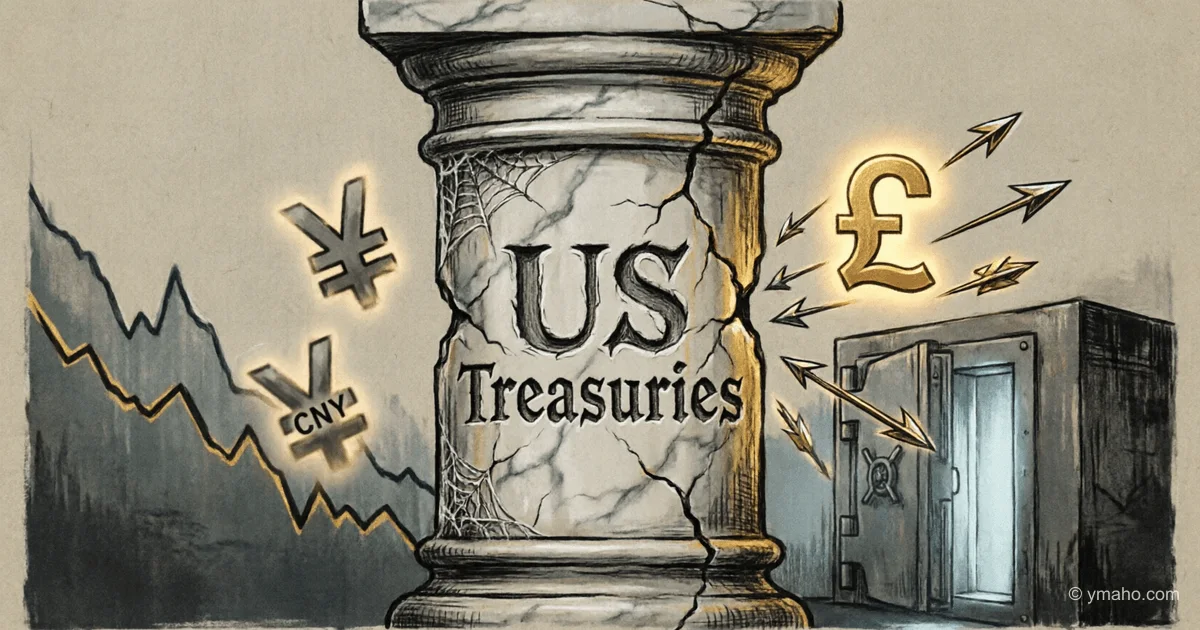
Foreign Governments Cut Holdings of U.S. Treasury Bonds to $9.25 Trillion
Japan and China led the sell-off of U.S. Treasury securities in March, reducing total holdings from $9.47 trillion to free up dollar liquidity amid the conflict with Iran.
The reduction of foreign holdings in U.S. Treasuries to $9.25 trillion is not just a reaction to geopolitics but a moment when the architecture of the global dollar system begins to show a structural crack. While headlines discuss the withdrawals by Japan and China, the market overlooks that the very model where foreign central banks endlessly fund the U.S. deficit is approaching its logical limit.
The Essence: What Is Really Happening
The numbers look dramatic: total foreign holdings fell from $9.49 trillion to $9.35 trillion in one month. But the essence is not panic or a flight from the dollar. According to the U.S. Treasury, of the total reduction of $138.4 billion, only $16.6 billion came from net sales of short-term bills, while foreigners actually bought $13.5 billion of long-term securities. The remaining amount is negative portfolio revaluation due to rising yields. When 10-year Treasuries rose from 3.94% to 4.32% and 30-year yields broke above 5%, the market value of bonds purchased earlier at low rates simply collapsed, creating the illusion of a mass exodus.
The main process here is not selling but a forced restructuring of the holders of U.S. debt. China reduced its position by 6% in a month to $652.3 billion—the lowest since September 2008. Japan shed 4% of its portfolio, bringing it to $1.192 trillion. But their place is being taken not by other central banks but by hedge funds and price-sensitive investors whose money flows through the UK, Luxembourg, and the Cayman Islands. The UK's share rose to $926.9 billion, making it the second-largest holder after Japan. London in this scheme is not the end investor but a proxy hub for speculative capital.
Timeline and Context
The current situation is not a sudden crash but the culmination of a trend stretching back to early 2025. China has been reducing its holdings of U.S. government debt for several consecutive months, and since January its portfolio has shrunk by more than 14%. But March 2026 became a turning point due to the overlap of two factors. First, the conflict with Iran drove energy prices and inflation expectations to three-year highs. The VIX volatility index jumped to 25.6, 33% above February levels, and the yield on 30-year bonds exceeded 5% for the first time since 2007. Second, reserve rebalancing. Central banks in Asia and the Middle East were forced to extract dollar liquidity from Treasuries to support their own currencies and pay for more expensive energy imports.
A telling moment: even when 20-year Treasuries offer a yield of 5.122%—the highest since October 2023—demand at auctions remains mixed. The bid-to-cover ratio was 2.55, weaker than February but above the six-month average. The market is not rejecting U.S. debt but demanding a premium for it that did not exist before. Investors no longer consider any yield level sufficient for automatic purchase.
Who Wins and Who Loses
Paradoxically, the U.S. Treasury itself benefits from this capital flow. Yes, it pays more on new borrowings, but demand at primary auctions remains steady. Net capital inflows into U.S. assets in March totaled $150.7 billion, of which $76.8 billion went into corporate bonds and another $10.5 billion into equities. Foreigners are not leaving the dollar—they are changing the risk structure within the dollar system, shifting from "risk-free" Treasuries to yield-bearing corporate securities.
The biggest losers are export-oriented countries with hard dollar pegs. When Japan and China reduce Treasury positions to obtain cash dollars, it creates a chain reaction in Asian currency markets. The Indian rupee has already breached 96 per dollar, and Delhi's foreign exchange reserves fell from $728 billion to $690 billion in four weeks. Each new round of rising Treasury yields is a blow to emerging economies.
The winners are U.S. banks and dealers. Primary dealers' share at the last 20-year auction was only 9.4%, meaning they did not have to buy up unsold leftovers. The market itself absorbs supply, albeit at higher rates.
What the Media Is Not Saying
The main non-obvious insight is the changing function of the Treasury market itself. Traditionally, Treasuries served as "global collateral": central banks held them as a perfectly liquid asset that could be instantly sold or used as collateral. Now this model is faltering. By reducing holdings, China is not just diversifying reserves but restructuring the very mechanics of currency management. Beijing is shifting dollar liquidity from Treasuries into corporate instruments and gold, whose returns do not directly correlate with Washington's fiscal problems.
The second hidden factor is the role of new Fed Chair Kevin Warsh. He takes office at a time when the market is effectively forcing the Fed to abandon its role as "buyer of last resort." With the Fed's balance sheet at $6.7 trillion and plans to reduce it by another $2.5 trillion, Warsh is deliberately allowing long-term rates to rise to maintain the dollar's attractiveness as a reserve currency. The price of this is mortgage rates tied to 30-year Treasuries, which are already creeping up, and the rising cost of servicing government debt for the U.S. budget itself.
Forecast: Next 30 Days and 90 Days
30 days (by June 21, 2026). I expect April TIC data to show a partial recovery in foreign holdings. Analysts, including BOC International Chief Economist Guan Tao, directly predict a rebound: once geopolitical tensions in the Middle East ease, central banks will return to buying. The yield on 30-year bonds will remain in the range of 5.0-5.3%, and 10-year yields at 4.5-4.7%. The key uncertainty factor is U.S.-Iran negotiations: any hint of a deal will send yields down by 15-20 basis points.
90 days (by end of August 2026). Here there is a fork. If the conflict with Iran drags on and the U.S. budget deficit continues to swell, the yield on 30-year bonds could test 5.5%. This would trigger a second wave of "paper" losses for foreign holders and accelerate the exodus of central banks from long-term bonds. China could reduce its portfolio to $600 billion, Japan to $1.1 trillion. But if a deal with Iran happens and oil falls below $100 per barrel, yields will correct to 4.8-5.0%, and we will see the return of Asian buyers. The baseline scenario is maintenance of the status quo: foreign central banks will continue to slowly reduce the share of Treasuries in reserves, replacing them with gold and corporate instruments, but without a panicked flight from the dollar.
Editorial Forecast
Asset: 10-year U.S. Treasury yield. Direction: up by 3-5 basis points in the next 48-72 hours.
Key levels: support at 4.62%, nearest resistance at 4.69% (May 20 high). Confidence level: medium. The market will continue to price in a premium for uncertainty until specifics emerge on U.S.-Iran talks and Warsh's first press conference as Fed chair. The main risk to the forecast is a sudden announcement by Trump of a breakthrough in negotiations with Tehran, which would instantly send yields down by 8-10 basis points and cause a sharp reversal in Treasuries. This is an editorial opinion, not an investment recommendation.
— Editorial Team









