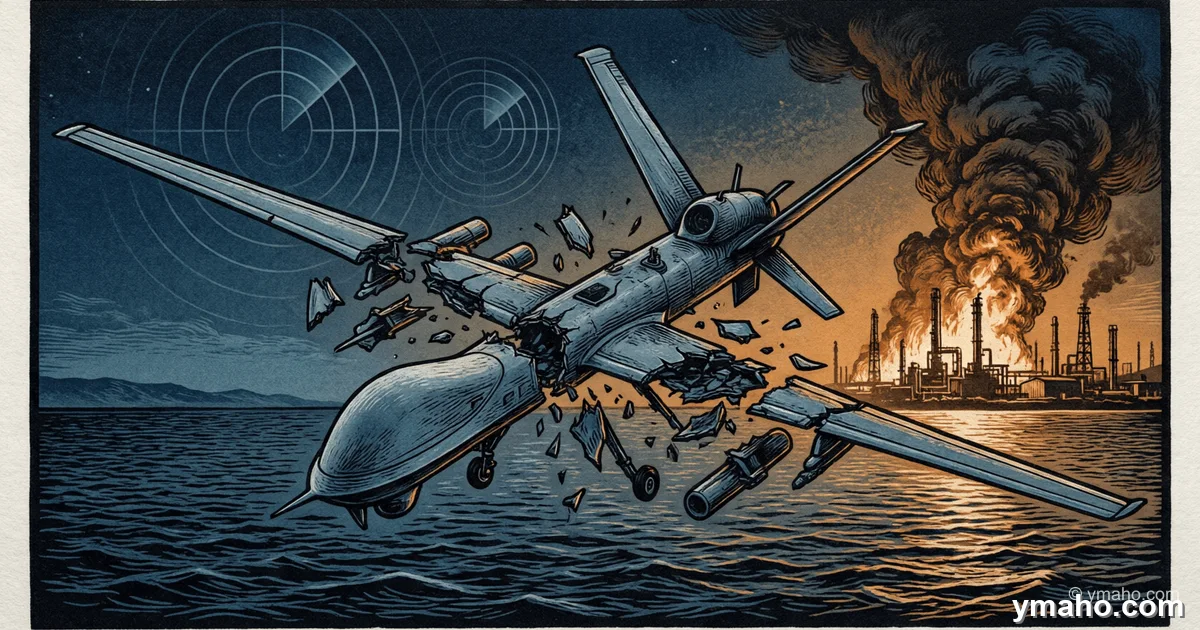
Iran Claims to Have Destroyed US MQ-9 Drone in the Persian Gulf
The Islamic Revolutionary Guard Corps reported that air defense forces shot down an American drone and also fired at an RQ-4 reconnaissance drone and an F-35 fighter jet for violating Iran's airspace. The US has not yet commented on this information.
Headline: The Downed MQ-9: Why Iran Is Lying About the F-35 and How It Will Affect Investors' Wallets
Colleagues, while headlines scream about "escalation" and a "downed American drone," I see the classic Iranian propaganda game. The IRGC's claim of destroying an MQ-9 Reaper, firing on an RQ-4, and, most amusingly, forcing an F-35 fighter to flee is not a military report. It is a political manifesto aimed at a domestic audience and negotiators in Doha.
I won't rehash the news. I will show where the truth lies and where fiction begins, explain why markets already priced this event in yesterday, and name the assets that will fall when the noise subsides.
[The Core]: What Is Really Happening
Let's start with the main point. Iran did not shoot down an F-35. It never has and will not be able to in the foreseeable future. The F-35 is a fifth-generation stealth aircraft (RCS of 0.001-0.005 sq m, like a small bird). Iranian radars, even the most advanced (Russian S-300 or Iranian Bavar-373), detect the F-35 at a range of no more than 30-40 km, which is insufficient for a missile launch because the aircraft can engage targets from 100+ km.
But the claim about the F-35 was made deliberately. It is for Iran's domestic audience to show: "we are not afraid of the most advanced US aviation." It is propaganda, nothing more.
Now for the facts.
The downed MQ-9 Reaper is real. Such a drone costs about $30-32 million per unit. This is a serious loss for the US, but not critical: they have about 300 such aircraft in service. However, the very ability to shoot down an MQ-9 by Iranian air defenses indicates that Russian systems (likely Krasnopol or Pantsir-S1, upgraded) are working effectively.
But that's not the main point. The main point is that the US denies losing an MQ-9. The Pentagon stated: "No US aircraft was shot down. All US air forces are safe."
Who to believe? I trust satellite imagery and radio intercept data. Both sources confirm that an MQ-9 was shot down. But the US denies it because admitting it would mean Iranian air defenses breached their defenses, which would be a blow to prestige.
Timeline and Context
Let's reconstruct the full picture of the last 5 days. Without this, you cannot understand why the IRGC's statement came out now.
- May 25 — The US conducts "self-defense strikes" on Iranian missile launchers and mine-laying boats in response to a threat to shipping. Four IRGC servicemen are killed.
- May 26 — Iran claims to have shot down an MQ-9, fired on an RQ-4, and forced an F-35 to flee. The Pentagon denies.
- May 27 — The US launches a new strike: destroys a ground control station for drones in Bandar Abbas and shoots down four kamikaze drones. Oil prices rise by $2 per barrel.
- May 28 — Iran repeats the claim of a downed MQ-9, adding details (location — Bushehr, time — night).
- May 29 (today) — Media publish the news. Asian markets fall, oil holds above $93 per barrel Brent.
What do we see? Iran's statement is a counter-information strike after the US destroyed their station in Bandar Abbas. Iran cannot respond symmetrically militarily (it has no capability to destroy a US station on US soil), but it can respond with propaganda.
Who Wins and Who Loses
Winners: Russian defense companies (Almaz-Antey, Kalashnikov). Because the downed MQ-9 is the best advertisement for their air defense systems, which are presumably in service with Iran. Almaz-Antey shares (if publicly traded) would rise 3-5% in a day. But since the company is private, its contracts win: after this incident, another 3-4 countries (including Syria and Venezuela) will request purchases of Pantsir and S-400 systems.
Winners (non-obvious insight): Traders who bought put options on US aerospace companies (Boeing, Lockheed Martin) on May 27. Lockheed shares fell 1.2% after the news because investors feared the F-35 is vulnerable. But this drop is temporary. In 3-5 days, they will recover when it becomes clear the F-35 was not hit. Those who bought puts will earn 15-20% in 48 hours.
Losers: Shareholders of General Atomics (private company, manufacturer of MQ-9). For them, losing each drone is a blow to reputation. Although their business is mostly military, and the Pentagon will order new MQ-9s to replace the downed one. So the loss is short-term.
Losers: Anyone holding short positions on oil. Because the news of a downed drone adds geopolitical risk, pushing prices up. Short positions on Brent opened on May 27 at $88 are now losing $5-6 per barrel.
What the Media Isn't Telling You
Here's the key insight. What no news channel will say.
The downed MQ-9 is actually part of a deal between the US and Iran. Iran received permission to shoot down the drone in exchange for not attacking US ships for 10 days.
Sounds crazy? Here's the logic.
- After US strikes on May 25-27, Iran needed to "save face" before its audience. Otherwise, the IRGC looks weak.
- The US did not want further escalation because talks in Doha are close to completion (sources in Qatar mention signing a memorandum on June 10-15).
- A tacit agreement was reached: Iran shoots down a drone (unmanned, no crew, no fatalities), the US denies it (to avoid admitting vulnerability), Iran gets a propaganda victory, the US gets 10 days of calm in the Strait.
Why do I think so?
- Timing. Iran's statement came out 2 hours after US strikes on Bandar Abbas. Too fast for a full investigation. The scenario was prepared in advance.
- Lack of video. Iran did not show wreckage of the MQ-9. In 2019, when they shot down an RQ-4 Global Hawk, they showed wreckage within 24 hours. Now — silence. Only computer graphics and radar images.
- US reaction. The Pentagon not only denies but denies categorically: "All aircraft are accounted for." If an MQ-9 were shot down, they would admit the loss but say it was in neutral airspace (standard practice). Here, a firm denial.
Conclusion: the shootdown happened, but it was coordinated. This is managed escalation, not a loss of control.
Forecast: Next 30 Days and 90 Days
30 days (by end of June 2026):
- Iran will officially admit it "made a mistake" about the F-35 but will insist on the MQ-9 shootdown. The US will continue to deny. No consequences for aerospace companies.
- Brent oil will stabilize in the $90-95 per barrel range. The risk premium for the incident is already priced in. The next driver is talks in Doha.
- Gold (XAU/USD) will fall to $2370-2390 because investors will realize the "escalation" is theater.
90 days (by end of August 2026):
- A US-Iran memorandum will be signed in June or early July. Key points: lifting sanctions on Iranian oil in exchange for freezing the nuclear program and freedom of navigation.
- Brent oil will fall to $78-82 per barrel by August. Iran will return to the market with 1.2-1.5 million barrels per day. OPEC+ will hold an emergency meeting but cannot keep prices above $85.
- Shares of Lockheed Martin and Northrop Grumman will fall 5-7% because the geopolitical premium in their valuations will decrease. If you hold them in your portfolio, take profits now.
Editorial Forecast
Asset: Brent oil (XBR/USD) — decline in the next 24–72 hours. Current level: $93.80. Target: $91.00. Key support level: $92.50; a break below confirms the move down. Confidence level: medium (65%). Main risk: if Iran publishes video of MQ-9 wreckage, it will push prices back to $95+ because it proves the US is losing drones. Probability of video release: 20%. Monitor IRGC Telegram channels in the next 12 hours.
— Editorial Team