Mechanism of Lung Cell Adaptation to Chronic Tobacco Smoke Exposure Discovered
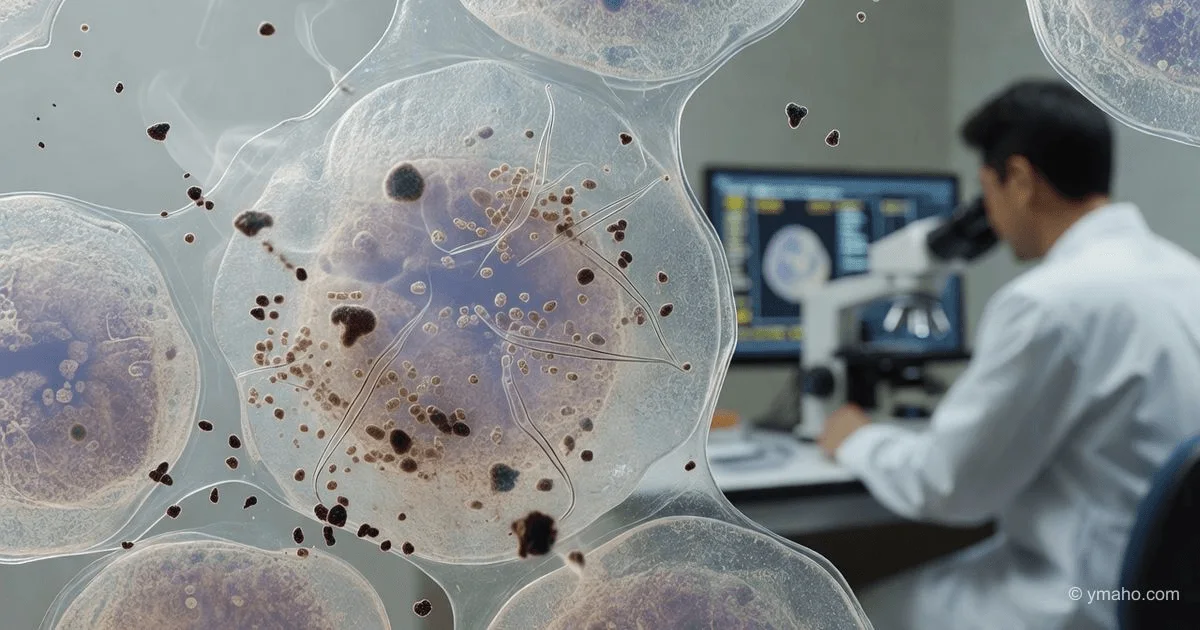
In a study published in Nature, scientists showed that prolonged smoke exposure causes mitochondrial fragmentation and activation of the NRF2-dependent pathway in epithelial cells, promoting their survival and the formation of precancerous changes.
Chemotherapy kills, but smoke teaches how to live: why NRF2 is the smoker's "guardian angel" that we will start attacking in 2026
The inside scoop that no oncologist at a local clinic will notice is that the fresh publication in Nature from June 7, 2026, is not about toxicology. It is a manifesto that we have misunderstood chemoprevention of lung cancer for about twenty years. While everyone was looking for ways to "strengthen antioxidant defenses" in smokers with vitamins and NAC, nature was doing the exact opposite—it was teaching cells to cheat. The study by a Korean-American group (B2B cells, organoids, 40 weeks of WCSE) uncovered a mechanism that insurance companies and the FDA will use as the basis for new screening protocols by the end of 2026.
[The Core]: What Is Really Happening
This is not just about "adaptation," but a fundamental switch in the cellular metabolic paradigm from oxidative phosphorylation to glycolysis, accompanied by mitochondrial fragmentation. Normal lung cells under smoke attack should trigger apoptosis. But chronic exposure (40 weeks in vitro, equivalent to ~15 years of human smoking) causes mitochondria not to burst but to "chop up"—becoming short, round, yet retaining membrane potential. It's like cutting off a car's wheels, but it keeps going at 120 km/h.
The first insight that is not obvious: such fragmentation is not a breakdown but a programmed evolutionary defense. Upon activation of Drp1 (the protein that cuts mitochondria) and suppression of Mfn2, the cell reduces production of reactive oxygen species (mitoROS) but does not fall into ATP starvation. It simply switches to "emergency power." In the study, T-B2B cells showed a paradoxical thing: under oxidative stress, they decreased overall ROS levels compared to naive cells. This is not adaptation. This is evolution of a cellular phenotype into an "unkillable" mode.
The second layer is nuclear factor erythroid 2-related factor 2 (NRF2). The media writes "NRF2 activation" without understanding the scale. In the chronic experiment, NRF2 is activated not through the canonical pathway (KEAP1 damage) but through post-translational protein stabilization and nuclear translocation, independent of the ubiquitin-proteasome system. That is, the cell "sticks" in antioxidant defense forever. This leads to accumulation of mutational signatures SBS5 and SBS18 (oxidative DNA damage: C>A transversions). The cell becomes genetically unstable but metabolically viable. This is the dialectic of carcinogenesis: the better you defend against death, the closer you are to becoming cancer.
[Timeline and Context]
The context of this publication is the crisis of preclinical models. Previously, everyone studied the acute effect of cigarette extract: splash it, look at apoptosis after 24 hours, write a paper on oxidative stress. The new work breaks this approach. They used a chronic model of Whole Cigarette Smoke Extract (WCSE), including both gas and solid phases, which no one had systematically done before.
An important chronological anchor: exactly one month before, in May 2026, a paper by Roy et al. in Cancer Discovery described VVD-065—the first covalent allosteric degrader of NRF2 (molecular glue). And a month before that (April 2026), Chen et al. in Int J Biol Sci showed synergy between canagliflozin (SGLT2 inhibitor) and brusatol (NRF2 inhibitor) against KEAP1-mutant NSCLC. That is, the industry is already in an arms race: while Nature describes how NRF2 saves the cell, clinical researchers are already testing how to kill this NRF2.
Why is this important right now? Because 15-30% of all non-small cell lung cancers (NSCLC) have mutations in the KEAP1-NRF2 pathway, and in squamous cell carcinoma this figure reaches 30-40%. And these tumors are the most aggressive, most resistant to chemotherapy and radiotherapy, and they are "cold" for immunotherapy (resistance to anti-PD-1). The new work in Nature explains why: they are originally born from such stress-adapted progenitor cells.
[Who Wins and Who Loses]
Winner #1: Vividion Therapeutics (partner of Bayer, now likely Roche or BMS). Their molecule VVD-065 is already in Phase I (NCT05954312)—the first-in-class NRF2 degrader. Results from Roy et al. (May 2026) showed that VVD-065 does not just inhibit but forces KEAP1 to degrade NRF2 more actively, acting as a "super glue" for the ubiquitin ligase complex. If Phase I safety data are clean (the risk being autoimmune inflammation due to loss of protection in normal cells), Vividion will become a prime M&A target in Q4 2026. Valuation? No less than $4-5 billion.
Winner #2: Broad Institute and the group of Thales Papagiannakopoulos. Their April 2026 preprint showed that KEAP1-deficient cancers are dependent on glutamine metabolism, and the glutaminase inhibitor DRP-104 synergizes with KRAS inhibitors (MRTX1133). This is a direct path to combination therapy: hit KRAS + suppress NRF2 through metabolic vulnerability. Patents on this method have already been filed.
Loser: The "old school" oncologists who still prescribe antioxidants (vitamin E, N-acetylcysteine) to smokers for "cancer prevention." This study is another nail in the coffin of that approach. Adapted cells (T-B2B) already have high basal NRF2 levels. Adding exogenous antioxidants may paradoxically protect precancerous clones rather than normal alveoli. Screening protocols (e.g., the US USPSTF) should be rewritten: smokers with >20 pack-years should NOT be given antioxidants until confirmation of absence of NRF2 mutations in biopsy.
Silent loser: Immunotherapy as monotherapy (pembrolizumab). In May 2026, a discussion on Targeted Oncology highlighted that KEAP1 and STK11 mutations are markers of resistance to PD-1 inhibitors. The logic is simple: NRF2 makes the tumor microenvironment "cold" by suppressing antigen presentation and CD8+ T-cell recruitment. Now we know that this phenotype is established already at the stage of epithelial adaptation to smoke. That is, the patient hasn't even smoked their last cigarette, but their future tumor is already programmed to evade the immune system.
[What the Media Are Not Saying]
The dirtiest secret of the study, which Nature did not put in the headlines, is the contradictory role of KEAP1. In the classical view, KEAP1 is a tumor suppressor: if it is broken, NRF2 is dysregulated, and cancer grows. But in the March 2026 issue of EMBO Journal (vol. 45), Prieto-Garcia et al. showed something shocking: in certain genetic contexts (e.g., with co-mutations in TP53 and LKB1), KEAP1 can play a proto-oncogenic role. Deleting KEAP1 in some mouse models suppressed tumor growth through induction of reductive stress (too much NADH, too little oxidation).
What does this mean for patients? It is a disaster for simple solutions. We cannot blindly give everyone an NRF2 inhibitor (like VVD-065). Because in 15% of NSCLC patients (especially those with co-mutations in STK11), inhibiting NRF2 may accelerate progression. We need biomarkers. We need to look not only at KEAP1 but also at LKB1, P53, PTEN status. Clinicians who start prescribing VVD-065 "by eye" based on KEAP1 mutation will kill patients within 6 months.
The second omission concerns e-cigarettes. In Table 1 of a 2022 review, it is clearly stated: vapes do not directly activate NRF2 as potently as regular cigarettes, but flavorings do. And mitochondrial fragmentation in vaping occurs through a TLR9-dependent mechanism (atherosclerosis, not lung cancer). That is, vapers get metabolic heart disease, but not the insidious epithelial adaptation that leads to squamous cell carcinoma. This means that lung cancer epidemiology will change in 10-15 years: adenocarcinoma (linked to vapes?) will overtake squamous cell carcinoma (linked to cigarettes). Insurers have already calculated this.
[Forecast: Next 30 Days and 90 Days]
Next 30 days:
Expect at least two major press releases from companies developing NRF2 inhibitors. The first from Vividion (Bayer) with a Phase I update. They will likely announce reaching the maximum tolerated dose (MTD) and name specific target tumors: KEAP1-mutant NSCLC and squamous cell carcinoma of the head and neck. If toxicity is acceptable (no significant interstitial pneumonia), shares of their private owners will soar.
The second from Mirati Therapeutics (part of BMS) or Revolution Medicines: they will announce the start of combination trials of their KRAS(G12D) inhibitors with DRP-104 (glutaminase inhibitor) in KEAP1-deficient cancer models, citing the April Broad preprint. Phase I/II start date: September 2026.
Also expect the European Respiratory Society (ERS) to issue a warning: NAC (N-acetylcysteine) and other mucolytics with antioxidant effects should not be prescribed to patients at high risk of NSCLC without confirmed glutathione deficiency. This will be based on the logic of the new study: feeding the glutathione pool in NRF2-hyperactivated cells means selectively protecting the malignant clone.
Next 90 days:
The key event is the publication of full Phase I data for VVD-065 at the IASLC World Conference on Lung Cancer (WCLC) in September 2026. I predict an objective response rate (ORR) of 25-30% in KEAP1-mutated patients refractory to chemotherapy. This will trigger accelerated FDA approval (breakthrough therapy designation) by December 2026 to early 2027.
Also, at least one paper in Cell will be published on spatial transcriptomics of "adapted" lung regions in smokers. It will show "niches" of cells with fragmented mitochondria and nuclear NRF2 surrounded by normal epithelium. This will enable a diagnostic test based on bronchoscopy with laser capture microdissection—biopsy of these niches will yield 90% predictive value for 5-year cancer risk.
And the final, most cynical forecast: Big Tobacco (Philip Morris, British American Tobacco) will, through shell funds, start sponsoring research to develop "mitochondrial fragmentation inhibitors" (i.e., substances that prevent adaptation to smoke). Results will appear in journals like Toxicology and Applied Pharmacology and will claim that "modified cigarettes with added Mdivi-1 (Drp1 inhibitor) reduce carcinogenesis risk." Don't fall for it. If you don't smoke, mitochondria don't fragment. There is no treatment. Prevention is the only way.
— Editorial Team