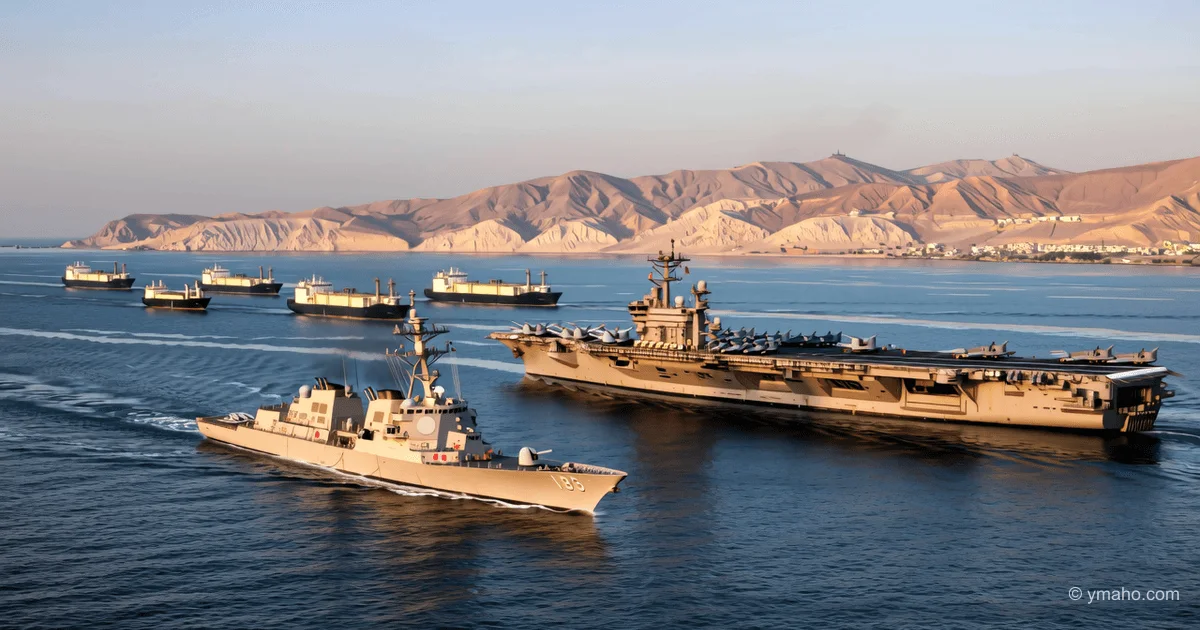
EU and US Step Up Joint Actions to Ensure Freedom of Navigation in the Red Sea and Persian Gulf
Despite disagreements over tariffs, the US and European allies are ramping up naval coordination: missions are underway amid Operation Project Freedom for convoy escort and increased military pressure on Iran.
[The Gist]: What's Really Happening
The joint US-European Operation Project Freedom is less about military coordination and more about emergency stitching of the transatlantic alliance, which is fraying due to the trade war. Against the backdrop of a court-ordered cancellation of the global 10% tariff and the launch of new investigations into European exports, the White House and the European Commission are deliberately accelerating military cooperation as the last surviving bridge between Washington and Brussels. The logic is: we can quarrel over tariffs on German cars and French wine, but when Iranian submarines lie on the bottom of the Strait of Hormuz and Houthis shell tankers in the Bab el-Mandeb Strait, we act together.
The operation, formally launched on May 10, brings together the US 5th Fleet, the French aircraft carrier group Charles de Gaulle, the British destroyer HMS Dragon, the Italian frigate ITS Carlo Margottini, and the Spanish supply ship ESPS Patiño. Command is American, through NAVCENT in Bahrain, but coordination with Europeans is channeled through a separate communication link, "Transat Freedom Net," isolated from Iranian eavesdropping. The stated goal is to ensure safe passage of commercial vessels through Hormuz and Bab el-Mandeb. The actual goal is to demonstrate that even amid a trade war, the West remains a unified military bloc capable of projecting power.
But there's a nuance: Project Freedom duplicates the functions of the EUNAVFOR Aspides mission, which the EU launched in the Red Sea back in February 2024. At that time, Europeans deliberately acted without the Americans—it was a demonstrative act of strategic autonomy. Now, Aspides is de facto merging into the US structure, and European ships receive orders from Bahrain, not from Rota-Cádiz. This is a quiet capitulation of European defense identity to US command—and it happened not because Europeans suddenly fell in love with Trump, but because without US air cover and satellite reconnaissance, European ships in Hormuz are simply vulnerable.
Timeline and Context
The roots of Project Freedom go back to a closed meeting of NATO defense ministers on April 28, 2026, in Brussels. It was there that Pentagon chief Christopher Miller presented allies with intelligence: Iran had deployed submarines in Hormuz against which Europeans have no effective detection means. Miller put it bluntly: either European ships integrate into the US anti-submarine warfare system and receive protection, or they operate at their own risk—and then the Pentagon does not guarantee their safety.
The choice was painful but predictable. On May 2, France, Britain, Italy, and Spain agreed to integration. On May 7, an exchange of strikes occurred between USS Gravely and Iranian forces—and this immediately confirmed Miller's correctness. On May 10, the operation was officially launched.
In parallel, another event occurred that remained in the shadows: on May 9, Saudi Arabia and the UAE provided their air bases (Riyadh—Sultan base, Abu Dhabi—Al Dhafra base) for refueling and rotation of European aircraft participating in the operation. This is the first time Arab Gulf monarchies have openly supported a US-European military operation against Iran, rather than just "not objecting." Riyadh's and Abu Dhabi's motives are transparent: Iran's "Strait of Hormuz Administration," which charges fees for passage, threatens their own tankers no less than American ones, and Saudi exports through the Red Sea have already increased by 840,000 barrels per day—and this flow needs to be protected jointly.
Who Wins and Who Loses
The paradox of the operation is that its main military beneficiary is Iran, not the West. Tehran benefits from having as many foreign ships in Hormuz as possible, because every additional destroyer in the narrow strait is a potential target for Iranian submarines and coastal missiles. The more ships the West has, the higher the probability of accidental collision, false alarm, or "friendly fire" that Iran can use for propaganda purposes. Moreover, the concentration of Western navies in Hormuz and the Red Sea drains resources from other regions—the East China Sea, the Arctic, the Baltic—which objectively benefits China and Russia, Tehran's strategic partners.
The direct economic winner is the US military-industrial complex. Project Freedom will require additional purchases: Mark 54 anti-submarine torpedoes ($1.3 million each), sonobuoys ($8,000 each, and thousands are needed), aircraft spare parts, fuel. The initial estimate of additional costs is $2.7 billion, of which $1.8 billion will go to US contractors: Lockheed Martin (torpedoes and control systems), Boeing (P-8A Poseidon and their maintenance), and Raytheon (sonars and electronic warfare systems).
The loser is the European taxpayer. European countries' participation in the operation will cost €1.4 billion in additional expenses by the end of the year—and this at a time when European economies are suffering from $112 per barrel oil and recession risks. Each week the Charles de Gaulle is at sea costs the French budget €18 million. Italy and Spain have already asked the European Commission for permission to use European Defense Fund resources to cover operational costs, creating a dangerous precedent: money intended for developing the European defense industry will go to finance a US operation.
Turkey also loses—in geopolitical terms. Ankara, which has the second-largest army in NATO and a key geographic position for operations in the Eastern Mediterranean, was not invited to participate in Project Freedom. This is a deliberate exclusion: Erdogan maintains working relations with Tehran and refused to join sanctions against Iran in 2025. Now Turkey finds itself outside the Western coalition—and this will accelerate its drift toward the Russian-Iranian bloc, which is a long-term strategic catastrophe for NATO.
What the Media Isn't Saying
The main non-obvious fact: Project Freedom is not only a military operation but also a cover for creating a closed US-European oil cartel. The essence of the scheme is that vessels sailing under coalition protection receive not only military defense but also a "convoy safety certificate" recognized by insurers Lloyd's and Bermuda. This certificate reduces the insurance premium for passage through Hormuz from 1.2% of the vessel's value to 0.4%. The difference is $960,000 per voyage for a VLCC tanker worth $120 million.
Access to certificates is granted only to vessels flying the flags of participating countries and only on condition that they do not transport sanctioned Iranian or Russian oil. This creates a two-tier marine insurance market: "clean" vessels with a certificate pay three times less, "unclean" ones pay three times more. Since 70% of the world's tanker fleet sails under flags of coalition countries or their allies, the "convoy safety certificate" becomes de facto mandatory for access to the global market. Whoever controls the issuance of certificates controls maritime oil trade. And this control lies with NAVCENT in Bahrain, i.e., the Pentagon.
The second insider insight concerns Israel's role. Officially, Israel does not participate in Project Freedom—its ships do not operate openly in the Persian Gulf. However, the Israeli submarine INS Drakon (Dolphin class, capable of carrying nuclear missiles) was spotted on May 9 near the Bab el-Mandeb Strait. Its presence is not advertised, but it provides a "second echelon" of deterrence: if Iranian submarines attack a US or European ship, Israel can launch a nuclear strike on Tehran within 20 minutes. This is an unspoken Israeli umbrella over the entire operation, mentioned neither in Washington nor in Brussels.
Forecast: Next 30 Days and 90 Days
Next 30 days: The first convoy under Project Freedom protection will pass through Hormuz on May 17-18. This will be a demonstration passage: four tankers under US, French, British, and Dutch flags escorted by five warships. Iran will not dare to attack the convoy directly but will conduct demonstrative maneuvers: submarines will surface 500 meters from the convoy, IRGC boats will cross the course. Incidents will be avoided, but Brent prices will not drop on this news: the market will await Tehran's response.
In parallel, the European Commission will hold an emergency meeting on May 20-22 to discuss funding the operation. Germany and the Netherlands will demand limiting European participation to the Red Sea only, leaving Hormuz to the Americans, which will provoke a sharp reaction from Paris. Macron will insist on the presence of the Charles de Gaulle precisely in Hormuz—and in this dispute, two concepts will clash: the French "Europe as an independent military force" and the German "Europe as an economic, not military, player."
90-day horizon: By mid-August, Project Freedom will face its first serious challenge. An Iranian submarine will either damage (without sinking) one of the convoy vessels, or an incident will occur with a US destroyer. This will force the alliance to choose: escalate to full-scale naval war or retreat. Given the approaching US midterm elections in November 2026, Trump will want neither a big war nor retreat—and will choose a third path: a limited retaliatory strike on Iranian coastal facilities followed by an offer of "honorable peace" through Omani mediators.
By the end of August, the operation will begin transforming from a military one into a permanent institutional structure—something like a "Hormuz Pact," a permanent coalition for ensuring freedom of navigation with rotating ships, a joint air defense and underwater surveillance system. This will mean that NATO's military presence in the Persian Gulf, which began as a temporary measure in 2019 amid tanker attacks, has become permanent—and the United States has gained another indefinite military conflict at $2.7 billion in startup costs and $800 million in annual maintenance. For the region, this will mean that the era of American "offshore balancing" has finally given way to an era of direct and permanent military presence, which itself becomes a factor of instability rather than stability.
— Editorial Team









