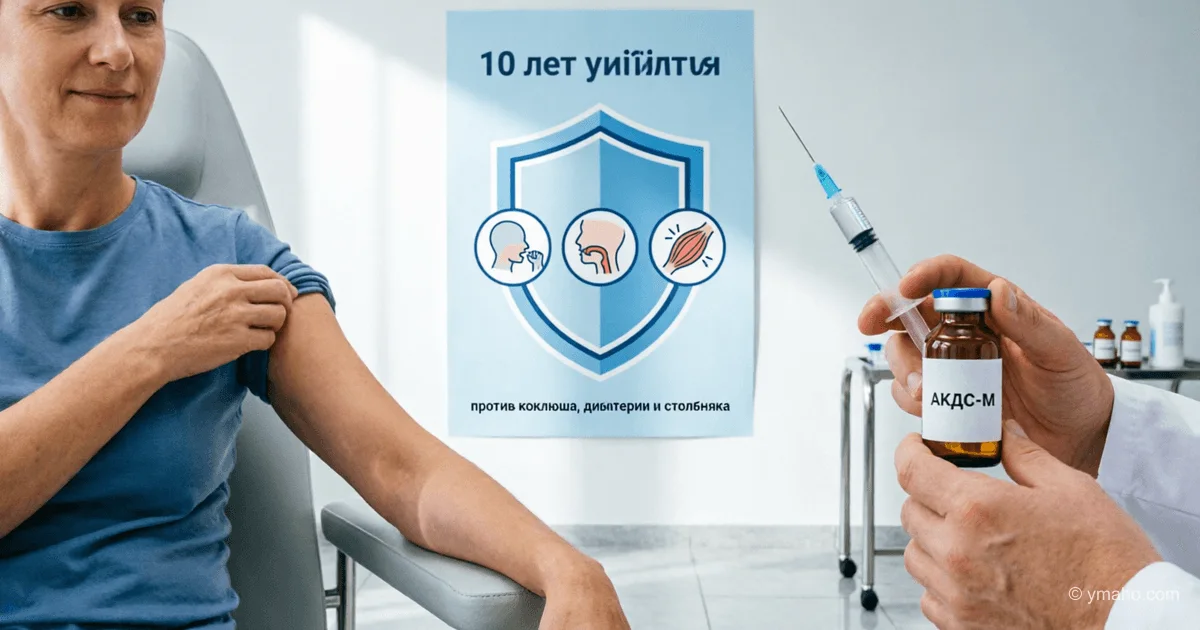
First Vaccine for Adults Against Pertussis, Diphtheria, and Tetanus Registered in Russia
The Natsimbio holding of Rostec State Corporation has obtained a registration certificate for the domestic aDTaP-M vaccine. The drug provides protection against three infections for 10 years, and its acellular pertussis component makes it suitable for revaccination of people over 18.
The silent killer gets an answer: Russia's first adult vaccine against pertussis, diphtheria, and tetanus
Introduction
"Until today, Russia had no domestic analogue of a three-component vaccine for preventing these infections in adults," stated Andrey Zagorsky, General Director of Natsimbio. This fact had long been a given in Russian healthcare, an unnoticed problem against the backdrop of more prominent infectious challenges.
On April 24, 2026, this given became a thing of the past. The Natsimbio holding of Rostec State Corporation received a registration certificate from the Russian Ministry of Health for the aDTaP-M vaccine—the first domestic adsorbed acellular vaccine for preventing pertussis, diphtheria, and tetanus in adults.
The event occurred against the backdrop of a worrying epidemiological situation: in 2024, pertussis incidence in Russia was 4.5 times higher than the long-term average, and in 2023, a 30-year anti-record was set—nearly 53,000 cases. This vaccine is not just a new line in the drug registry. It is the healthcare system's response to a real and growing threat.
Event Details and Timeline
Drug Characteristics
The aDTaP-M vaccine (adsorbed acellular pertussis-diphtheria-tetanus vaccine with reduced antigen content) is produced on a full cycle at the Microgen enterprise in Perm—one of Russia's key manufacturers of immunobiological drugs.
Key characteristics of the drug:
| Parameter | Value |
|-----------|-------|
| Composition | Reduced concentrations of diphtheria and tetanus toxoids + acellular pertussis component |
| Target group | Individuals over 18 years old |
| Duration of protection | Up to 10 years after a single dose |
| Replacement possibility | Can be used instead of a two-component vaccine (diphtheria + tetanus) |
| Production capacity | Up to 5 million doses per year, with potential for expansion |
The fundamental difference from existing pediatric vaccines (traditional DTaP) is precisely the acellular pertussis component. While pediatric vaccines contain inactivated whole cells of the pertussis pathogen (whole-cell component), which provides a stronger immune response but also more pronounced side effects, acellular vaccines contain only purified antigens. This makes them safe and well-tolerated for adult revaccination.
Clinical Trials
Registration was preceded by clinical trials conducted at 10 Russian research centers involving 436 volunteers aged 18 to 60.
Study results:
- One month after immunization, most participants developed protective antibody titers against all three infections
- Good and very good tolerability of the vaccine was noted
- No serious adverse events were recorded
In the near future, a comparative study of the aDTaP-M vaccine and Adacel (imported analogue) is planned in children aged 4 to 18. The study will involve 550 participants, with completion expected by the end of 2027.
Development Background
The vaccine's development was not a spur-of-the-moment response to a surge in incidence. The creation of Russia's first adult vaccine against these infections was announced as early as February 2025, when the drug dossier was submitted to the Russian Ministry of Health for registration. This was preceded by a period of intensive work under sanctions restrictions, when access to imported analogues became unstable.
Alexander Nazarov, Deputy General Director of Rostec, emphasized the development context: "Under sanctions restrictions, we are actively working to create vaccines that were previously produced only by foreign companies."
Impact and Significance
For the Healthcare System: Closing a Strategic Gap
Before the registration of aDTaP-M, the Russian market for adult revaccination vaccines against pertussis was entirely dependent on imports. The main drug was Adacel (Sanofi Pasteur) and, to a lesser extent, Boostrix (GSK).
This dependence created several problems:
- Availability: Imported vaccines periodically disappeared from pharmacies, and their cost was high
- Vulnerability: Under sanctions pressure, supplies could be interrupted at any moment
- Limited coverage: The absence of a domestic analogue hindered the inclusion of adult revaccination in the National Immunization Schedule
Now all these problems can be resolved. "The availability of full-cycle domestic production could be a significant factor for including the vaccine in the National Immunization Schedule and revising approaches to pertussis prevention, including introducing additional revaccinations in adults every ten years," noted Igor Nikitin, Scientific Advisor at Natsimbio.
Production capacity allows for up to 5 million doses per year. According to Alexander Nazarov, "within a year, we will be able to fully cover the current market needs."
For Epidemiological Control: Combating the "Adult Reservoir"
The key problem of pertussis, long underestimated, is adults as a source of infection for infants.
Traditionally, pertussis was considered a "childhood infection," and all vaccination efforts were focused on children. However, studies show:
- Children under one year, especially unvaccinated ones, are most vulnerable to pertussis—the disease can be fatal for them
- The source of infection for infants in most cases is adult family members (parents, grandparents)
- In adults, pertussis often runs atypically—masquerading as prolonged bronchitis or allergic cough, without characteristic attacks
- An adult with chronic cough in 25% of cases turns out to be a carrier of the pertussis bacterium
Vaccinating adults every 10 years creates a "ring of immunity" around vulnerable populations. This is standard practice in many developed countries (USA, UK, Germany), where adult revaccination against pertussis is part of national immunization schedules. With the advent of a domestic vaccine, Russia has gained the technological capability to follow this example.
For Patients: Accessible and Safe Protection
For an adult, aDTaP-M is an opportunity to protect themselves and their loved ones from a dangerous infection without relying on imports or overpaying. The vaccine has already been included in the List of Vital and Essential Drugs (VED), which is an important step toward its accessibility.
From a safety perspective, the acellular pertussis component makes the drug well-tolerated. Unlike the pediatric whole-cell DTaP, which could cause pronounced local and systemic reactions in adults, aDTaP-M is specifically designed with reduced antigen content for use in the adult population.
The duration of protection is 10 years. This means that a single revaccination of an adult creates long-term immunity comparable to imported analogues.
Reactions of Key Players
Rostec and Natsimbio position the event as a strategic victory in technological sovereignty. Alexander Nazarov, Deputy General Director of Rostec, stated: "The emergence of the first domestic vaccine against pertussis, diphtheria, and tetanus for adults is another important step toward improving the quality and accessibility of modern immunoprophylaxis in Russia."
Andrey Zagorsky, General Director of Natsimbio, added: "We are confident that the market entry of the aDTaP-M vaccine will increase the accessibility and quality of immunoprophylaxis, including pertussis, in Russia."
The Russian Ministry of Health issued the registration certificate, which is formal recognition of the drug's safety and efficacy. The next step could be considering the inclusion of the vaccine in the National Immunization Schedule.
The professional community remains cautiously optimistic, awaiting the results of the comparative study with Adacel, which will continue until the end of 2027. Nevertheless, the very fact of a domestic product appearing in this niche is viewed positively.
Forecast and Conclusions
The registration of aDTaP-M is not an isolated event but part of a systematic effort to achieve technological sovereignty in the field of immunobiological drugs. Over the past five years, Natsimbio has launched production of several multicomponent vaccines, providing healthcare with highly effective solutions.
Expected development scenarios:
- Short-term (2026-2027): Launch of serial production, market entry of the drug. Conducting a comparative study with the imported analogue Adacel.
- Medium-term (2027-2028): Likely inclusion of aDTaP-M in the National Immunization Schedule for adults. This would be a systemic solution, not a point measure.
- Long-term (2028+): Formation of sustainable population immunity to pertussis through coverage of adult revaccination every 10 years. Reduction in incidence among infants—the most vulnerable group.
The main takeaway from this news: The problem of pertussis in adults has long remained in the "gray zone" of Russian healthcare—everyone acknowledged its existence, but there was no systemic solution. The reason was not a lack of understanding of the need for revaccination, but technological dependence on imports. Now this barrier has been removed.
Igor Nikitin, Scientific Advisor at Natsimbio, summed it up: "The experience of national programs in many countries shows that introducing regular revaccinations is an effective strategy for reducing morbidity and mortality, as well as preventing economic losses associated with pertussis infection, especially in high-risk groups."
Adult vaccination against pertussis has ceased to be a question of "is there a drug?" It has become a question of "when will we start?" With the registration of aDTaP-M, that moment is closer than ever.
— Editorial Team









