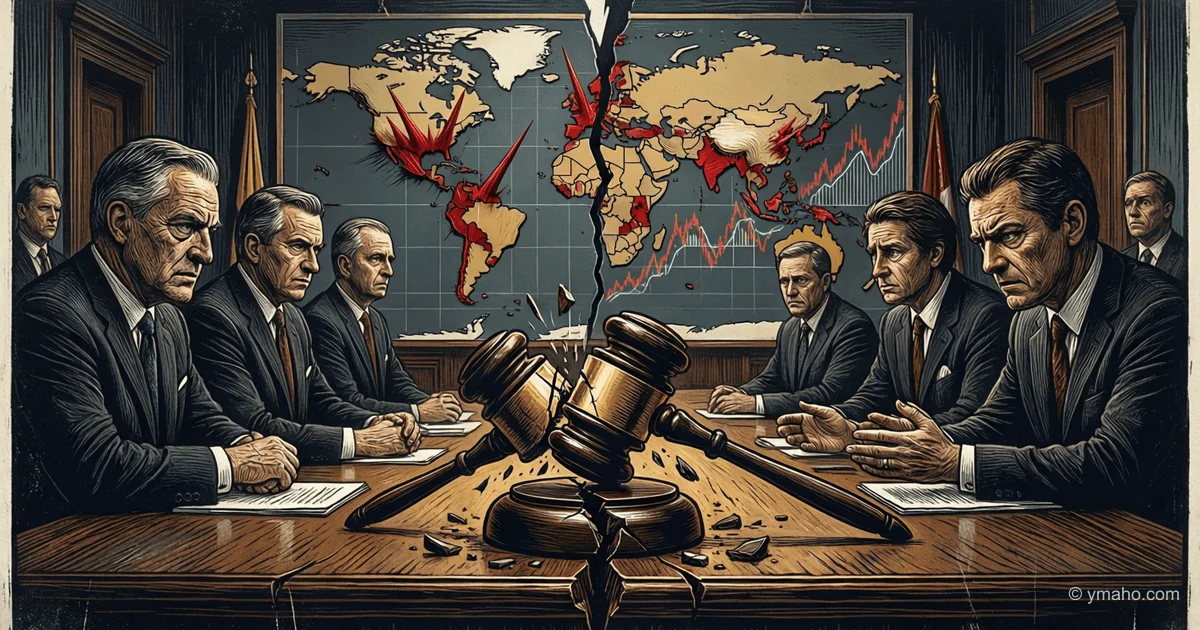
Fed Meeting Becomes Most Contentious in 30 Years
Four Fed committee members voted against the decision to hold rates steady, making the April meeting the most divided in three decades amid growing inflation fears fueled by the Middle East conflict.
Split at the Fed: Why Four Dissenting Votes Are Not Just Disagreement, but Monetary Policy Paralysis
[The Gist]: What's Really Happening
When I saw the headlines that the April FOMC meeting was the most contentious in 30 years, my first thought was: markets are underestimating the scale of the disaster. An 8-4 vote is not just four dissenting committee members. It's the breakdown of the consensus that has been the bedrock of the Federal Reserve's operations for decades.
But the scariest part is hidden in the details that didn't make the mainstream. The four "no" votes split into two opposing camps. Three members — Beth Hammack, Neel Kashkari, and Lorie Logan — demanded removing the "easing bias" from the statement, i.e., any hint of future rate cuts. And the fourth — Stephen Miran — insisted on an immediate 25-basis-point rate cut.
As a financial analyst, let me tell you: when within a single committee there are simultaneous calls to both raise and cut rates, that's not just a "dispute." It's paralysis. The Fed doesn't know which way to go because fundamental indicators point in opposite directions due to the same factor — the Persian Gulf war.
Timeline and Context
The chain of events leading to this split began forming long before April.
April 28-29, 2026 — The last meeting chaired by Jerome Powell. Rates held at 3.50–3.75%. But the 8-4 vote was the most divided since October 6, 1992.
April 30, 2026 — Publication of voting details shocks markets. Three hawks demand removing the "easing bias." One dove — Stephen Miran — demands a cut.
May 15, 2026 — Jerome Powell's term as chair expires. He remains on the Board of Governors until January 2028 but no longer has a vote on the FOMC.
May 20, 2026 — Release of the April meeting minutes. It turns out that "many" participants — in Fed terminology, five or more — wanted to remove the easing bias from the statement but did not vote against due to "political constraints." The minutes also reveal that the "vast majority" sees a risk that inflation will take longer to return to target than previously expected.
May 21, 2026 — Publication of a detailed analysis of the split. Analysts at Oxford Economics confirm: "Although there will be a new Fed chair in June, building consensus for rate moves in either direction in the near term will be a difficult task."
Non-obvious insight: When the minutes say "many" and the vote shows only three dissenting hawks, it means one thing — some of those who wanted to vote against did not do so to avoid weakening Powell's position at his last meeting. The real split is deeper than 8-4. I estimate the actual hawk-to-dove ratio inside the FOMC as 7-5 or even 8-4 in favor of hawks.
Who Wins and Who Loses
Kevin Warsh wins — formally. The new chair gets a blank slate to change policy. He has already stated his intention to abandon the practice of "forward guidance" and move to a more "rules-based" policy. But that's where the trap lies.
Powell wins — informally. The outgoing chair remains on the Board of Governors — something that hasn't happened since 1948. He publicly stated that he "believes Kevin Warsh when he says he will resist pressure" and that "the Fed's independence is now under threat." In effect, Powell becomes a "shadow chair" who will monitor Warsh's every move and influence votes through the remaining board majority.
Warsh loses — in practice. He inherits an FOMC where three hawks have already proven willing to vote against the chair. He will need to gather at least six votes for any decision. And this in an environment where President Trump publicly demands rate cuts, while economic data points to the need for hikes.
The American consumer loses. Inflation "remains elevated, partly reflecting recent increases in global energy prices." Gasoline hits wallets, and the Fed can't decide what to do. The CME FedWatch tool shows the probability of rates staying unchanged until July 2027 exceeds 50%.
Quiet win — for volatility traders. The split at the Fed means any statement from any committee member can move markets. Banks like Goldman Sachs, as I've written before, are earning record trading revenues from such uncertainty.
What the Media Isn't Saying
The main lie being propagated in the news is headlines like "Fed Holds Rates Steady." Yes, rates were held. But this decision was the final chord of the Powell era and a death knell for the era of consensus at the Fed.
First omission — the "shadow chair effect." Powell remains on the Board of Governors until January 2028. He will be in the FOMC meeting room but unable to vote. His moral authority is a tool of influence that other members lack. He can publicly criticize Warsh's decisions, and markets will listen. In effect, the US now has two Fed chairs: official and shadow.
Second omission — the legal war over the Fed. The Trump administration is already using the Department of Justice to "audit" Fed members who refuse to cut rates. The Supreme Court is considering a case on whether the president can fire Fed board members without "sufficient cause." If the court sides with the administration, the Fed's independence will be destroyed. Is this priced into the dollar? No.
Third omission — Christopher Waller already signaled. On May 22, 2026, Fed Governor Christopher Waller delivered a hawkish speech in Frankfurt. He stated that he can no longer rule out a rate hike if inflation does not cool. This was a coordinated signal to the market: the Fed is ready to tighten. But markets did not react appropriately because no one believes Trump will allow rate hikes before the election.
Forecast: Next 30 Days and 90 Days
30 days: The FOMC meeting on June 16-17 — the first under Kevin Warsh. I expect rates to remain at 3.50–3.75%. But the language will change radically. Warsh will remove the "easing bias" from the statement, shifting it to neutral. This is already partially priced into two-year Treasuries, which have risen to 4.117%.
90 days: If the Persian Gulf conflict resolves within 2-3 weeks (which I consider likely), oil prices will fall to $80–85, inflationary pressure will ease, and the Fed will keep rates unchanged through year-end. If the strait remains blocked — the hawkish wing of the FOMC will gain arguments for a rate hike. But I bet on the first scenario. Trump will not allow rate hikes before the election, even if it means "convincing" Fed members through the courts.
Editorial Forecast
Asset and direction: US Treasury bonds (two-year) — short-term yield increase.
Hawkish signals from the FOMC minutes and Christopher Waller's speech indicate that the market is underestimating the possibility of policy tightening. The yield on two-year Treasuries, which has already risen to 4.117%, could test the 4.25–4.30% level in the next 24–72 hours.
Key levels: Current range — 4.10–4.15%. A break above 4.20% would open the path to 4.30–4.35%.
Confidence level: Medium (55%). The market has only partially priced in the hawkish shift. The main risk is political pressure from Trump on Warsh ahead of his first meeting.
Main risk to the forecast: If Warsh signals in public comments in the coming days a commitment to rate cuts (contrary to the minutes and Waller), two-year Treasury yields will plummet 20–30 basis points, returning to 3.90–4.00%. Watch for any statements from the Trump camp — they will pressure Warsh publicly and behind closed doors.
— Editorial Team









