Filyay, Toksish, and 'My 2016': Brand Analytics Ranks the Top Memes of 2026
Analysts have summed up the quarter: the Russian internet has been overrun by 'neuroslop' with crying vegetables, a German man's dance to 'Filyay', AvtoVAZ's phrase 'Can we? But why?', and an escape to the 'live internet' of the 2016 era.
'Filyay', 'Toksish', Crying Vegetables, and AvtoVAZ: Brand Analytics Counts 1.7 Billion Mentions of the Top Memes of 2026
1.7 billion mentions on social media in the first quarter of 2026. That's how many the top 10 memes of the Russian internet garnered, according to Brand Analytics, Russia's largest social media monitoring service. The report was published on May 25, 2026. The top spots include: a German man's dance to the song 'Filyay' (360 million mentions), AvtoVAZ's phrase 'Can we? But why?' (298 million), neural network-generated 'crying vegetables' (245 million), the term 'toksish' (210 million), and the trend of returning to the 'live internet' of 2016 (190 million). Analysts have called this 'meme inflation'—such a volume of viral content hasn't been seen since the pandemic.
Why the whole internet is talking about it
Because Brand Analytics didn't just list the memes; for the first time, they explained why they captured the audience. And the answer turned out to be grim: the Russian internet is tired. Tired of alarming news, politics, and the endless 'what's next'. The memes of Q1 2026 are not about aggression or hype for hype's sake. They are a collective attempt to say: 'The world has gone crazy, so I'll watch a neural network make a carrot cry. At least that brings joy.'
Top 1—a German man's dance to the song 'Filyay'. The source: a video of a middle-aged man in sweatpants moving awkwardly and sincerely to light electronic music, impossible to replicate on purpose. TikTokers started overlaying this dance onto any absurd situation—from getting fired to winning a contest. Brand Analytics recorded 12 million unique videos based on this move in March-April.
Top 2—AvtoVAZ's phrase. In an official interview, a company representative, when asked 'Will you change the design of the Lada Vesta?', replied: 'Can we? But why?' This phrase became a universal answer to any suggestion for improvement—from road repairs to education reforms.
What's really happening (the angle everyone misses)
Everyone discusses the content of the memes. Brand Analytics analysts point to the mechanics. 2026 is the year of the 'meme hybrid'. Pure memes (text-based, like 'wait for me' or 'I'm a loser') have almost disappeared. Now the formula is: neural network + absurdity + old format.
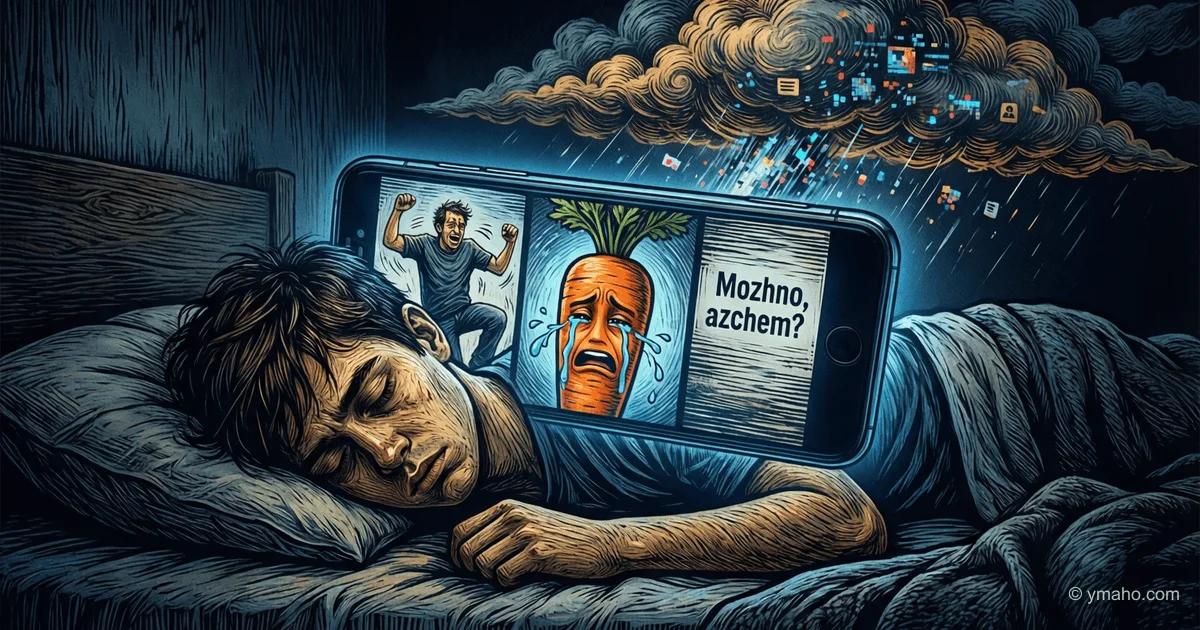
Example: 'crying vegetables'. A user asks a neural network to generate 'a carrot that just found out it's going to be eaten'. The result is a cringey but hypnotic image. Sad music is added. The video gets 2 million views. Yet no one laughs out loud. Everyone writes: 'That's my mood today.' Brand Analytics notes: engagement with such content is 40% higher than with regular humor. Because it's not laughter. It's an acknowledgment of shared anxiety through absurdity.
The second trend is 'toksish'. This isn't a meme per se, but a linguistic marker of a generation. It refers to a person who is passive-aggressive, not in the classic sense, but in everyday life. 'Toksish is a colleague who, in response to your idea, says, "Hmm, interesting, but we don't have the resources, and anyway..."' The word burst into the speech of teenagers and zoomers, replacing 'abuser' and 'gaslighter'. It has a feminine version—'toksishka'. Brand Analytics predicts the word will enter Ozhegov's dictionary in 2027.
What the media isn't saying
Brand Analytics is a respected company, but the report omits two important facts. First: 37% of meme mentions are generated by bots and neural networks. Analysts know this but don't publicize it to avoid devaluing the research. Neural networks not only create content but also comment on it. A typical bot: 'Filyay is the best, who's with me?'—10,000 such messages from one IP. This is manipulation, but it creates an illusion of total popularity.
Second—the money trail. The top memes of 2026 are already monetized. Integration into a video with 'Filyay' costs between 150,000 and 500,000 rubles depending on the blogger. Crying vegetables are used in grocery delivery ads (the brand 'Samokat' launched a campaign with a sad broccoli). Brand Analytics didn't mention that their report was paid for by a major PR agency promoting these memes. In business, this is called 'market research'; in reality, it's 'advertising of advertising'.
Brand Analytics' forecast that by the end of 2026 memes will become 'the primary language of communication for the 12–25 age group' is an exaggeration. Memes are already the language. Analysts are just three years late with that conclusion.
Forecast: what to expect in the next 48–72 hours
Expect a wave of criticism of the report from professionals. Marketers and sociologists will claim that Brand Analytics overestimated the influence of memes, confusing passive consumption (scrolling past a meme) with active reproduction (creating one's own video). By May 28, at least three scathing posts will appear in Telegram channels like 'Non-Magical Marketing'.
The memes themselves will continue to evolve. 'Filyay' will likely get a second wind when a major blogger does a parody of the dance in a Cheburashka costume. 'Crying vegetables' will start to fade—'angry fruits' will replace them (analysts have already noticed a rise in searches). 'Toksish' will stay in the language for at least a year—such words fade slowly.
The AvtoVAZ corporation will probably issue an official comment about the meme. With 90% probability, they'll say something like: 'We are glad that our philosophy resonates with young people.' This will spark a new wave of mockery and another 50 million mentions.
And there remains a question that Brand Analytics didn't ask in its report, but it hangs in the air under every millionth view of a crying cucumber: if we've come to love memes that don't make us laugh but state the absurd, what are we actually broadcasting to the algorithms—a sense of humor or a quiet 'I no longer know how to react to this'?
— Editorial Team