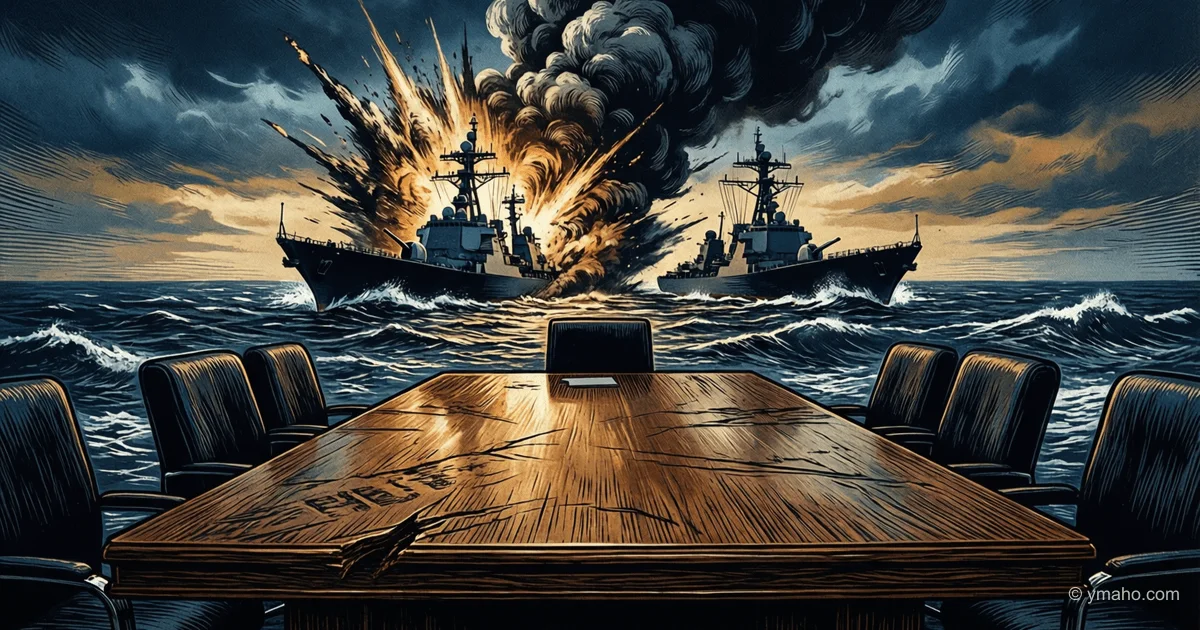
Iranian Media Report Details of US Strike, Negotiators Arrive in Doha
According to Nour News, strikes south of Larak Island resulted in casualties among IRGC personnel. Despite this, Iranian negotiators arrived in Qatar's capital for another round of talks with the US on lifting the blockade.
Diplomacy Under Fire: Why Iran Sent Negotiators to Doha Immediately After the Strike
When on Sunday, May 25, the Iranian news agency Nour News (close to the Islamic Revolutionary Guard Corps) confirmed that US and Israeli strikes south of Larak Island caused casualties among IRGC servicemen, the logical expectation was a breakdown in negotiations. Trump had boasted of "progress" just hours earlier, then explosions rang out. The standard scenario — Tehran walks away from the negotiating table, threatens a symmetric response, and escalation continues.
But that didn't happen.
Literally the next day, May 26, Iranian negotiators arrived in Doha for another round of talks with the US on lifting the blockade. To the average person, this looks like schizophrenia. To a professional trader, it's a signal that the deal is not just alive, but in its final, most cynical stage.
[The Essence]: What's Really Happening
"Strikes and negotiations" are not a contradiction, but a method. The US and Israel use limited military actions ("precision strikes") not to destroy Iran, but to establish "rules of the game" before signing an agreement.
For Tehran, the math is simple and grim: each day of the Strait of Hormuz blockade and sanctions on Iranian oil costs the country roughly $200-300 million USD in lost exports. The Iranian economy, already weakened by years of sanctions, cannot withstand such a regime for several more months.
On the other hand, the IRGC must show "resistance" to its domestic audience. Strikes on ships allow Iran to tell its people: "We are fighting." And arriving in Doha allows it to tell the world: "We are negotiating." For a financial analyst, this reads unequivocally: the negotiation process takes priority over military rhetoric.
[Timeline and Context]
- May 25, morning: President Trump on his social media platform Truth Social declares "beautiful progress" in negotiations and even threatens to "destroy Iran's nuclear program if a deal is not reached."
- May 25, day (local time): US and Israeli aircraft strike Iranian ships near Larak Island. Nour News reports "several dead" among IRGC military personnel. Maxar satellite images, analyzed by the OSINT community, show three damaged Ashura-class boats (Iranian speedboats capable of carrying anti-ship missiles).
- May 26, morning (today): Iranian negotiators arrive in Doha. The composition of the delegation is not disclosed, but Reuters sources in Qatar claim it includes representatives of Iran's Foreign Ministry and "consultants" from the economic bloc — people authorized to discuss lifting the blockade, not military issues.
A US State Department official (unfortunately unnamed in the reports) confirmed that the meeting will take place "in the coming days."
[Who Wins and Who Loses]
Winner — Qatar and its sovereign wealth fund.
Qatar is not just acting as a mediator. Doha has become the main beneficiary of the crisis. The Qatar Investment Authority has recently signed contracts for storage and re-export of Iranian oil "pending a deal" through its terminals in Ras Laffan. Once the strait is opened, Qatar will collect commissions on every barrel passing through its infrastructure.
Winner — Traders holding short positions on oil via options.
The announcement that negotiations are ongoing has already led to a slight decline in oil prices during the Asian session on May 26 (Brent fell from $98.50 to $97.20). Traders who bought call spreads (bets on price increases) are now panicking and locking in losses, while those who sold volatility are profiting.
Loser — Israel (in the short-term political perspective).
The Israeli government under Netanyahu struck alongside the US yesterday, but today finds that the US is negotiating with the enemy. Far-right ministers have already criticized the "deal" as capitulationist. However, Israel cannot stop the main negotiation track, as the US is its primary ally and arms supplier.
Loser — European energy companies.
Shell, TotalEnergies, and Eni. They are caught between two fires. Their LNG tankers cannot leave the Gulf, and alternative supplies from the US and Australia cost 30-40% more. The talks in Doha offer hope for a quick opening of the strait, but Rubio's statements that the strait will be opened "one way or another" do not reassure them.
[What the Media Isn't Saying]
Insight: The negotiators who flew to Doha are not the highest-ranking diplomats. Nour News, reporting on their arrival, specifies that this is a "technical delegation" for "detailing the mechanisms of lifting the blockade." This means the political decision was already made at the highest level in Tehran (by Supreme Leader Khamenei) before the strikes. The strikes were either coordinated with the Iranian side or, at least, were not a surprise to them.
Why do I think so? Because Iran's Foreign Ministry issued a statement about the negotiations almost simultaneously with the reports of casualties. If the strikes had been an uncoordinated escalation, Tehran would have first recalled its ambassador, frozen contacts, and returned to the table a week later. Here, there is no delay.
This is classic "gunboat diplomacy" in the style of the 19th century, transplanted into the era of drones and satellites. The US demonstrates it can strike, Iran demonstrates it won't break. And both sit down at the negotiating table to discuss who gets which piece of the pie.
[Forecast: Next 30 Days and 90 Days]
30 days:
- Markets will price in a strait deal as the base case. Probability of signing a framework agreement in the next 2-3 weeks: 65-70%.
- Brent will trade in the range of $92-$98, with sharp drops of 3-5% on each dose of optimism from Doha and equally sharp spikes on each "military incident."
- The Iranian rial (IRR) on the black market will likely strengthen by 10-15% against the dollar in anticipation of sanctions relief.
90 days:
- If a deal is reached in June, the strait could be fully opened by August. The release of stranded oil (estimated 40-60 million barrels) and an increase in Iranian exports (plus 1-1.5 million barrels per day) will crash prices. Brent could fall to $75-$80 by the end of Q3 2026.
- If the deal falls through (30-35% probability due to Israel's hardline stance or internal pressure in Iran), then Rubio's "force scenario" becomes real. Military demining of the strait would lead to a short-term oil spike to $120, followed by a collapse — but such a scenario would damage US reputation for decades.
Editorial Forecast
- Asset: Brent crude oil (futures)
- Movement: Short-term decline in the next 24–72 hours to $94–$96 per barrel
- Key levels: Current value ~$97.50, first support at $95.80, next target $93.90. Resistance at $99.20
- Confidence level: Medium (65%)
- Main risk: An unexpected statement by Trump or Netanyahu about ending negotiations due to "Iran's breach of commitments" could reverse the market 180 degrees, and Brent would surge to $103-$105 within 24 hours, despite the presence of negotiators in Doha.
Analytical opinion, not individual investment advice.
— Editorial Team