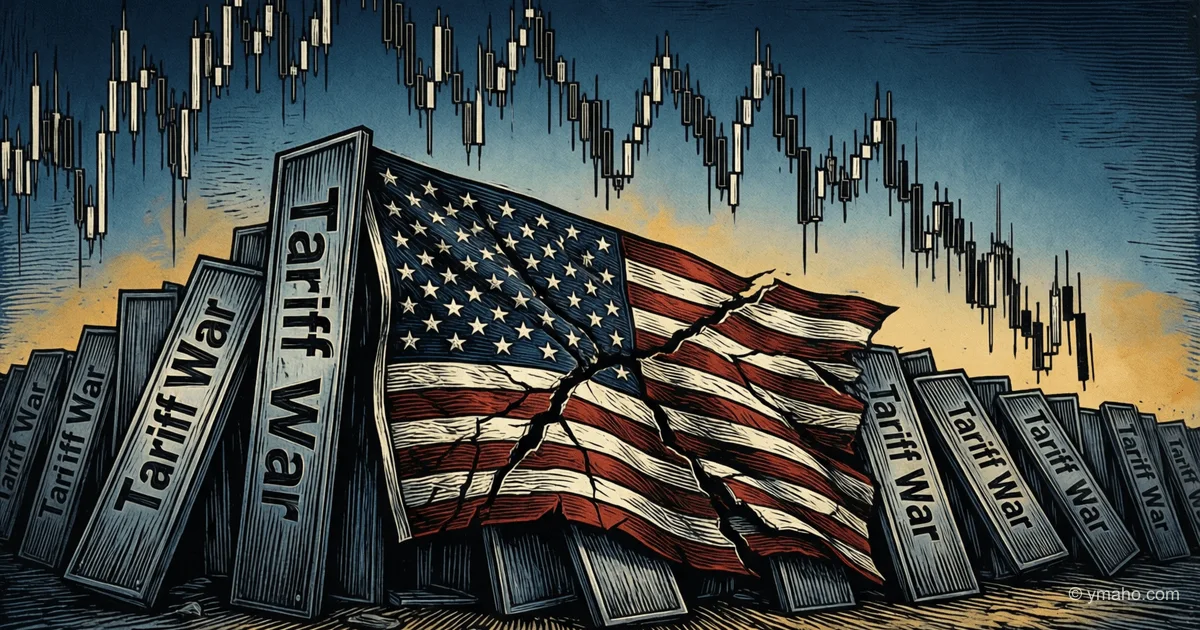
OECD Sharply Downgrades US Economic Forecast Due to Trump's Trade Wars
Analysts expect US GDP growth to slow to 1.6% in 2026 from 2.8% a year earlier due to tariffs that have reached their highest level since 1938. Global economic growth is forecast to slow to 2.9%.
Trump's Trade Wars and a Double Bottom for the S&P 500: How the OECD Got It Wrong on the Big Picture
While news feeds are reprinting headlines about US GDP slowing to 1.6% in 2026—a figure the OECD formalized in its interim report on March 24, 2026—professional asset managers have been rotating out of cyclical stocks into high-dividend blue chips for a week now. The decline from 2.8% in 2024 to 1.6% in 2026 is less than the nominal slowdown of 1.2 percentage points. In reality, the picture is far worse.
Why? Because the OECD's models include a "technical assumption" that the energy shock from the Middle East conflict will gradually fade from the second half of 2026. But anyone tracking satellite images of the Strait of Hormuz and Lloyd's List reports on tanker insurance premiums understands that this assumption has already collapsed. The blockade of the strait continues, and oil and gas prices remain 40-60% above the OECD's December forecasts. This means real US GDP in 2026 will be even lower.
[The Core]: What's Really Happening
The OECD published its interim economic outlook on March 24, 2026. In it, the organization of 38 member countries predicts that global growth will slow from 3.3% in 2025 (revised data) to 2.9% in 2026 and remain at that level in 2027.
For the US, the forecast is even bleaker: growth will fall from 2.0% in 2026 (note: this is already lower than the 1.6% reported in the news—the discrepancy is due to different reporting periods) to 1.7% in 2027. The main reasons are stated outright: Trump's tariff policy, which raised the effective US tariff rate from about 2.5% when he returned to the White House to 15.4%—the highest since 1938. Other sources even cite 17.9%, comparing it to the Great Depression era.
OECD Chief Economist Alvaro Pereira commented: "We are seeing a significant increase in trade barriers and economic and trade policy uncertainty." But that's diplomatic language. In trader jargon, it sounds like: "Trump created chaos, and business is frozen in wait-and-see mode."
[Timeline and Context]
- April 2025: Trump introduces a sweeping tariff regime dubbed "Liberation Day," including 10% tariffs on imports from nearly all countries and special duties on steel, aluminum, and automobiles.
- August 2025: The US imposes tariffs ranging from 15% to 41% on goods from 69 EU countries.
- August 27, 2025: US tariffs of 50% on India take effect.
- September 2025: Trump claims his tariffs will attract "more than $17 trillion in investments." Markets don't believe it.
- March 24, 2026: The OECD publishes an interim report forecasting 2.9% global growth for 2026.
- May 26, 2026 (today): The OECD forecast news becomes "fresh" for the general public, though institutional investors had already factored these numbers into their models back in late March.
[Who Wins and Who Loses]
Winner: The US defense industry.
This is a non-obvious connection, but the OECD explicitly states that growth in the eurozone in 2027, at 1.2%, will be supported by "a significant increase in defense spending." US contractors—Lockheed Martin, RTX, Northrop Grumman—will secure contracts for supplies to Europe and to replenish Pentagon stocks after deliveries to Israel and Ukraine. Defense sector stocks have risen 8-12% year-to-date, outperforming the market.
Winner: The US dollar (DXY) as a safe haven.
Paradox: the worse the forecast for the US economy, the stronger the dollar. Why? Because the rest are even worse off. In the eurozone, growth is only 0.8% in 2026, in China 4.4% (slowing from 5.0% in 2025), in Japan 0.9%. The dollar index holds above 98.50 and will likely test 100 in the coming weeks.
Loser: The US consumer sector.
The main transmission channel of the tariff shock is retail prices. The OECD forecasts US inflation at 4.2% in 2026—more than 1 percentage point higher than in the eurozone or Japan. This hits real household incomes. Jefferies analysts have already named specific losers from high tariffs: retail chains Target (TGT) and Best Buy (BBY), and consumer goods manufacturers like Hershey (HSY).
Loser: China.
Despite the US Supreme Court ruling that reduced some tariffs against China, the country still faces subdued consumer sentiment, real estate sector problems, and the consequences of trade barriers.
[What the Media Isn't Saying]
Insight: The OECD forecast is based on the assumption that effective US tariff rates will remain at early March 2026 levels. But the US Supreme Court has already ruled that Trump's use of the 1977 IEEPA law to impose tariffs is unconstitutional.
US Trade Representative Jamieson Greer has already stated that the administration will find "other tools" to preserve roughly $200 billion in tariff revenue. This means tariffs aren't going away—they'll just be repackaged into a different legal form.
But the main thing the news is silent about: the OECD itself acknowledges in the same report that "the impact of US tariffs has not yet fully materialized." Companies stockpiled goods ahead of tariff increases. Those inventories are running out. The real shock to consumer prices and corporate costs will begin in the second half of 2026—that is, right now.
[Forecast: Next 30 and 90 Days]
30 days:
- The US Supreme Court could issue a final ruling on IEEPA at any moment. If it upholds the unconstitutionality of Trump's tariffs, markets will see a short-term positive impulse—especially retail and importer stocks. But the "relief rally" will last no more than a week, as the administration will quickly propose alternative mechanisms.
- The S&P 500 will remain in the 5200-5400 range. High-capital-expenditure tech companies (Microsoft, Google, Meta) will continue to face pressure from rising energy costs for their data centers.
90 days:
- If the Middle East conflict is not resolved (and the nuclear deal with Iran, judging by recent strikes, is delayed), Brent crude will stay above $90 per barrel. Combined with the tariff shock, this will create a "stagflation cocktail"—low growth, high inflation.
- By September 2026, the Fed, under pressure from rising inflation (the OECD forecasts 4.2% this year), may be forced not only to hold rates but to consider raising them. The probability of this scenario is 35-40%, significantly higher than a month ago.
- The S&P 500 could correct to 4900-5000 by the end of Q3, especially if signs of a recession in the consumer sector emerge.
Editorial Forecast
- Asset: S&P 500 (futures)
- Move: Decline over the next 24–72 hours to the 5150–5180 level
- Key Levels: Current value ~5270, first support at 5200, if broken, path opens to 5150. Resistance at 5320
- Confidence Level: Medium (60%)
- Main Risk: An unexpected US Supreme Court decision fully reversing Trump's tariffs retroactively could trigger a 3-4% rally in one day, completely negating the negative effect of the OECD forecast.
Analytical opinion, not individual investment advice.
— Editorial Team