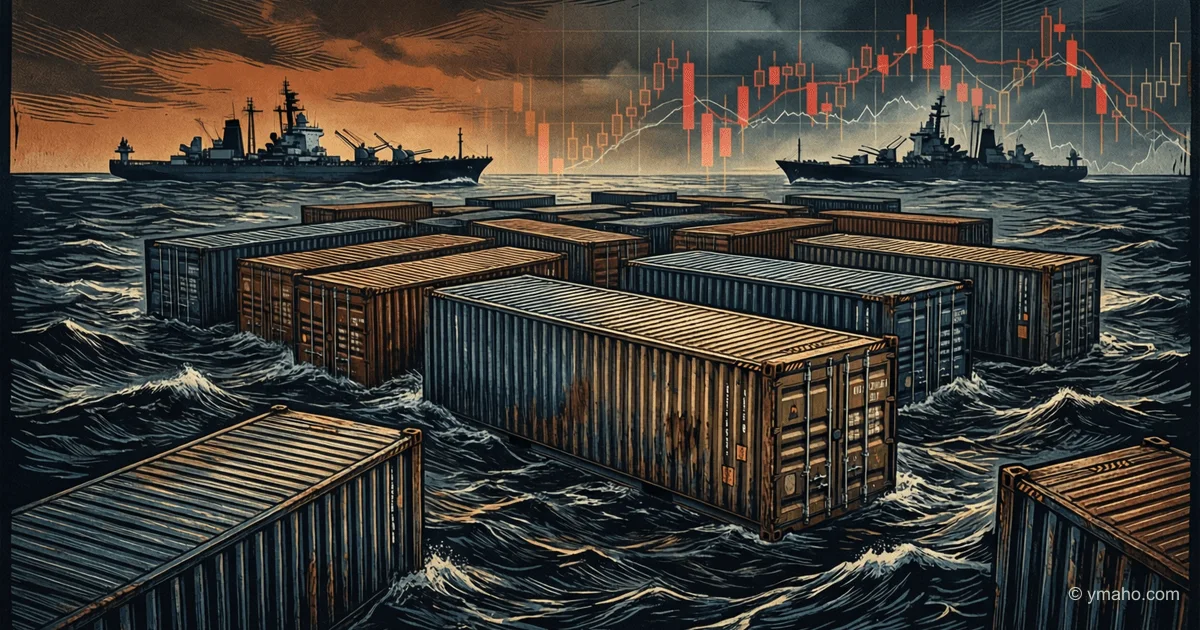
Global Trade Growth to Sharply Slow to 2.8% in 2026 — IMF Forecast
According to the April World Economic Outlook report, trade growth will more than halve from 5.1% in 2025. The Fund notes that the global economy is 'in the shadow of war' in the Middle East.
Global Trade in the Shadow of War: Why the IMF's 2.8% Forecast Is Already Outdated
The 2.8% figure for global trade growth in 2026, which the IMF released on April 14 in its report "World Economy in the Shadow of War," is now circulating from news outlet to news outlet as a fresh fact. But for those tracking container ship movements in real time and monitoring insurance premiums in the Strait of Hormuz, this forecast looks like a historical document rather than a working tool.
The problem is that the IMF's "baseline scenario," on which the 2.8% figure is built, assumes a normalization of energy markets and trade routes in the second half of 2026. But today is May 26, and the war in the Middle East is not only not subsiding but expanding to the Lebanese front. The IMF's own chief economist, Pierre-Olivier Gourinchas, admitted immediately after the publication that this forecast "may already be outdated."
[The Gist]: What Is Really Happening
In the April 14 document, the IMF recorded a sharp slowdown in global trade — from 5.1% in 2025 to 2.8% in 2026. The Fund directly linked this to "the negative impact of customs duties and changes in global supply chains," as well as the war in the Middle East.
But the key word here is "reference scenario." The IMF built it on the assumption that the conflict would be "limited in duration and scope" and that the main shocks would "fade by mid-2026." Under this scenario, the average Brent oil price in 2026 would be $82 per barrel.
Reality, however, dictates different numbers. Brent is already trading in the $95-$100 range, and the Strait of Hormuz remains partially blocked. Gulf countries, according to OPEC, have reduced production by nearly 8 million barrels per day. With these inputs, the IMF itself warns: the world is moving toward an "adverse scenario," where global growth collapses to 2.5%, and in the worst case, to 2.0%.
[Timeline and Context]
- April 14, 2026: The IMF publishes the April edition of the World Economic Outlook under the title "World Economy in the Shadow of War." Forecast: global trade will slow to 2.8% in 2026 from 5.1% in 2025.
- April 16, 2026: At a press conference in Washington, IMF Director of the Middle East and Central Asia Department Jihad Azour presents a regional forecast estimating GCC production losses at 13 million barrels of oil per day.
- May 24-25, 2026: US and Israeli strikes on Iranian ships near Larak Island. Talks in Doha continue, but the conflict does not abate. Brent remains above $95.
- May 26, 2026 (today): News of the IMF's 2.8% global trade forecast appears in feeds as "fresh," even though it is based on data nearly a month and a half old.
[Who Wins and Who Loses]
Winners: Semiconductor and AI Component Sector.
Paradox: total global trade volume is falling, but certain segments are experiencing explosive growth. In Singapore, a key Asian trade hub, electronics exports in the first quarter of 2026 rose 57.8% year-on-year. Enterprise Singapore (a government agency) raised its non-oil export growth forecast to 3-5% precisely due to AI components. Even the World Trade Organization revised its trade growth forecast upward — from 0.5% to 1.9% — citing "the continued strength of AI-related trade." Chip, integrated circuit, and data center equipment manufacturers are thriving amid the overall downturn.
Winners: Vietnam, Mexico, and Other "Alternative Manufacturing Hubs."
Trade wars between the US and China (effective tariffs have reached highs not seen since 1938) have led to a restructuring of supply chains. Goods that previously went directly from China now pass through Vietnam, Thailand, and Mexico — with a corresponding markup. These countries benefit from diversification, even as total global trade volume falls.
Losers: European Union (especially Germany).
According to the IMF, the eurozone is one of the main losers from the energy shock. Germany, as the largest exporter of industrial goods, is heavily dependent on cheap energy and stable supply chains. Both of these factors are now disrupted. Growth forecasts for the eurozone in 2026 range from 0.8% (OECD) to 1.3% (IMF).
Losers: China.
Beijing faces three simultaneous blows: US tariffs (even after Supreme Court decisions, they partially remain), slowing domestic demand due to the real estate crisis, and energy supply disruptions from the Strait of Hormuz blockade. The IMF forecasts China's growth at 4.5% in 2026, but that is a slowdown from 5.0% in 2025.
Winners: Russia (in a very limited sense).
The IMF upgraded its forecast for the Russian economy in 2026 to 1.1%. The reason: high oil and gas prices that offset sanctions pressure. But for global trade as a whole, Russia is a minor player; its share of global trade fell to less than 2% after 2022.
[What the Media Is Not Saying]
Insight: The main driver of the global trade slowdown is not so much the war as the collapse of the marine insurance market.
Insurance premiums for ships entering the Strait of Hormuz have risen 5-7 times compared to pre-war levels. For a typical VLCC (very large crude carrier), the cost of insurance for a single voyage can reach $2-3 million. This means that transporting goods through the Gulf has become economically unviable for many types of cargo — especially those with low margins (grain, fertilizers, cheap electronics).
According to Jihad Azour's presentation at the IMF, one-third of global fertilizer supplies and 20% of ammonia exports pass through the Strait of Hormuz. Urea futures prices have risen by 30%. These costs translate into higher food prices, which then reduce consumer demand in importing countries. Lower demand leads to fewer orders for new shipments — and trade falls.
But the news is silent on this because insurance markets are complex and boring. It is much easier to write "trade is slowing due to war" than to explain how rising premiums at Lloyd's lead to reduced wheat purchases by Egypt.
[Forecast: Next 30 Days and 90 Days]
30 days:
- The IMF will likely be forced to revise its 2.8% forecast downward to 2.3-2.5% at the July "update" (traditionally published at the end of July).
- Real trade data for the second quarter of 2026 (due in June-July) will show a 1-2% decline compared to the first quarter — the first signs that the IMF forecast was too optimistic.
- Shares of shipping companies (Maersk, Hapag-Lloyd) will continue to fall, despite temporary spikes in freight rates.
90 days:
- If the conflict is not resolved by August (60-70% probability at current pace), global trade will enter a mode of "structural fragmentation." This means supply chains will be restructured not temporarily but permanently — with the creation of "friendly" corridors.
- China will begin to more actively use the "Silk Road" through Central Asia and Russia to bypass sea routes, but railway capacity is an order of magnitude lower than container shipping.
- Global trade growth for the entire 2026 year could be not 2.8%, but 1.5-2.0% — the worst since 2020 (pandemic) and possibly since 2009 (financial crisis).
Editorial Forecast
- Asset: Shares of shipping company A.P. Moller-Maersk (MAERSK-B.CO)
- Movement: Decline in the next 24–72 hours by 2-4% from current levels
- Key levels: Current price ~11,000 DKK; support at 10,500, resistance at 11,500; target level on support break — 10,000
- Confidence level: Medium (60%)
- Main risk: A sudden US-Iran deal on the Strait of Hormuz — if the strait opens in the coming days, insurance premiums will collapse, freight rates will normalize, and shipping stocks could rise 10-15% in a week, completely ignoring the gloomy IMF trade forecast.
Analytical opinion, not individual investment advice.
— Editorial Team