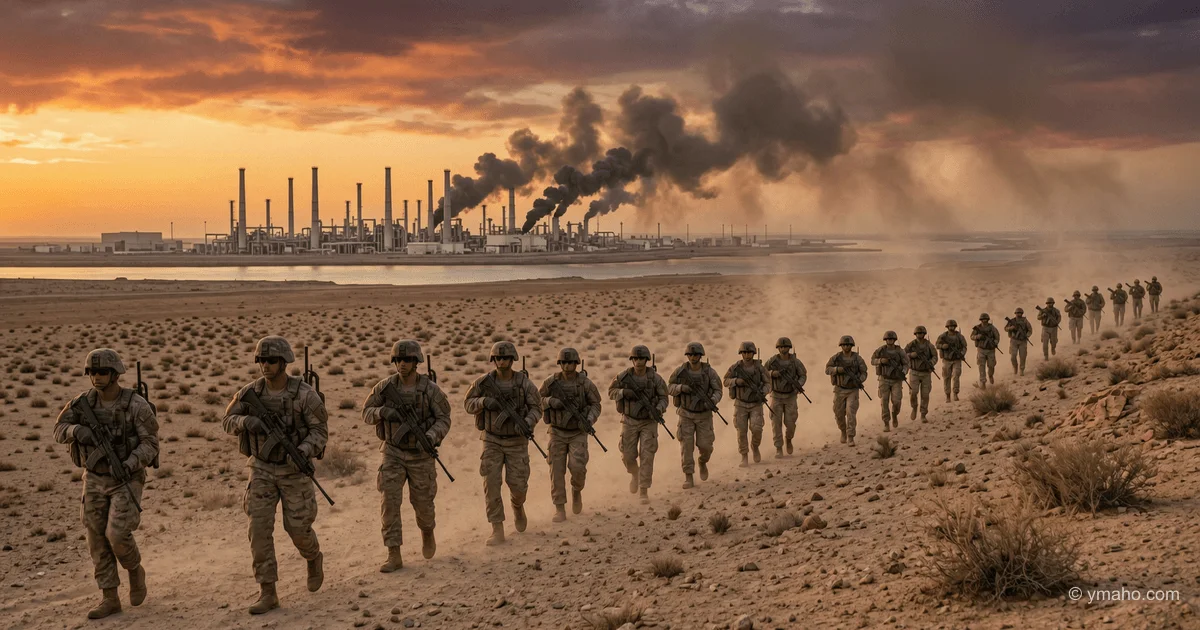
Expert assesses threat of US ground operation in Iran after failed negotiations
Political scientist Pavel Sharikov suggested that President Trump may be considering the possibility of a full-scale ground operation in Iran. Current law allows the US president to initiate military action for up to 60 days without congressional approval.
Ground operation in Iran: why analysts are talking about an unthinkable scenario
The gist: what is really happening
Political scientist Pavel Sharikov's public suggestion of a possible full-scale US ground operation in Iran is not expert improvisation or speculation on a hot topic. It is a marker of a tectonic shift in the discourse of the US foreign policy establishment, which just three months ago considered such a scenario political suicide for any administration.
In reality, we are witnessing the preparation of informational groundwork. When an expert of Sharikov's level, who has access to closed discussions at RIAC platforms and is connected to the international expert community, publicly articulates a ground invasion scenario, it means that at least one operational plan has already passed the interagency coordination stage in Washington. This is not about Trump giving the order to invade tomorrow. It is about the option no longer being taboo.
The 60-day window for military action without congressional approval, which Sharikov references, is a nod to the War Powers Act of 1973. But the insider detail that almost no one discusses is that a group within the legal service of the National Security Council under Trump is working on an expansive interpretation of this law. The gist is that the 60-day limit can be extended by another 30 days if the president cites "irresistible military circumstances." That totals 90 days without a single vote in Congress. This is enough to conduct a limited ground phase with the capture of key coastal facilities.
Timeline and context
The current escalation around Iran did not arise spontaneously. It is the result of a consistent failure of the diplomatic track stretching back to February-March 2026.
February 2026 — first indirect contacts in Geneva through a Swiss mediator. Agenda: dismantling Iran's weapons-grade nuclear program in exchange for lifting blocking sanctions on the Central Bank of Iran.
March 2026 — negotiations stall. Iran insists on retaining the right to enrich uranium up to 20%, while the US side demands the complete dismantlement of IR-9 centrifuges at the Natanz facility. The parties part ways without even signing a framework memorandum.
April 28–29 — failure of the Geneva round. IRGC orders commercial vessels to leave the Persian Gulf. The Strait of Hormuz is effectively blocked.
May 1–2 — drone attacks on the UAE. ADNOC infrastructure in Jebel Ali sustains damage, with losses estimated at $340 million.
May 4 — incident involving several vessels in the Strait of Hormuz. The parties' versions diverge radically, but the fact is that the maritime phase of the conflict has entered a hot stage.
May 5–6 — Trump rejects Iran's peace proposal, suspends Operation Project Freedom, but simultaneously claims progress in dialogue. Markets perceive this as de-escalation — and are mistaken.
It is against this backdrop that Sharikov's statement about a ground operation emerges. The context is critically important: after the failure of the maritime Operation Project Freedom and the demonstrative inability of the US Navy to ensure freedom of navigation, the Trump administration is seeking an alternative scenario to regain strategic initiative. The ground option becomes a logical — albeit extremely risky — continuation of the failed maritime operation.
Who wins and who loses
Paradoxically, the main short-term beneficiary of the very discussion of a ground operation is not the Pentagon or the US military-industrial complex, but the diplomatic corps. The leak or public articulation of the ground scenario sharply strengthens the US negotiating position in any future consultations. The Iranians receive a signal: if diplomacy yields no results, the White House is prepared to pursue a scenario that Tehran always considered unthinkable.
The military-industrial complex wins regardless. Even without an actual invasion, preparation for it requires deploying additional logistics infrastructure in Kuwait, Bahrain, and Saudi Arabia. Estimates suggest that the preliminary deployment of a single heavy brigade combat team costs $2.8–3.5 billion, excluding the cost of the operation itself.
Saudi Arabia loses. Riyadh finds itself in a catastrophic geopolitical trap: providing territory for a ground operation against Iran guarantees massive retaliatory strikes on the kingdom's oil infrastructure, including the Ras Tanura complex and the Ghawar field. Refusal undermines alliance relations with the US. Saudi Defense Minister Khalid bin Salman has already signaled through non-public channels that the kingdom is not interested in hosting US ground forces on its territory for operations against Iran.
China wins regardless of the outcome. A US ground operation in Iran would mean guaranteed destabilization of energy supplies from the Persian Gulf and diversion of US military resources for years. Beijing gains an ideal strategic window to intensify activity in the South China Sea.
What the media are not saying
The most significant unspoken aspect is Israel's position. In the public sphere, Jerusalem maintains cautious silence, but insider data indicates that it is Israeli intelligence, through Mossad channels, that is actively promoting the thesis in Washington that Iran's nuclear program has reached the point of no return. Within the Israeli military establishment, there is a faction that believes that without a ground component, any airstrikes on Iran's nuclear facilities will have only a temporary effect. This position is being conveyed to Trump's advisors through pro-Israel circles in the Republican Party.
The second unspoken topic is financing. No one publicly discusses how much a ground operation would cost. For comparison: the Iraq war cost the US budget over $2 trillion, while Iran has twice the population and four times the territory. Even a limited operation to capture the coastal zone in Khuzestan province and islands in the Strait of Hormuz would require additional funding of at least $120–180 billion in the first year. Given that the US national debt already exceeds $36 trillion and debt service costs are approaching $1.2 trillion annually, such expenditures without tax increases would lead to serious turmoil in the Treasury market.
Third insight: a ground operation against Iran is impossible without the preliminary deployment of an air and missile defense system along the entire northern coast of the Persian Gulf. Iran's arsenal of medium-range ballistic missiles is estimated at 3,000 to 5,000 units, and even the most advanced US Patriot and THAAD systems cannot guarantee interception of a salvo launch of hundreds of missiles. A ground operation under such conditions turns troop concentration areas into massively vulnerable targets.
Forecast: the next 30 days and 90 days
30 days (until early June 2026)
Rhetoric around the ground operation will intensify, but without a practical transition to the deployment phase. The Trump administration will use this threat as a bargaining chip. On the practical side, we will see enhanced forward basing: deployment of additional air defense batteries to Kuwait and Bahrain, and a buildup of rapid response forces at Al Udeid Air Base in Qatar. This is not preparation for invasion — it is creating infrastructure for any scenario.
The key indicator to watch is the movement of US Navy hospital ships. USNS Comfort and USNS Mercy are currently at their home ports of Norfolk and San Diego. If at least one of them begins moving toward the Persian Gulf, it will mean that the Pentagon has moved from planning to practical preparation.
90 days (until late July – early August 2026)
The probability of an actual ground operation remains low — in the range of 15–20%. But if negotiations reach a complete deadlock and the Iranian side continues attacks on shipping and allied facilities, the Trump administration may decide on a limited operation with a specific, narrowly defined objective.
The most likely scenario is the capture of Greater and Lesser Tunb islands, as well as Abu Musa in the Strait of Hormuz. These islands, occupied by Iran since 1971, are strategically important for control of the shipping channel. A limited amphibious operation involving US Marines and possibly UAE special operations forces could be carried out within the 60-day window without congressional approval.
But even such a limited scenario carries enormous risks. Iran could respond with massive missile strikes on US bases in the region, activation of proxy forces in Iraq, Syria, and Yemen, and — most dangerously — direct cyberattacks on critical infrastructure of the US and its allies, including the financial sector and energy grids.
A ground operation in Iran is a threshold beyond which the familiar architecture of regional security collapses completely. Even its active discussion is already changing the rules of the game, turning the unthinkable into a subject of bargaining and military planning.
— Editorial Team









