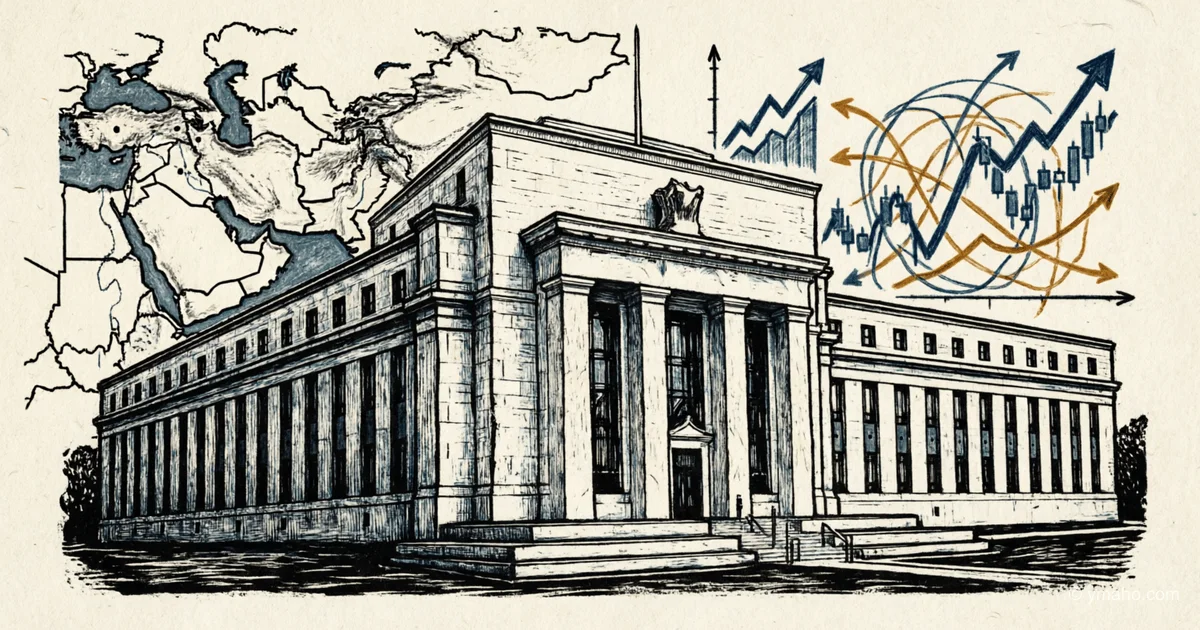
Fed Officials Grow More Concerned That Inflation Will Return to Target Later Due to Conflict
The minutes of the latest Fed meeting showed that most committee members see elevated risks that inflation will return to 2% later than expected. Meeting participants believe that high energy prices will continue to exert upward pressure on overall inflation.
When a "temporary" factor becomes permanent: How the energy shock rewrote the Fed minutes
Author's analytical review
[The Gist]: What's Really Happening
The minutes of the April Fed meeting, released on May 20, 2026, are a document that records a tectonic shift in the thinking of the US central bank. Formally, the rate remained at 3.5-3.75%, and only one committee member—Stephen Miran—voted for a cut. But the real story lies in the details that most commentators missed.
The vast majority of FOMC members stated that they see elevated risks of inflation returning to the 2% target later than expected. This is not a technical adjustment. It is an acknowledgment that the entire previous disinflation plan is likely no longer working.
But the most important thing is the new phraseology. The committee removed from the statement the wording about "flexibility and speed" in responding to economic data. Instead, a different phrase appeared: persistently high inflation and uncertainty around the duration of the conflict in Iran could mean that policy must remain on hold longer than previously assumed.
In Fed speak, this means only one thing: the window for rate cuts in 2026 has closed. And moreover, most committee members are already ready to discuss a hike.
Timeline and Context
Properly sequencing events is critical to understanding why these minutes are not an ordinary document.
April 28-29, 2026 — The FOMC meeting takes place. This is the last meeting chaired by Jerome Powell, who has served in this role for eight years. At the next meeting, June 16-17, the committee will be led by Kevin Warsh—a Trump appointee whom the market considers a "dove."
April 2026 — US inflation accelerates to 3.8%—a three-year high. The PCE index, the Fed's preferred indicator, reaches 3.5%. In both cases, this is significantly above the 2% target.
April 29, 2026 — The Fed leaves the rate unchanged. But something unprecedented happens: four committee members vote against—the largest number of dissenters since 1992. One (Miran) votes for a cut. Three (Beth Hammack, Neel Kashkari, Lorie Logan) vote against the "dovish bias" in the statement, believing that the next move should not be exclusively a cut but any direction, including a hike.
May 20, 2026 — The minutes are published. Markets see that the hawkish camp within the Fed has grown and strengthened.
Now (May 25, 2026) — I am writing this analysis. The CME FedWatch tool shows: the probability of a rate cut by December 2026 is only 1.6%. The probability of a 0.25 pp hike is 36.7%, and a 0.5 pp hike is 9.5%. The market is not just allowing for a hike—it is beginning to believe in one.
The key point that is overlooked: this meeting took place before the late-May escalation (cancellation of Trump's wedding, preparation for new strikes). That is, the minutes reflect a "calm" risk assessment. After the new events, the picture became even more hawkish.
Who Wins and Who Loses
Winner #1 — Short positions on bonds (Treasury bears). The yield on 10-year Treasuries has already risen, and the minutes provide grounds for further growth. "The Fed will do nothing to prevent yields from rising," comments Andrew Hollenhorst from Citi. The 4.75% level on the 10-year is a matter of weeks, not months.
Winner #2 — The US dollar. With rate hikes, the dollar becomes even more attractive for carry trades. The EUR/USD pair is under pressure. The nearest target is 1.04.
Loser — The US stock market, especially the technology sector. High rates hurt growth company valuations. And here's what's important: the Fed acknowledges that AI investments are paradoxically contributing to rising costs in several industries. This means that even the AI boom, which many consider a hedge against stagflation, is itself becoming part of the inflation problem.
Non-obvious winner — Those who understand the logic of "transmission." The minutes clearly indicate: high fuel costs are gradually being passed through to transportation tariffs, airfare prices, and fertilizer costs. Inflation has ceased to be "energy-driven" and has become generalized. Companies that can benefit from this transmission (logistics with flexible pricing, agricultural producers with fertilizer inventories purchased at old prices) will come out ahead.
Those not named but in play — New FOMC members arriving in June. Kevin Warsh is formally considered a "dove"—he has publicly spoken in favor of rate cuts. But the minutes show that the hawkish camp within the committee is stronger than ever. Warsh will have to lead a divided committee where the majority opposes his preferences. This is a classic "new chair's trap"—either he adapts to the majority (and loses face) or tries to change the committee's mind (and spends political capital).
What the Media Isn't Saying
Insight #1 — The Fed's hidden admission: inflation has become "entrenched."
The Fed long argued that the energy shock was a temporary phenomenon that would disappear once the conflict ended. But now the committee acknowledges: "even after the conflict ends, oil and other commodity prices may remain high longer than expected."
Why is this critical? Because it is an admission that inflation expectations have begun to decouple from real geopolitics. Businesses are already embedding high prices into their long-term contracts. Consumers are getting used to expensive gasoline and groceries. This is the classic mechanism of inflation "entrenchment" that the Fed fears most.
Insight #2 — The real reason for the split at the April meeting.
The vote of four dissenters is not just a technical disagreement. Three of the four dissenters (Hammack, Kashkari, Logan) demanded the removal of the "dovish bias" wording from the statement—that is, the signal that the next move would be a cut.
What does this mean? These three committee members believe that the Fed can no longer promise easing at all. They consider it dangerous to even keep such a possibility in the statement. They want markets to prepare for a rate hike as an equally likely scenario.
And here's what's important: at the March meeting, only "some" committee members spoke of a "strong case" for removing the dovish bias. In April, it was already "many." The trend is clear. By the June meeting, it will likely become a majority.
Insight #3 — The role of the Iran war as a "permanent" factor.
The minutes contain a phrase I consider key: the conflict in the Middle East could "significantly alter the balance of risks and complicate the choice of an appropriate policy path going forward."
Analysts interpreted this as "the Fed is waiting for the war to end before making a decision." But I read it differently. The Fed acknowledges that the conflict could continue for an extended period. And under these conditions, there is no right decision. Any decision—hike, cut, or hold—will have serious negative consequences.
Hike → recession. Cut → inflation surges. Hold → stagflation.
This is the very "catastrophic irreversible collapse" that Kirill Dmitriev spoke about, only in the monetary dimension.
Forecast: Next 30 Days and 90 Days
Next 30 days:
- FOMC meeting June 16-17 — the first under Kevin Warsh's leadership. Probability of a rate hike: 20-25%. More likely scenario: rate unchanged, but the Fed finally removes the "dovish bias" from the statement. The market will react to this as a de facto hawkish signal.
- 10-year Treasury yield — rise to 4.65-4.75%. With a hawkish statement in June, test of 4.80%.
- Dollar — strengthening to 101.5-102.0 on DXY by mid-June.
- Stock market — increased volatility. S&P 500 could correct 2-4% if hawkish course is confirmed.
Next 90 days:
Base scenario (55% probability): The Fed keeps rates unchanged until September-October, continuing to signal a "prolonged pause." Inflation remains in the 3.0-3.5% range. Markets gradually adjust to the new reality—high rates for a long time. Dollar remains strong (100-102). Stocks—sideways with a downward bias.
Rate hike scenario (30% probability): The Iran war continues, oil stays above $100, US inflation accelerates to 4.0%+ by August. The Fed hikes 0.25 pp at the September meeting. Markets fall 5-8% in the first 48 hours after the decision. Dollar rises to 103-104.
"Dovish reversal" scenario (15% probability): A quick peace deal with Iran, oil falls to $75-80, inflation expectations drop sharply. The Fed holds rates and signals readiness to cut in 2027. This is the best scenario for risk assets, but the least likely.
Editorial Forecast
Asset: 10-year US Treasury yield (TNX)
Direction: Upward in the next 24–72 hours
Key levels: Current level around 4.55-4.60%. Nearest resistance at 4.65%. If it holds above, next level 4.75%
Confidence level: High (70%). The minutes have been published, the information is already being digested by the market, and yields have every reason to rise further.
Main risk: Sudden news of peace talks with Iran could reverse the trend, lowering yields by 15-20 basis points in a single day. Probability of this scenario in the next 72 hours is about 15-20%.
This forecast is an analytical opinion of the editorial board and does not constitute individual investment advice. Make decisions based on your own risk assessment and consultations with licensed financial advisors.
— Editorial Team









