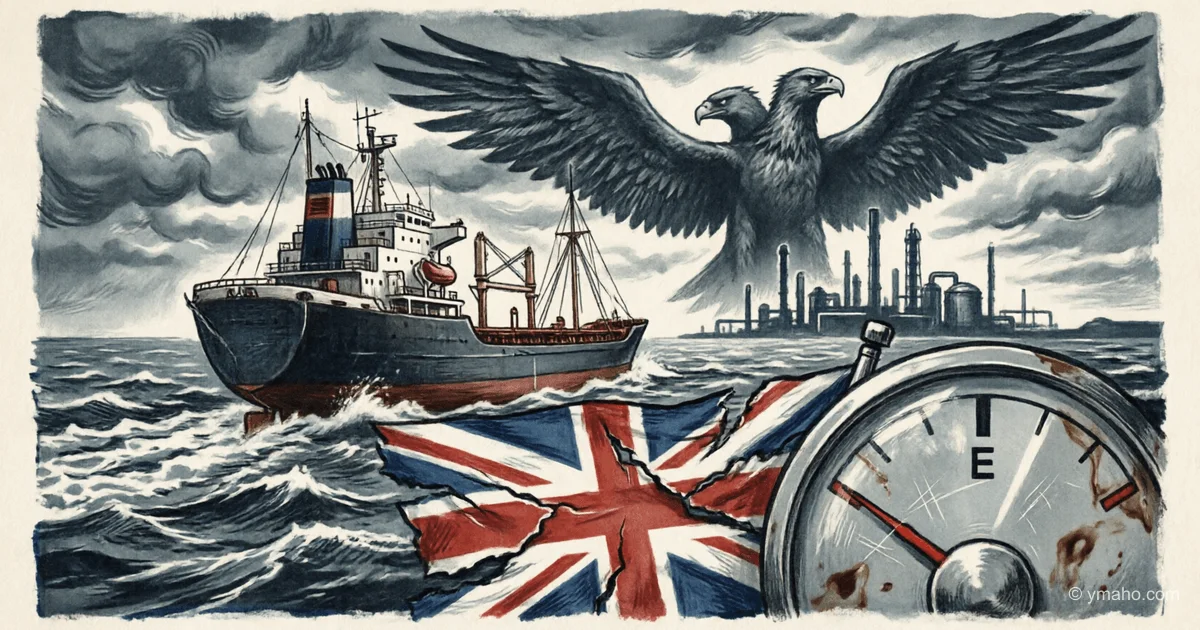
UK Eases Sanctions on Russian Oil Amid Soaring Fuel Prices
Due to a fuel shortage caused by the effective blockade of the Strait of Hormuz, the UK government has allowed imports of jet fuel and diesel produced in third countries from Russian crude.
The UK Treasury's decision on May 20 to lift the ban on imports of jet fuel and diesel made from Russian crude in third countries is not just a technical adjustment to the sanctions regime. It marks a moment of political and financial collapse that markets are still refusing to acknowledge amid inflation figures.
While economists debate how much this measure will undermine Western unity, energy traders see something else: London has just admitted that the blockade of the Strait of Hormuz has dealt a physical blow so severe that it outweighs principles. And this changes the rules of the game for everyone.
The Essence: What Is Really Happening
The new OFSI general license, effective May 20, indefinitely permits the import of aviation kerosene and diesel into the country, even if they were derived from Russian oil at refineries in India or Turkey. This directly contradicts the UK's own ban introduced in October 2025, which was supposed to close the "processing loophole."
The core of the matter is simple: Britain is running out of fuel. Goldman Sachs analysts led by Michele Della Vigna warned in early May that the UK's commercial jet fuel stocks could fall below the critical threshold of 10 days of coverage by mid-summer. This is not a hypothetical risk—it is a direct threat to air travel.
Markets are used to thinking of sanctions as a long-term construct. But the reality is that physical fuel shortages always outweigh geopolitical morality.
Timeline and Context
This decision cannot be viewed in isolation from events in the Middle East and the US.
- February 28, 2026: The blockade of the Strait of Hormuz begins. Europe instantly loses about 500,000 barrels per day of jet fuel from the Middle East and Asia.
- Mid-May 2026: Goldman Sachs records an extreme physical fuel shortage in Europe. Jet fuel prices in the region surge from a pre-war $831 per ton to an unprecedented $1,843 in April, and as of May 19, they still hover at $1,359.
- May 19–20, 2026: The UK government publishes an "indefinite" license to import sanctioned Russian oil products via third countries. Simultaneously, US Treasury Secretary Scott Bessent extends a 30-day sanctions exemption for Russian oil.
London and Washington are acting in sync. While politicians recite mantras about "unwavering support for Ukraine," their treasuries are opening the floodgates for money that will flow into the Russian budget. This is not hypocrisy; it is panic.
Who Wins and Who Loses
Who wins:
- The Russian budget and "gray" traders. Indian and Turkish refineries processing Russian crude regain access to the British market. The refining margins previously captured by Middle Eastern exporters are now shifting to schemes involving Russian discounts. This amounts to billions of dollars that the West has officially allowed to bypass sanctions.
- Airlines (in the short term). The expansion of spot supplies will slightly cool panic in the spot fuel market. However, as Robin Mills of Qamar Energy notes, this measure is unlikely to lower prices for end consumers at gas stations or in airfares.
Who loses:
- Ukraine and G7 unity. This is a reputational disaster. On May 20, the UK signed a G7 statement on "unwavering commitment" to sanctions, and on May 21, it effectively lifted them for itself. Emily Thornberry, chair of the Foreign Affairs Committee, has already called this a betrayal, and Kyiv agrees.
- European consumers. Diesel at $1,232 per ton and gasoline at 158.52 pence per liter in Britain—this is the new reality that even Russian imports cannot undo. According to UK government estimates, implementing the ban without "mitigations" would have cost businesses £130 million in the first year, but the price shock itself has already hit logistics and households.
What the Media Is Not Saying
Headlines talk about "easing sanctions," but no one mentions the synchronization of US and UK actions. On May 18–20, both Bessent and the UK Treasury simultaneously opened emergency valves. This indicates that behind closed doors, military and financial authorities have concluded that the Iranian crisis cannot be resolved quickly. The blockade will drag on, and the world must prepare to live with high fuel prices for months.
The second overlooked point is the reason for the rush specifically in Britain. According to S&P Global, the country has closed two refineries and is now Europe's largest net importer of jet fuel—around 195,000 barrels per day. It has no strategic reserves, unlike continental Europe, and almost no safety buffer. It is this vulnerability, not just rising prices, that forced London to cave.
Forecast: Next 30 Days and 90 Days
30 days. The rise in diesel and kerosene prices will slow but not stop. The physical deficit of 250,000 barrels per day in Europe's jet fuel market will persist, especially if Asian suppliers do not return to the region. We will see a 15–20% increase in airfares and a reduction in summer flights.
90 days. The critical moment will come by August. If the blockade is not lifted, the UK's commercial stocks will hit rock bottom, and the government will have to introduce fuel rationing for airlines. This will hit the tourist season and trigger a wave of bankruptcies among small carriers. Indian refineries processing Russian crude will post record margins, but the political cost for the West will become unbearable.
Editorial Forecast
Asset: Spot diesel prices (ULSD CIF NWE)
Direction: Sideways with potential for decline in the next 24–72 hours. The UK decision will increase supply on the spot market, but the fundamental deficit will prevent prices from falling below $1,180 per ton.
Key levels: Resistance at $1,250, support at $1,200. A break below the latter is unlikely without news of peace with Iran.
Confidence level: Low. The market reacts nervously to any headlines about negotiations, and a single Trump tweet about a truce could erase the risk premium by 5–7%.
Main risk: The official reopening of the Strait of Hormuz. In this scenario, diesel in Europe would crash below $1,000 per ton within a day, as the market would be flooded with pent-up Middle Eastern oil.
Editorial opinion, not investment advice.
— Editorial Team









