Breakthrough in Gene Editing: AI Model Learns to Predict CRISPR Outcomes
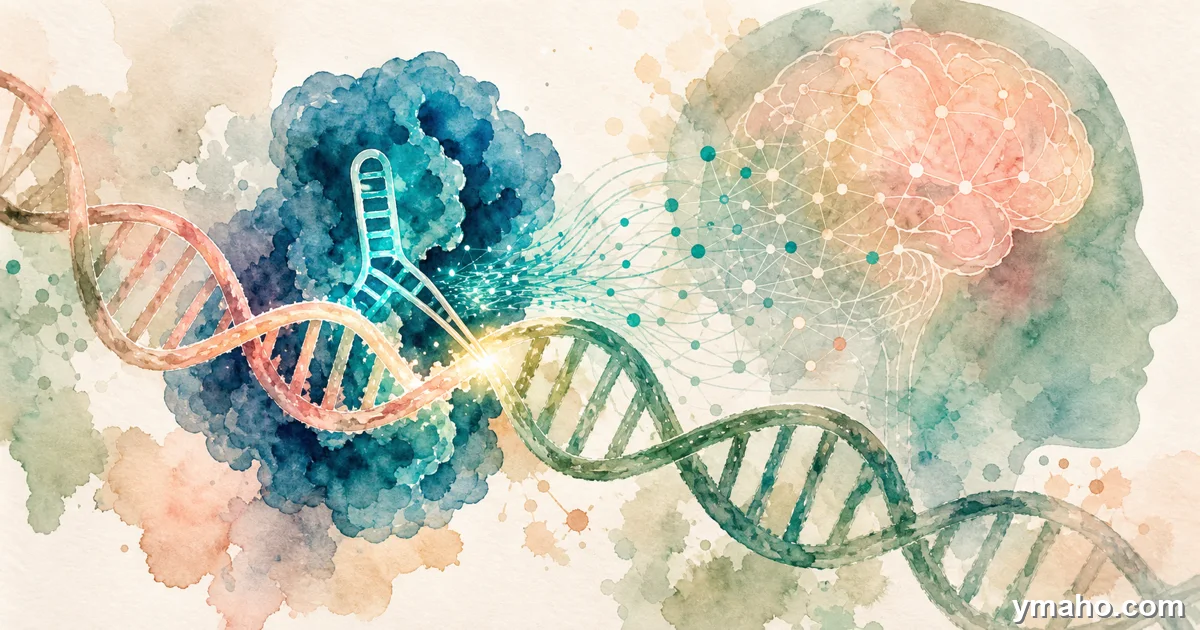
An international team of scientists from the University of Zurich and Ghent University has developed an AI system called Pythia that accurately predicts how a cell will repair DNA after CRISPR editing. This model enables the creation of 'molecular glue' for highly precise gene insertions, avoiding dangerous mutations and large deletions.
Analytical Review: Pythia — When AI Learned to Predict How a Cell 'Stitches Up' CRISPR
Analysis Date: May 29, 2026
[The Gist]: What's Really Happening
On the surface, it's yet another AI model for biologists. Scientists from Zurich and Ghent created the Pythia algorithm, which predicts how a cell will repair DNA after a CRISPR cut. It allows gene insertion with the precision of 'molecular glue,' avoiding dangerous mutations. A nice story for Nature Biotechnology.
But the real story here isn't about precision. It's about a fundamental rethinking of what we considered an 'error.'
On August 22, 2025, a paper was published in Nature Biotechnology. Nine months have passed. Why am I writing about it now? Because only now is the scientific community beginning to realize that Pythia is not just another tool for designing donor templates. It's the first time we're not trying to suppress the 'wrong' repair pathway (MMEJ — microhomology-mediated end joining). We've learned to program it.
The main non-obvious insight that isn't in the headlines:
For eight years, genetic engineers tried to force cells to repair DNA the 'right' way — via HDR (homology-directed repair). And they lost because HDR only works in dividing cells. Pythia is not an improvement of HDR. It's an admission that the 'wrong' MMEJ pathway is actually the only universal one. Instead of fighting the cell, the authors learned to predict how it would err and fed it the 'right error.'
Timeline and Context
2012-2020: The golden age of HDR. All gene therapy research revolved around the 'correct' repair pathway. Problem: HDR only works in dividing cells. Neurons, cardiomyocytes, hepatocytes — unreachable.
2018: David Liu's group at Harvard develops inDelphi, the first model for predicting small deletions after CRISPR. It shows that MMEJ is not random. But the model only works for short deletions, not insertions.
2022: Technologies like PITCh and GeneWeld emerge, attempting to use MMEJ for insertions. But without AI — blindly.
August 2025: Publication of Pythia. Key difference: the model is trained to predict not only deletions but also exactly how the cell will join donor DNA to the genome. The authors analyzed millions of possible repair outcomes and identified the rules governing MMEJ.
Game-changing results:
- In HEK293 cells — 32 genetic loci with precise insertion
- In Xenopus frog embryos — germline transmission
- In adult mouse brains — insertion into non-dividing neurons
The last point is a historic breakthrough. No one had previously inserted genes into neurons of an adult organism with predictable accuracy. HDR simply doesn't work there.
Who Wins and Who Loses
Absolute winner: the gene therapy community for neurodegenerative diseases. Alzheimer's, Parkinson's, Huntington's — all diseases where neurons are the target. With Pythia, for the first time, there's a tool for precise gene insertion into non-dividing cells. Not 'insertion with a prayer,' but insertion with a predictable outcome.
Winner: fundamental biology. Pythia allows inserting fluorescent tags into proteins directly in living organisms. 'This lets us directly observe what individual proteins do in healthy and diseased tissue,' says Thomas Nart. For understanding pathogenesis, this is a level that didn't exist before.
Loser: the entire HDR-oriented gene therapy ecosystem. Companies that built their platforms on HDR (with long homology arms, cell cycle stimulation) now have to rethink their architecture. HDR won't die, but its share in applications involving non-dividing cells will drop from 80% to 20% within 3-5 years.
Non-obvious loser: Intellia Therapeutics. Yes, they have NTLA-2001 for transthyretin amyloidosis, approved in the UK. But their technology is based on classic CRISPR and HDR for in vivo editing. Pythia offers an alternative that could be more precise and safer. If Pythia shows comparable results in the clinic, Intellia's positioning as 'leader in in vivo editing' will be questioned.
What the Media Isn't Saying
First and most important. The 40% improvement in accuracy touted in press releases is for 32 tested loci in HEK293 cells. In primary mouse neurons or human organoids, efficiency may differ. From 32 loci to all 20,000 human genes — a huge gap.
Second. MMEJ, even guided by Pythia, still leaves 'scars' — loss of one or more tandem repeats in the repair arms. In 45% of reads at the left junction and 28% at the right, one or more repeats were lost. This is not 'error-free' insertion. It's 'predictable' insertion with a limited set of errors. For clinical application, the difference is critical.
Third. The authors claim Pythia works 'in any cell — even non-dividing.' Formally yes, experiments in mouse brain confirm this. But efficiency in the brain was significantly lower than in HEK293. The Nature Biotechnology paper reports numbers an order of magnitude lower. 'Works' and 'works with clinically meaningful efficiency' are different things.
Fourth. The path from mouse neurons to human neurons in a clinical context is 5-7 years and hundreds of millions of dollars. Pythia is a tool for preclinical research, not a ready therapeutic solution. It will need to prove the absence of oncogenic insertions (large deletions, translocations, chromosomal rearrangements) on a scale sufficient for an IND application.
Forecast: Next 30 Days and 90 Days
30 days:
A flurry of preprints using Pythia will begin. Since the model is accessible to researchers (the authors promise open access to the design tool), every lab working with neurodegenerative models will try to insert their favorite reporter gene.
Key question to be discussed at conferences (e.g., CRISPR 2026 in Boston in September): How does Pythia compare to prime editing? The latter also allows gene insertion without HDR, but with smaller insert sizes. Who will win the race for the 'universal tool for non-dividing cells'?
90 days:
First replication studies. Other groups will attempt to replicate the authors' results in independent cell lines and other organisms. If replication succeeds, Pythia becomes a standard tool. If discrepancies arise, a discussion about the model's limitations will begin.
Second event: patent applications. The University of Zurich and Ghent University have likely already filed applications for the methodology. If the patent is broad (covering 'use of AI for designing microhomology arms'), it could create barriers to commercialization.
Long-term forecast (2026-2028):
Pythia will change the preclinical stage of gene therapy development. Within two years, most labs working with mouse models of neurodegenerative diseases will switch from HDR to Pythia-optimized MMEJ. Reason: not efficiency (still lower than HDR in dividing cells), but the ability to work with non-dividing targets.
Pythia will enter clinical practice no earlier than 2030. It will need to:
- Show efficacy in human primary neurons or organoids
- Rule out off-target effects on a genome-wide scale
- Develop a GMP production protocol for donor templates
- Conduct toxicology studies in primates
And finally: don't believe that AI 'solved' the CRISPR problem. It did something else — turned the 'noise' of cellular repair into a 'signal.' We've finally stopped asking 'why does the cell repair DNA so unpredictably?' and started asking 'how can we predict what it will do this time?' That's a paradigm shift. But the road to conquering genetic diseases is still a generation long.
— Editorial Team