EMA Recommends First Oral GLP-1 Drug for Weight Loss
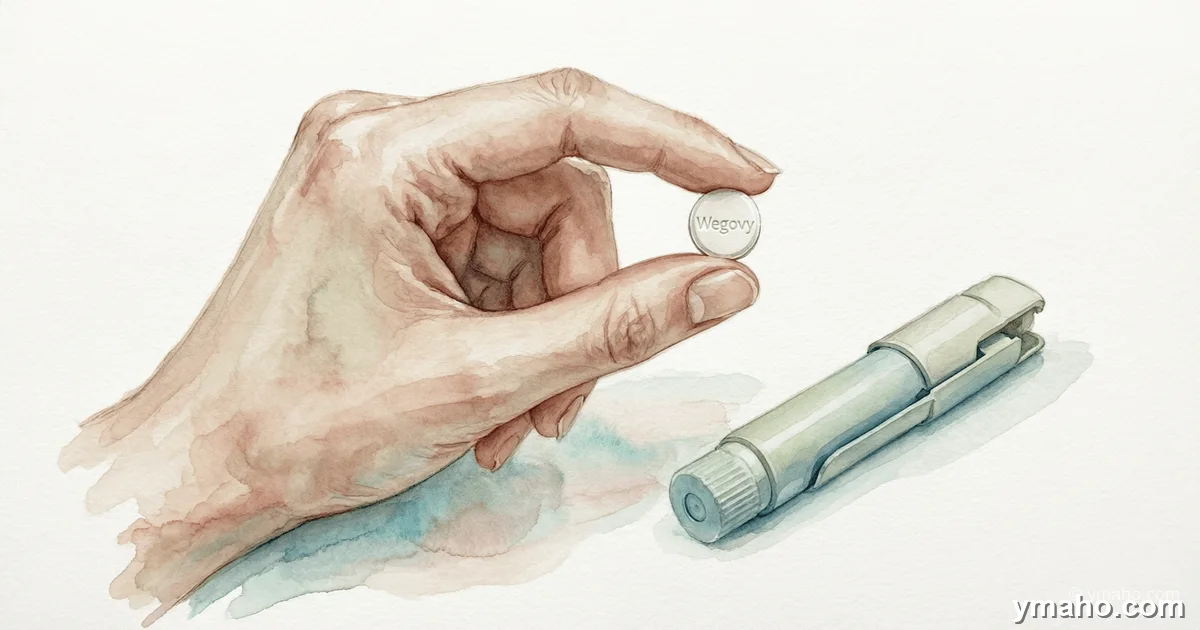
The European Medicines Agency's Committee for Medicinal Products for Human Use has issued a positive opinion for the oral form of semaglutide (Wegovy), making it the first GLP-1 receptor agonist tablet for weight control in Europe. The recommendation also covered a new high-dose version of the drug in a convenient single-dose pre-filled pen.
Analytical Review: EMA Recommends First Oral GLP-1 for Weight Loss — The End of the Injection Era?
Analysis Date: May 29, 2026
[The Gist]: What's Really Happening
On the surface, Europe is finally catching up with the US in the oral GLP-1 race. The EMA committee issued a positive opinion for oral Wegovy (semaglutide 25 mg) for weight control. The first tablet in this class in Europe. Convenient. Progressive.
But the real story here isn't about convenience. And it's not even about weight.
On May 22, 2026, the CHMP recommended two new Wegovy formats at once: oral tablets (1.5/4/9/25 mg) and a high-dose (7.2 mg) single-dose pre-filled pen. The tablets showed a 16.6% weight reduction under on-treatment analysis (13.6% ITT in the OASIS 4 study). One in three patients lost more than 20% of their body weight.
Sounds like a victory. And it is a victory — but not over obesity.
The key non-obvious insight missing from press releases:
This approval is not about weight loss. It's about solving a structural problem of the GLP-1 class: the massive patient dropout due to needle phobia and injection inconvenience. In the US, in the first four months after the tablet launch, over 1 million people started taking oral Wegovy. Not because tablets are more effective than injections (they are roughly equivalent). But because millions of people who would never agree to an injection are now willing to take a pill. Novo Nordisk didn't expand the market — it created a new market on top of the old one.
Google AdInline article slot
Timeline and Context
To understand the scale of the shift, look at the numbers.
December 2025: The FDA becomes the first in the world to approve oral Wegovy for weight loss.
January–April 2026: US launch. Over 2 million prescriptions in four months. First-quarter revenue of $360 million from the oral form alone. Novo Nordisk's CEO called it "the best launch in company history."
May 22, 2026: CHMP gives the green light for Europe.
Expected: European Commission decision within 1–2 months. Launch in selected EU countries in the second half of 2026.
Why does this matter right now?
The GLP-1 obesity market was valued at approximately $55 billion globally in 2025. Forecast for 2030: $120–150 billion. But this growth hits a ceiling: not everyone is willing to take injections. Surveys show that 30–40% of people with obesity who are theoretical candidates for therapy refuse it precisely because of injections. Tablets remove this barrier.
Data from OASIS 4 (published in NEJM): 307 participants, 64 weeks, weight loss of 13.6% vs. 2.2% for placebo. Gastrointestinal side effects: 74% vs. 42%. Yes, nausea and diarrhea haven't gone away. But now the patient can take a pill at home anytime without pulling out a syringe.
Who Wins and Who Loses
Absolute winner: Novo Nordisk. The company has just closed the main vulnerability in its portfolio. Lilly with tirzepatide (Mounjaro/Zepbound) currently has no approved oral form for obesity. Technologically, it's challenging: effective oral delivery of GLP-1 requires a special absorption enhancer (SNAC), and Novo owns this platform. Lilly lacks such technology.
Moreover, the CHMP also approved a single-dose pen for 7.2 mg Wegovy. Previously, patients needed three separate 2.4 mg injections to achieve the therapeutic dose. Now it's one injection. Not a revolution, but an important step in convenience.
Winners: Patients. Especially those who fear needles or simply don't want to deal with injections at work or while traveling. The oral form also has no drug interaction restrictions — it can be taken with most other medications.
Loser: Lilly. Injectable Zepbound (tirzepatide) shows weight loss of up to 20–25% — higher than the 16.6% of oral Wegovy. But if a patient chooses between "injection with 22% loss" and "pill with 16% loss," many will choose the pill. The efficacy gap is not large enough to outweigh the convenience gap. Lilly is now frantically working on its own oral formulation, but it's still 2–3 years from market.
Non-obvious loser: Bariatric surgery providers. The weight-loss surgery market (bypass, sleeve gastrectomy) has already shrunk by 15–20% since the advent of GLP-1s. The arrival of a convenient oral form will accelerate this trend. A patient who previously considered surgery as a "one-and-done" solution may now choose a pill. Surgical centers relying on a steady stream of patients with BMI >35 will face pressure.
What the Media Isn't Saying
First and most important. The 16.6% weight loss is an "on-treatment analysis" figure. In the ITT analysis (intention-to-treat, including all randomized patients, even dropouts), the reduction was 13.6%. The difference is small but important for understanding real-world effectiveness, where compliance is always lower.
Second. The tablet must be taken strictly on an empty stomach after an 8-hour fast, and you must wait 30 minutes before eating or taking other medications. It's not "take and forget." It's a regimen that requires discipline. Patients who skip breakfast for the pill will do it. But how many are willing?
Third. Price. Novo Nordisk hasn't announced European prices, but in the US, a monthly course of oral Wegovy costs about $1,350. In Europe, prices will be lower (thanks to negotiation systems), but unlikely to be below €800–1,000 per month. For comparison, the injectable form in Europe costs €300–500 per month. Tablets are more expensive. Paradox: the more convenient form is pricier.
Fourth. The CHMP recommended tablets only for adults, while the injectable form is approved from age 12. Adolescents with obesity — a fast-growing market segment — remain on injections only. This is a deliberate regulatory decision: the safety of the oral form in the pediatric population has not yet been proven.
Forecast: Next 30 Days and 90 Days
30 days:
A formal European Commission decision is expected. This usually takes 60–67 days after the CHMP recommendation, but given priority status, a decision could come as early as June. Highly likely positive.
The key question for insurers and national formularies (NHS in the UK, KBV in Germany, HAS in France): will the oral form be reimbursed like the injectable, or with more restrictions? My forecast: yes, it will be reimbursed, but with prior authorization required only for patients who cannot use injections for medical or psychological reasons.
90 days:
Novo Nordisk will begin shipments to the first EU countries. Most likely Germany (Europe's largest pharma market with a relatively fast reimbursement system), then Denmark (home market), then the UK, France, and Italy.
Meanwhile, Lilly will announce (or may have already announced) the start of Phase 3 for its oral tirzepatide formulation. If they can show 18–20% weight loss with a tablet, the race will enter a new level.
In the US, where tablets are already on the market, the first real-world data on therapy duration will emerge. The persistence metric — how long patients continue taking the tablets — will become critical. If it turns out that many drop out in the first three months due to the "fasting + 30 minutes" regimen, Novo Nordisk will have to rethink its marketing strategy.
Long-term forecast (2026–2028):
By the end of 2027, oral Wegovy will capture 25–30% of the entire European GLP-1 obesity market. Injections won't disappear (they are more effective and cheaper), but tablets will become the preferred choice for a new cohort of patients — those who never started therapy because of needles.
By 2028, competitors will emerge: oral tirzepatide from Lilly, possibly oral analogs from Pfizer (danuglipron) and others. Prices will begin to drop, and the market will fragment.
And most importantly: don't believe this is the "end of the obesity epidemic." Even a perfect pill won't solve the problems of diet, lifestyle, and social determinants. But it will solve one specific problem: the fear of injections. And for Novo Nordisk, that's enough to earn tens of billions more.
— Editorial Team