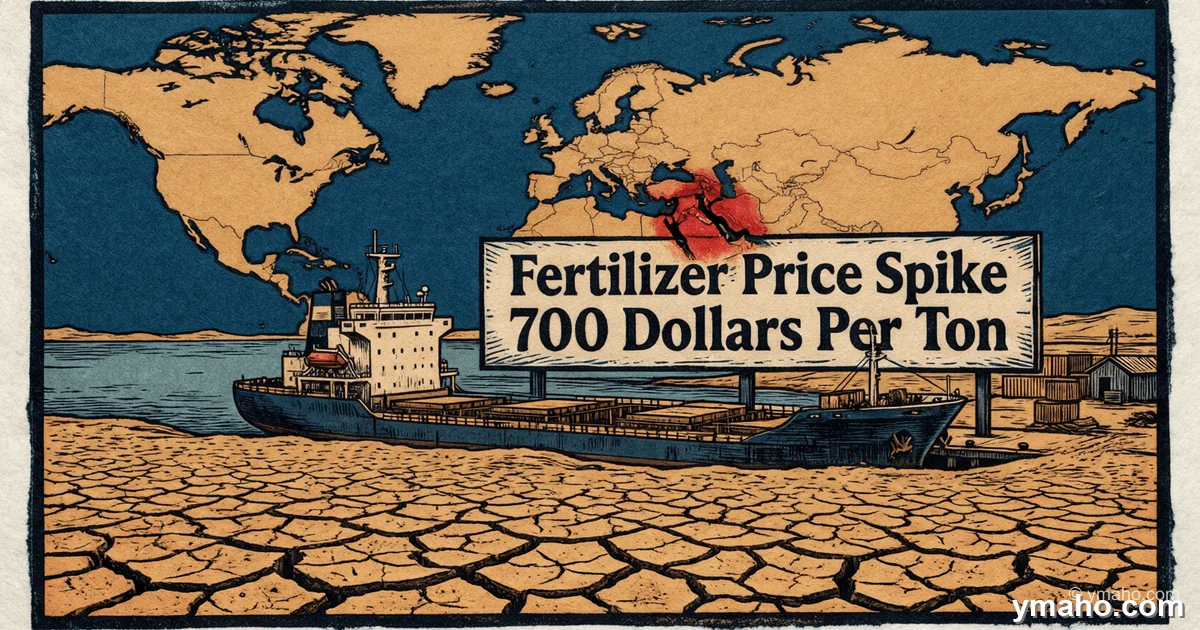
Conflict in Iran Triggers Global Food Crisis Due to Fertilizer Shortage
Due to gas disruptions, Qatar has halted exports of nitrogen fertilizers, causing up to 40% of global trade in this product to disappear. Fertilizer prices in the US have risen by more than 50%, creating risks of crop failure in Brazil and India.
Qatar Halts Fertilizer Exports: This Is Not a Crisis, but a Reset of the Global Food Pyramid
Colleagues, while news feeds are filled with headlines about shortages and famine, I see something entirely different. Qatar, which stopped exporting nitrogen fertilizers due to gas disruptions, did not create a crisis. It merely pulled the trigger that had been cocked for years.
The news that 40% of global nitrogen fertilizer trade has vanished and prices in the US have soared by 50% is not the beginning. It is the chronicle of a foretold death. The death of an agricultural model built on cheap gas and vulnerable logistics.
[The Core]: What Is Really Happening
Let's get straight to the point that even experts on CNBC miss. This is not about fertilizers. It is about the fact that nitrogen fertilizers are liquefied natural gas in solid form.
The process of producing ammonia (the basis of nitrogen fertilizers) requires huge amounts of natural gas. Up to 85% of the cost of urea is the cost of gas. When Qatar, the world's largest LNG exporter, halts production, it is not just cutting fertilizer supplies. It is demonstrating to the world that without stable gas, there is no stable food.
According to the UN Food and Agriculture Organization (FAO), up to 40% of the global harvest depends on artificial fertilizers. Through the Strait of Hormuz passes 34% of the world's urea, nearly a quarter of ammonia, and 20% of LNG. This is not a "supply chain." This is an aorta that has been squeezed.
But the main thing happening behind closed doors now: global traders (Vitol, Bunge, Cargill) are not panicking. They are calmly rewriting contracts with multi-year links to fertilizer indices. They understand what the general public will only realize in 6-9 months: the 2027 harvest is already priced at $700+ per ton of urea.
Timeline and Context
What we are seeing now did not start yesterday or even in February when the conflict began. Let's reconstruct the full picture:
- October 2025 — Rabobank analysts publish a forecast where the fertilizer affordability index plunges into deep negative territory, repeating 2022 levels. Fertilizer demand begins to shrink even BEFORE the crisis due to high prices. Farmers are already under stress.
- February-March 2026 — The conflict in Iran begins. Blockade of the Strait of Hormuz. Urea prices in Egypt surge by $60 per ton in a single day. Qatar, the largest exporter (11% of global urea exports), halts shipments. According to StoneX, freight insurance becomes "economically unfeasible."
- April 2026 — Anhydrous ammonia prices in the US exceed $1,100 per ton (+30% since late February). The US Department of Agriculture sounds the alarm and announces a 30% increase in domestic production "within a year or two" — in practice, this means nothing will change in the coming months.
- May 2026 (now) — Qatar officially stops exports. Up to 40% of global nitrogen fertilizer trade is paralyzed. Fertilizer prices have risen by about 50% since the start of the conflict. FAO Chief Economist Maximo Torero declares a systemic crisis: 3-4 million tons of fertilizers per month are not reaching buyers.
What is important in this timeline? Unlike oil, where the market reacts instantly, the effect of the fertilizer crisis appears with a lag of one to two seasons. What we are seeing now in fertilizer prices will hit wheat and corn harvests only in autumn 2026 — spring 2027.
Who Wins and Who Loses
Winners: Russian fertilizer producers (directly or through commodity company ETFs). Russia, with a 20-25% share in global fertilizer trade, becomes a beneficiary of the shortage. While Qatar and Saudi Arabia cannot ship products, Russian supplies via the Baltic and Black Sea continue steadily. Urea prices have already risen to $700 per ton, and this is not the limit.
Winners (non-obvious insight): North African producers (Egypt, Algeria). Egypt produces 6-7 million tons of urea per year and exports most of it. Algeria, with significant gas reserves, is also ramping up production. They are taking market share lost by Gulf countries.
Winners (even less obvious): US fertilizer producer CF Industries. CF shares have risen to their highest since late 2022. The company postponed maintenance at a Louisiana plant to produce an additional 100,000 tons of nitrogen fertilizers. The USDA lifted restrictions on supplies from Venezuela and promises a 30% increase in domestic production — but this is just a drop in the ocean.
Losers: Farmers in Brazil and India. Brazilian farmers already have the lowest margins in a decade. Fertilizer costs are eating up all profits. In India, Yara plants have halted nitrogen production due to reduced gas supplies; plants receive only 70% of their gas needs. This is despite India consuming 40 million tons of urea annually.
Losers: Sub-Saharan African countries. Ethiopia, which gets 90% of its nitrogen fertilizers from the Gulf region, currently has no supplies at the height of the planting season. Kenya, Uganda, and South Africa are forced to buy on the spot market at prices close to $1,000 per ton.
What the Media Is Not Saying
Now for the main insight that will not appear in official UN reports but is discussed in the corridors of Rabat and São Paulo.
The fertilizer crisis is not an accident but an acceleration of a structural shift that was inevitable. And global traders have a plan.
The problem is that the "market mechanisms" economists love to talk about do not work here. Farmers cannot "buy less fertilizer" — then yields would drop by 20-40%. But they also cannot buy at current prices — then they operate at a loss. This is a dead end.
What is really happening:
- Farmers are switching to soybeans. Unlike corn, soybeans require almost no nitrogen fertilizers — they biologically fix nitrogen from the air. This means corn acreage will shrink, while soybean acreage will grow. Result: a corn shortage (the basis of animal feed) and a soybean surplus. Corn prices will rise; soybean prices will fall or remain stable.
- Countries with reserves will not suffer. For example, Benin ordered fertilizers back in late 2025 and currently faces no shortage. This shows the crisis will hit unevenly: those who prepared will weather it with minimal losses.
- The time lag is the main killer. As noted by ICC Secretary General John Denton, "while the world is focused on oil, a ticking time bomb is quietly counting down." The effect of the blockade will become noticeable in three months, with the peak hitting the 2027 harvest.
But the scariest detail: grain prices have not risen proportionally to fertilizer prices. Four years ago, in 2022, both rose in sync. Now, grain stocks after two bumper seasons are sufficient, and wheat and corn prices have risen only slightly. This means farmers have no "natural insurance" in the form of high prices for their products. They are caught between the hammer of expensive fertilizers and the anvil of stable grain prices.
Forecast: Next 30 Days and 90 Days
30 days (by end of June 2026):
- Urea prices will reach $750-800 per ton on spot markets (currently $700). The main driver is India, which is forced to hold import tenders at any price because domestic stocks are dwindling. At the last tender on April 15, bids were already around $1,000 per ton.
- Shares of fertilizer producers (CF Industries, Yara, Mosaic) will continue to rise another 5-8% from current levels, as the market is only beginning to grasp the scale of the structural deficit.
- Brazil will announce a 5-7% reduction in corn planting area for the 2026/27 season. This will be the first official signal that the fertilizer crisis has turned into a food crisis.
90 days (by end of August 2026):
- Corn prices (CBOT) will rise 20-25% from current levels when markets see real data on reduced fertilizer application in the US and Brazil. Corn is the most nitrogen-demanding crop and will be hit first.
- Retail food prices in Europe and the US will add 3-5% to the inflation rate by August — this will be the first "food shock" noticeable to ordinary consumers. The full effect, as experts note, will manifest in 12-18 months.
- Russia and Egypt will increase fertilizer exports to Asia and Africa, capturing the share lost by Qatar and Saudi Arabia. According to FAO, Russian capacity is 85-90% utilized, so fully replacing the lost volumes (3-4 million tons per month) will not be possible, but partial compensation will occur.
Editorial Forecast
Asset: Corn futures (CBOT) — up in the next 24–72 hours. Current level: around 460 cents per bushel. Target: 475 cents. Key resistance level: 465 cents; breaking it opens the way to 480. Confidence level: high (70%). Main risk: if the UN and ICC announce the creation of a "maritime corridor" for fertilizers through the Strait of Hormuz in the coming days (negotiations are ongoing), fertilizer and corn prices may temporarily correct by 5-7%. But this will be a short-term pullback that does not change the structural deficit set for the next 12-18 months. In any correction, look for entry points for long positions in corn and fertilizer producer stocks.
— Editorial Team